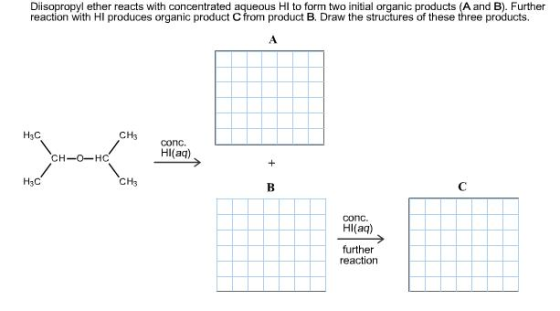
Diisopropyl ether reacts with concentrated aqueous HI to form two initial organic products (A and B). Further reaction...
Homework Answers

Add Answer to:
Diisopropyl ether reacts with concentrated aqueous HI to form two initial organic products (A and B). Further reaction...
Diisopropyl ether reacts with concentrated aqueous HI to form two initial organic products (A and B). Further reactio...
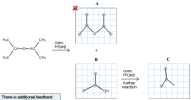 Diisopropyl ether reacts with concentrated aqueous HI to form two
initial organic products (A and B). Further reaction with HI
produces organic product C from product B. Draw the structures of
these three products.
Diisopropyl ether reacts with concentrated aqueous HI to form two
initial organic products (A and B). Further reaction with HI
produces organic product C from product B. Draw the structures of
these three products.
Benzyl ethyl ether reacts with concentrated aqueous HI to form two initial organic products (A and B). Further reaction...
Benzyl ethyl ether reacts with concentrated aqueous HI to form two initial organic products (A and B). Further reaction of product B with HI produces organic product C. Draw the structures of these three products.
Benzyl ethyl ether reacts with concentrated aqueous HI to form two initial organic products (A and B). Further reacti...
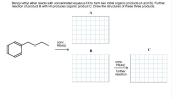 Benzyl ethyl ether reacts with concentrated aqueous HI to form
two initial organic products (A and B). Further reaction of product
B with HI produces organic product C. Draw the structures of these
three products.
Benzyl ethyl ether reacts with concentrated aqueous HI to form
two initial organic products (A and B). Further reaction of product
B with HI produces organic product C. Draw the structures of these
three products.
2-Ethoxy-2,3-dimethylbutane reacts with concentrated aqueous HI to form two initial organic products (A and B). Further...
2-Ethoxy-2,3-dimethylbutane reacts with concentrated aqueous HI to form two initial organic products (A and B). Further reaction with HI produces organic product C from product B. Draw the structures of these three products.
2-Ethoxy-2,3-dimethylbutane reacts with concentrated aqueous HI to form two initial organic products (A and B). Further...
 2-Ethoxy-2,3-dimethylbutane reacts with concentrated aqueous HI to form two initial organic products (A and B). Further reaction with HI produces organic product C from product B. Draw the structures of these three products.
Ethers react with HI to form two cleavage products. One of the products might react further with HI. In the first box...
 Ethers react with HI to form two cleavage products. One of the
products might react further with HI. In the first box below draw
the two major products that could be recovered after treatment with
one equivalent of HI. In the second box draw the two major products
that could be recovered after treatment with excess HI. (If a
product of the first step does not undergo additional reaction with
excess HI, repeat its structure in the second box.)
Ethers...
Ethers react with HI to form two cleavage products. One of the
products might react further with HI. In the first box below draw
the two major products that could be recovered after treatment with
one equivalent of HI. In the second box draw the two major products
that could be recovered after treatment with excess HI. (If a
product of the first step does not undergo additional reaction with
excess HI, repeat its structure in the second box.)
Ethers...
Draw the structure(s) of the major organic product(s) of the following reaction Dilute aqueous HCI •...
 Draw the structure(s) of the major organic product(s) of the following reaction Dilute aqueous HCI • Use the wedge/hash bond tools to indicate stereochemistry where it exists. • If the reaction produces a racemic mixture, draw both stereoisomers. • Include counter-ions, e.g., Na, 1', in your submission, but draw them in their own separate sketcher. Omit products derived from the acidic or basic reagent itself, e.g. HN(i- Pr), derived from N(i-Pr)2 - • If substantial starting material is present at...
Draw the final products for the following two step reaction. The nucleophile selectively reacts once in...
 Draw the final products for the following two step reaction. The
nucleophile selectively reacts once in each step.
Draw the major organic product(s) produced in the following
reaction.
Draw all possible products produced in the following
reaction.
Draw the starting materials (electrophile as an alkyl bromide)
needed to complete the following reaction. The mechanism for this
reaction follows a SN1 pathway.
Draw the final products for the following two step reaction. The
nucleophile selectively reacts once in each step.
Draw the major organic product(s) produced in the following
reaction.
Draw all possible products produced in the following
reaction.
Draw the starting materials (electrophile as an alkyl bromide)
needed to complete the following reaction. The mechanism for this
reaction follows a SN1 pathway.
3. 1,2-dimethyl-1,3-cyclohexadiene reacts with HCl to form up to four different products. HCI 4 possible products...
 3. 1,2-dimethyl-1,3-cyclohexadiene reacts with HCl to form up to four different products. HCI 4 possible products a. b. Give the structures for the four products. When the reaction is run at low temperature, two products are formed preferentially ldentify these two products. c. When the reaction temperature is increased, a single product is favored. Identify the major product under these reaction conditions
[Review Topical [References) 1-Butene reacts with borane in THF followed by hydrogen peroxide in aqueous NaOH to...
 [Review Topical [References) 1-Butene reacts with borane in THF followed by hydrogen peroxide in aqueous NaOH to give A (CH100). Treatment of A with aqueous chromic acid or Cro, in acetic acid gives B (C,H,O,). Draw the structure of B. • You do not have to consider stereochemistry. . In cases where there is more than one answer, just draw one. ChemDoodle [Review Topics) [References) A (CzH,0) reacts rapidly with ethylmagnesium bromide in anhydrous ether to give B (C,H,20). Treatment...
 Benzyl ethyl ether reacts with concentrated aqueous HI to form
two initial organic products (A and B). Further reaction of product
B with HI produces organic product C. Draw the structures of these
three products.
Benzyl ethyl ether reacts with concentrated aqueous HI to form
two initial organic products (A and B). Further reaction of product
B with HI produces organic product C. Draw the structures of these
three products.
 2-Ethoxy-2,3-dimethylbutane reacts with concentrated aqueous HI to form two initial organic products (A and B). Further reaction with HI produces organic product C from product B. Draw the structures of these three products.
 Ethers react with HI to form two cleavage products. One of the
products might react further with HI. In the first box below draw
the two major products that could be recovered after treatment with
one equivalent of HI. In the second box draw the two major products
that could be recovered after treatment with excess HI. (If a
product of the first step does not undergo additional reaction with
excess HI, repeat its structure in the second box.)
Ethers...
Ethers react with HI to form two cleavage products. One of the
products might react further with HI. In the first box below draw
the two major products that could be recovered after treatment with
one equivalent of HI. In the second box draw the two major products
that could be recovered after treatment with excess HI. (If a
product of the first step does not undergo additional reaction with
excess HI, repeat its structure in the second box.)
Ethers...
 Draw the structure(s) of the major organic product(s) of the following reaction Dilute aqueous HCI • Use the wedge/hash bond tools to indicate stereochemistry where it exists. • If the reaction produces a racemic mixture, draw both stereoisomers. • Include counter-ions, e.g., Na, 1', in your submission, but draw them in their own separate sketcher. Omit products derived from the acidic or basic reagent itself, e.g. HN(i- Pr), derived from N(i-Pr)2 - • If substantial starting material is present at...
 Draw the final products for the following two step reaction. The
nucleophile selectively reacts once in each step.
Draw the major organic product(s) produced in the following
reaction.
Draw all possible products produced in the following
reaction.
Draw the starting materials (electrophile as an alkyl bromide)
needed to complete the following reaction. The mechanism for this
reaction follows a SN1 pathway.
Draw the final products for the following two step reaction. The
nucleophile selectively reacts once in each step.
Draw the major organic product(s) produced in the following
reaction.
Draw all possible products produced in the following
reaction.
Draw the starting materials (electrophile as an alkyl bromide)
needed to complete the following reaction. The mechanism for this
reaction follows a SN1 pathway.
 3. 1,2-dimethyl-1,3-cyclohexadiene reacts with HCl to form up to four different products. HCI 4 possible products a. b. Give the structures for the four products. When the reaction is run at low temperature, two products are formed preferentially ldentify these two products. c. When the reaction temperature is increased, a single product is favored. Identify the major product under these reaction conditions
 [Review Topical [References) 1-Butene reacts with borane in THF followed by hydrogen peroxide in aqueous NaOH to give A (CH100). Treatment of A with aqueous chromic acid or Cro, in acetic acid gives B (C,H,O,). Draw the structure of B. • You do not have to consider stereochemistry. . In cases where there is more than one answer, just draw one. ChemDoodle [Review Topics) [References) A (CzH,0) reacts rapidly with ethylmagnesium bromide in anhydrous ether to give B (C,H,20). Treatment...
Most questions answered within 3 hours.
-
Where is the error in this code sequence?
String s1 = "Hello";
String s2 = "ello";...
asked 10 months ago -
Financial data for Joel de Paris, Inc., for last year
follow:
Joel de Paris, Inc.
Balance...
asked 10 months ago -
Consider this reaction:
Al2(SO4)3 (aq)+ BaCl3
(aq) Al2Cl6 (aq)- +
3BaSO4(s) . What is the...
asked 10 months ago -
Suppose that Savneet is considering increasing her
recent random sample from 20 car rentals to 40...
asked 10 months ago -
Trucks arrive at an unloading terminal at an average rate of 120
per hour.
Trucks arrive...
asked 10 months ago -
Why are methanol and ethanol completely soluble in water while
octanol is not very little soluble....
asked 10 months ago -
A facilities manager at a university reads in a research report
that the mean amount of...
asked 10 months ago -
When the CuSO4 is rehydrated by adding water to the anhydrous
compound, is this an endothermic...
asked 10 months ago -
A ray of sunlight is passing from diamond into crown glass; the
angle of incidence is...
asked 10 months ago -
A block of mass 0.249 kg is placed on top of a light, vertical
spring of...
asked 10 months ago -
how do the kidneys compensate in the presences of acidosis
a) trigger hyperventilate
b) reserve acid...
asked 10 months ago -
Question 501 pts
The rental rate of capital to the firm increases. Which of the
following...
asked 10 months ago