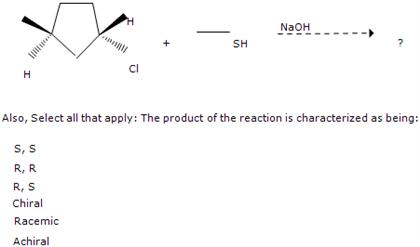
Draw the organic product of the following reaction between (1S,3S)-1-chloro-3-methylcyclopentane and methanethiol in the presence of...
Draw the organic product of the following reaction between (1S,3S)-1-chloro-3-methylcyclopentane and methanethiol in the presence of sodium hydroxide. Show any H's on chirality centers, if applicable, and use wedge-and-dash bonds.
Homework Answers
Primary and secondary alkyl halides undergo  reactions with strong nucleophiles. Alkyl halides react with thiols to form sulphides. Here, the reaction follows through mechanism.
reactions are concerted and form a product with an inverted configuration.
Asymmetric carbon (chiral centre) can be identified, when the carbon atom is bonded with four different groups or atoms. Assign the R and S configurations to the asymmetric carbon atoms.
Alkyl halide acts as substrate and thiol acts as a nucleophile, and base NaOH acts as catalyst.
This reaction occurs in two steps. They are,
1.Nucleophile generation
2.Nucleophilic attack on the substrate
Chirality centre: An atom (usually carbon) which is bonded to four different atoms or groups is known as chiral centre. In general, it is represented with an asterisk (*).
R and S configuration can be assign to the compound by using the following CIP (Cahn-Ingold-Prelog) sequence rules:
Rule 1: Select the chiral centre in the compound and assign priorities to the atoms based on its atomic number. The atom which is having highest atomic number gets the priority and atom which is having least atomic number (usually hydrogen) gets fourth priority.
Rule 2: If the isotopes of same atom are attached to the chiral centre, then the atom with the higher atomic mass receives higher priority.
Rule 3: If the first atom of each substituent is same then give priority to the second atom in each substituent.
Rule 4: If the substituents have multiple bonds, then the multiple bonded atoms are considered as same number of single boned atoms.
If the rotation of the numbering is in clockwise direction, then the configuration of the isomer is R. Similarly, if the rotation of the numbering is in anticlockwise direction, then the configuration of the isomer is S.
Consider the reaction between NaOH and Thiol as shown below:

Consider the reaction of given compound with the nucleophile generated to form the substitution product as shown below:

Hence, the organic product of the given reaction is shown below:

The product of the reaction is characterized as R, S and chiral.
Add Answer to:
Draw the organic product of the following reaction between
(1S,3S)-1-chloro-3-methylcyclopentane and methanethiol in the
presence of...
Draw the organic product of the following reaction between (1S,3S)-1-chloro-3-methylcyclopentane...
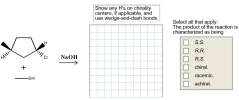 Draw the organic product of the following reaction between (1S,3S)-1-chloro-3-methylcyclopentane and methanethiol in the presence of sodium hydroxide.
Draw the skeletal structure of the major organic product of (3S,5S)-5-chloro-2,3-dimethyloctane when it reacts with sodium...
Draw the skeletal structure of the major organic product of (3S,5S)-5-chloro-2,3-dimethyloctane when it reacts with sodium iodide in acetone. please use stick and wedge bonds
Draw the correct organic product for the following oxidation reaction:
 Draw the correct organic product for the following oxidation reaction:Predict the oxidation product of treating the given alkene with the reagent shown below. Include stereochemistry where applicable. Include H's on chirality centers. (mCPBA = meta-chloroperoxybenzoic acid)
Draw the two major allylic alcohol intermediates and the two final products in the following two-step...
 Draw the two major allylic alcohol intermediates and the two
final products in the following two-step synthesis. Show the
correct stereochemistry of each compound; if applicable, use
wedge/dash bonds to indicate chirality centers, and you must show
hydrogens on these centers.
Map Draw the two major allylic alcohol intermediates and the two final products in the following two-step synth Show the correct stereochemistry of each compound; if applicable, use wedge/dash bonds to indicate chirality centers, and you must show hydrogens...
Draw the two major allylic alcohol intermediates and the two
final products in the following two-step synthesis. Show the
correct stereochemistry of each compound; if applicable, use
wedge/dash bonds to indicate chirality centers, and you must show
hydrogens on these centers.
Map Draw the two major allylic alcohol intermediates and the two final products in the following two-step synth Show the correct stereochemistry of each compound; if applicable, use wedge/dash bonds to indicate chirality centers, and you must show hydrogens...
Draw the product(s) of the Diels-Alder reaction of 1,3-butadiene with cis-1,2-dibromoethene.
 Draw the product(s) of the Diels-Alder reaction of 1,3-butadiene
with cis-1,2-dibromoethene. Use wedge-and-dash bonds to show the
stereochemistry of the product(s). Include hydrogens at any
chirality centers.
Draw the product(s) of the Diels-Alder reaction of 1,3-butadiene
with cis-1,2-dibromoethene. Use wedge-and-dash bonds to show the
stereochemistry of the product(s). Include hydrogens at any
chirality centers.
Draw the product(s) of the Diels–Alder reaction of 1,3-butadiene with trans-1,2-dibromoethene. Use wedge-and-dash bonds to show...
 Draw the product(s) of the Diels–Alder reaction of 1,3-butadiene
with trans-1,2-dibromoethene. Use wedge-and-dash bonds to show the
stereochemistry of the product(s). Include hydrogens at any
chirality centers.
Draw the product(s) of the Diels–Alder reaction of 1,3-butadiene
with trans-1,2-dibromoethene. Use wedge-and-dash bonds to show the
stereochemistry of the product(s). Include hydrogens at any
chirality centers.
Organic Chem - these are not two independent questions, both are part of the same answer
 1)Characterize the following
alkene as having the E or Z configuration. Draw the product(s) of
bromination of this compound, including all expected stereoisomers
(if any). Use wedge-and-dash bonds to designate the stereochemistry
at any chirality centers, and make sure to draw an explicit
hydrogen if a chirality center has one.
2)
Alkenes can be converted to alcohols by
hydroboration–oxidation. Draw the structure of the alcohol(s)
formed in the following reaction sequence. If applicable, draw
hydrogen at a chirality center and...
1)Characterize the following
alkene as having the E or Z configuration. Draw the product(s) of
bromination of this compound, including all expected stereoisomers
(if any). Use wedge-and-dash bonds to designate the stereochemistry
at any chirality centers, and make sure to draw an explicit
hydrogen if a chirality center has one.
2)
Alkenes can be converted to alcohols by
hydroboration–oxidation. Draw the structure of the alcohol(s)
formed in the following reaction sequence. If applicable, draw
hydrogen at a chirality center and...
Draw one enantiomer of the major product of the following Diels-Alder reaction. (Use wedge/dash bonds to...
 Draw one enantiomer of the major product of the following Diels-Alder reaction. (Use wedge/dash bonds to indicate the orientation of substituents in the product. Hydrogen atoms on chirality centers must be shown explicitly.)
Draw one enantiomer of the major product of the following Diels-Alder reaction (Use wedge/dash bonds to...
 Draw one enantiomer of the major product of the following Diels-Alder reaction (Use wedge/dash bonds to indicate the orientation of substituents in the product. Hydrogen atoms on chirality centers must be shown explicitly.)
 Draw the two major allylic alcohol intermediates and the two
final products in the following two-step synthesis. Show the
correct stereochemistry of each compound; if applicable, use
wedge/dash bonds to indicate chirality centers, and you must show
hydrogens on these centers.
Map Draw the two major allylic alcohol intermediates and the two final products in the following two-step synth Show the correct stereochemistry of each compound; if applicable, use wedge/dash bonds to indicate chirality centers, and you must show hydrogens...
Draw the two major allylic alcohol intermediates and the two
final products in the following two-step synthesis. Show the
correct stereochemistry of each compound; if applicable, use
wedge/dash bonds to indicate chirality centers, and you must show
hydrogens on these centers.
Map Draw the two major allylic alcohol intermediates and the two final products in the following two-step synth Show the correct stereochemistry of each compound; if applicable, use wedge/dash bonds to indicate chirality centers, and you must show hydrogens...
 Draw the product(s) of the Diels–Alder reaction of 1,3-butadiene
with trans-1,2-dibromoethene. Use wedge-and-dash bonds to show the
stereochemistry of the product(s). Include hydrogens at any
chirality centers.
Draw the product(s) of the Diels–Alder reaction of 1,3-butadiene
with trans-1,2-dibromoethene. Use wedge-and-dash bonds to show the
stereochemistry of the product(s). Include hydrogens at any
chirality centers.
 1)Characterize the following
alkene as having the E or Z configuration. Draw the product(s) of
bromination of this compound, including all expected stereoisomers
(if any). Use wedge-and-dash bonds to designate the stereochemistry
at any chirality centers, and make sure to draw an explicit
hydrogen if a chirality center has one.
2)
Alkenes can be converted to alcohols by
hydroboration–oxidation. Draw the structure of the alcohol(s)
formed in the following reaction sequence. If applicable, draw
hydrogen at a chirality center and...
1)Characterize the following
alkene as having the E or Z configuration. Draw the product(s) of
bromination of this compound, including all expected stereoisomers
(if any). Use wedge-and-dash bonds to designate the stereochemistry
at any chirality centers, and make sure to draw an explicit
hydrogen if a chirality center has one.
2)
Alkenes can be converted to alcohols by
hydroboration–oxidation. Draw the structure of the alcohol(s)
formed in the following reaction sequence. If applicable, draw
hydrogen at a chirality center and...
 Draw one enantiomer of the major product of the following Diels-Alder reaction. (Use wedge/dash bonds to indicate the orientation of substituents in the product. Hydrogen atoms on chirality centers must be shown explicitly.)
Most questions answered within 3 hours.
-
Where is the error in this code sequence?
String s1 = "Hello";
String s2 = "ello";...
asked 11 months ago -
Financial data for Joel de Paris, Inc., for last year
follow:
Joel de Paris, Inc.
Balance...
asked 11 months ago -
Consider this reaction:
Al2(SO4)3 (aq)+ BaCl3
(aq) Al2Cl6 (aq)- +
3BaSO4(s) . What is the...
asked 11 months ago -
Suppose that Savneet is considering increasing her
recent random sample from 20 car rentals to 40...
asked 11 months ago -
Trucks arrive at an unloading terminal at an average rate of 120
per hour.
Trucks arrive...
asked 11 months ago -
Why are methanol and ethanol completely soluble in water while
octanol is not very little soluble....
asked 11 months ago -
A facilities manager at a university reads in a research report
that the mean amount of...
asked 11 months ago -
When the CuSO4 is rehydrated by adding water to the anhydrous
compound, is this an endothermic...
asked 11 months ago -
A ray of sunlight is passing from diamond into crown glass; the
angle of incidence is...
asked 11 months ago -
A block of mass 0.249 kg is placed on top of a light, vertical
spring of...
asked 11 months ago -
how do the kidneys compensate in the presences of acidosis
a) trigger hyperventilate
b) reserve acid...
asked 11 months ago -
Question 501 pts
The rental rate of capital to the firm increases. Which of the
following...
asked 11 months ago