Consider the following equilibrium reaction: 4NH3(g) + 5O2(g) <---> 4NO(g) + 6H2O(g) Heat = -904.4 kJ...
How does each of the following changes affect the yield of NO at equilibrium? Answer increase, decrease, or no change.
a. increase [NH3]
b. Increase [H2O]
c. Decrease [O2]
d. Decrease the volume of the container in which the raction occurs.
e. Add a catalyst
f. Increase temperature
Homework Answers
In a chemical reaction, the chemical equilibrium is a state of system in which the concentration of reactants and products do not change with time.
At equilibrium, the reaction seems to be stopped due to the simultaneous rate change in the concentration of reactants and products.
Equilibrium attains a dynamic situation indicating that: the rate of forward reaction is equal to the rate of backward reaction and there is no net change in concentration.
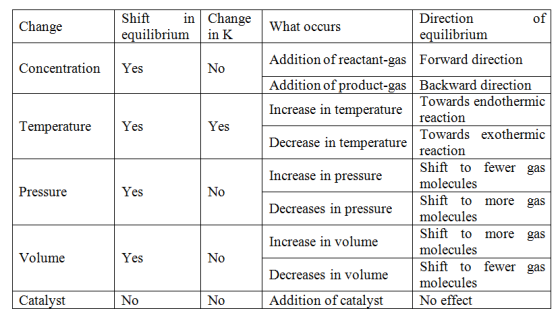
Le Chatliers principle:
If a system at equilibrium is disturbed, the equilibrium moves in such a way to counteract the change.
Factors affecting chemical equilibrium are as follows:
oConcentration
oTemperature
oPressure ( or volume)
oFactors Affecting Equilibrium:
(a)
Consider the given equilibrium reaction:
Increase
is the reactant of the given reaction. So, when there is an increase in the concentration of reactant, it causes an increase in the yield of .
(b)
Consider the given equilibrium reaction:
Increase
is the product of the given reaction. So, when there is an increase in the concentration of product, it causes a decrease in the yield of .
(c)
Consider the given equilibrium reaction:
Decrease
is the reactant of the given reaction. So, when there is a decrease in the concentration of reactant, it causes a decrease in the yield of .
(d)
Consider the given equilibrium reaction:
Decrease the volume of the container in which the reaction occurs.
Change in the volume, effects the yield of the reaction.
Volume is inversely proportional to the pressure.
Decrease in the volume, increases the pressure of the container.
When there is an increase in the pressure of the container, equilibrium shifts to the side in which there are less number of moles. In the reactant side, only 9 moles are present, so the equilibrium shifts to the reactant side.
Therefore, when there is a decrease in the volume, then there is also a decrease in the yield of .
Ans: Part aIncrease the yield of
Part bDecrease the yield of
Part cDecrease the yield of
Part dDecrease the yield of
Add Answer to:
Consider the following equilibrium reaction: 4NH3(g) + 5O2(g)
<---> 4NO(g) + 6H2O(g) Heat = -904.4 kJ...
The following question refers to the reaction: 4NH3(g) + 5O2(g) ⇌ 4NO(g) + 6H2O(g) The reaction...
The following question refers to the reaction: 4NH3(g) + 5O2(g) ⇌ 4NO(g) + 6H2O(g) The reaction as written is exothermic. What will happen if heat is added to the system? (A) The equilibrium will shift to the left (B) The equilibrium will shift to the right (C) The NO concentration will remain constant, but there will be more water vapour (D) The equilibrium position will not change if heat is added (E) The system increase in temperature Explanation will be...
Consider the following reaction: 4NH3 + 5O2 4NO + 6H2O Determine the following rates at a...
Consider the following reaction: 4NH3 + 5O2 4NO + 6H2O Determine the following rates at a time when the rate of consumption of O2 is 1.26e-03 M/s. a) rate of consumption of NH3 M/s b) rate of formation of NO M/s c) rate of formation of H2O M/s d) rate of reaction M/s
Calculate the ^Ho in (kj) for the following reaction : 4NH3 (s) + 5O2 (g) --->...
Calculate the ^Ho in (kj) for the following reaction : 4NH3 (s) + 5O2 (g) ---> 4NO (g) + 6H2O (l) ^Ho: NH3 - 46.0 NO 90.0 H2O - 286 A. - 1,172 B. - 1,716 C. - 150 D. - 1,356
Determine delta sub r H in Kj/mol for this reaction. 4No+6H2O --> 4NH3 +5O2 using the...
Determine delta sub r H in Kj/mol for this reaction. 4No+6H2O --> 4NH3 +5O2 using the equations and the enthalpy change of the reactions given. N2 + O2 --> 2NO delta sub r H= 180.1 NH3 --> 1/2 N2 +1.5H2. delta sub r H= 54.3 2H2O --> 2H2 + O2 delta sub r H= 486.7
1. Ammonia reacts with oxygen according to the equation 4NH3(g)+5O2(g)→4NO(g)+6H2O(g),ΔHrxn=−906 kJ Calculate the heat...
1. Ammonia reacts with oxygen according to the equation 4NH3(g)+5O2(g)→4NO(g)+6H2O(g),ΔHrxn=−906 kJ Calculate the heat (in kJ) associated with the complete reaction of 155 g of NH3. 2. What mass of butane in grams is necessary to produce 1.5×10³ kJ of heat? What mass of CO2 is produced? Assume the reaction to be as follows: C4H10(g)+132O2(g)→4CO2(g)+5H2O(g),ΔHrxn=−2658 kJ
Consider the following reaction: 4NH3(g) + 502(g) – 4NO(g) + 6H2O(g); AH = -906 kJ Now...
 Consider the following reaction: 4NH3(g) + 502(g) – 4NO(g) + 6H2O(g); AH = -906 kJ Now answer the following two questions. 1. Which condition will release more heat? A. Combining 4.0 g of NH3 with excess O2 or B. Combining 5.0 g of O2 with excess NH3 2. How much heat will be released from your answer in question 1? Condition will release more heat and the value of this heat energy is
Consider the reaction 4NH3(g) +5O2(g) ⇌ 4NO(g)+6H2O(g)
Consider the reaction4NH3(g) +5O2(g) ⇌ 4NO(g)+6H2O(g) where ΔS° rxn= 180.5 J/KUsing standard thermodynamic data (in the Chemistry References), calculate the entropy change of the surroundings and the universe at 25°C.
Consider the reaction: 4NH3(g) + 5O2(g) -----> 4NO(g) +6H2O(g) Using standard absolute entropies at 298K, calculate...
Consider the reaction: 4NH3(g) + 5O2(g) -----> 4NO(g) +6H2O(g) Using standard absolute entropies at 298K, calculate the entropy change for the system when 2.25 moles of NH3(g) react at standard conditions. theta S°system = ___________ J/K
Part A Ammonia reacts with oxygen according to the equation 4NH3(g)+5O2(g)→4NO(g)+6H2O(g),ΔHrxn=−906 kJ Calculate the h...
Part A Ammonia reacts with oxygen according to the equation 4NH3(g)+5O2(g)→4NO(g)+6H2O(g),ΔHrxn=−906 kJ Calculate the heat (in kJ) associated with the complete reaction of 155 g of NH3. Part B What mass of butane in grams is necessary to produce 1.5×10³ kJ of heat? What mass of CO2 is produced? Assume the reaction to be as follows: C4H10(g)+132O2(g)→4CO2(g)+5H2O(g),ΔHrxn=−2658 kJ
4NH3(g) + 5O2(g) = 4NO(g) + 6H2O(g) How many grams of NH3 are used up if...
4NH3(g) + 5O2(g) = 4NO(g) + 6H2O(g) How many grams of NH3 are used up if 10.13 g of NO are produced?
 Consider the following reaction: 4NH3(g) + 502(g) – 4NO(g) + 6H2O(g); AH = -906 kJ Now answer the following two questions. 1. Which condition will release more heat? A. Combining 4.0 g of NH3 with excess O2 or B. Combining 5.0 g of O2 with excess NH3 2. How much heat will be released from your answer in question 1? Condition will release more heat and the value of this heat energy is
Most questions answered within 3 hours.
-
Where is the error in this code sequence?
String s1 = "Hello";
String s2 = "ello";...
asked 11 months ago -
Financial data for Joel de Paris, Inc., for last year
follow:
Joel de Paris, Inc.
Balance...
asked 11 months ago -
Consider this reaction:
Al2(SO4)3 (aq)+ BaCl3
(aq) Al2Cl6 (aq)- +
3BaSO4(s) . What is the...
asked 11 months ago -
Suppose that Savneet is considering increasing her
recent random sample from 20 car rentals to 40...
asked 11 months ago -
Trucks arrive at an unloading terminal at an average rate of 120
per hour.
Trucks arrive...
asked 11 months ago -
Why are methanol and ethanol completely soluble in water while
octanol is not very little soluble....
asked 11 months ago -
A facilities manager at a university reads in a research report
that the mean amount of...
asked 11 months ago -
When the CuSO4 is rehydrated by adding water to the anhydrous
compound, is this an endothermic...
asked 11 months ago -
A ray of sunlight is passing from diamond into crown glass; the
angle of incidence is...
asked 11 months ago -
A block of mass 0.249 kg is placed on top of a light, vertical
spring of...
asked 11 months ago -
how do the kidneys compensate in the presences of acidosis
a) trigger hyperventilate
b) reserve acid...
asked 11 months ago -
Question 501 pts
The rental rate of capital to the firm increases. Which of the
following...
asked 11 months ago