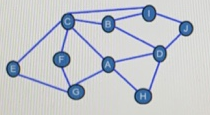
Find the list of vertices following the breadth-first traversal of the graph below starting from vertex A.
Find the list of vertices following the breadth-first traversal of the graph below starting from vertex A. (Note: when two or more nodes are equally as likely to be selected, select the one that comes first alphabetically).
Enter your answer as a list of nodes with no space (or any other separator) between them.
Homework Answers


Add Answer to:
Find the list of vertices following the breadth-first traversal of the graph below starting from vertex A.
for this graph starting at vertex H. Ties should be resolved by whichever vertex is alphabetically...
 for this graph starting at vertex H. Ties should be resolved by
whichever vertex is alphabetically earlier.
list the order the vertices are removed during Dijkstra's
algorithm for this graph starting at vertex H. Also list any update
to the known distance values for neighboring vertices (including
the initial update from infinity to a known value). Also include a
list of edges (pairs of vertices) in the tree that is formed as
part of the traversal in Dijkstra's algorithm. Ties...
for this graph starting at vertex H. Ties should be resolved by
whichever vertex is alphabetically earlier.
list the order the vertices are removed during Dijkstra's
algorithm for this graph starting at vertex H. Also list any update
to the known distance values for neighboring vertices (including
the initial update from infinity to a known value). Also include a
list of edges (pairs of vertices) in the tree that is formed as
part of the traversal in Dijkstra's algorithm. Ties...
(5 marks) a. The pseudo-code for breadth-first search, modified slightly from Drozdek,1 is as follows: void...
 (5 marks) a. The pseudo-code for breadth-first search, modified slightly from Drozdek,1 is as follows: void breadthFirstSearch (vertex w) for all vertices u num (u) 0 null edges i=1; num (w) i++ enqueue (w) while queue is not empty dequeue ( V= for all vertices u adjacent to v if num(u) is 0 num (u) = i++; enqueue (u) attach edge (vu) to edges; output edges; Now consider the following graph. Give the breadth-first traversal of the graph, starting from...
4. A directed graph is given below. Answer the following questions. When there are multiple vertices...
 4. A directed graph is given below. Answer the following questions. When there are multiple vertices that can be considered for a certain step, always operate on the vertex with the smallest ASCII value first. Note that with this consideration, each question has a unique answer. 1) What is the traversal result using breadth-first search starting from vertex A? 2) What is the traversal result using depth-first search starting from vertex A? thetopologicasing of this graph? 4
For the following graph, give the result of any one breadth-first traversal beginning at A, where...
 For the following graph, give the result of any one breadth-first traversal beginning at A, where the label of a vertex is printed when the vertex is visited. A 8 4 7 1 D 2 3 N E F
For the following graph, give the result of any one breadth-first traversal beginning at A, where...
 For the following graph, give the result of any one breadth-first traversal beginning at A, where the label of a vertex is printed when the vertex is visited. A 00 4 7 B с D 2 2 3 E F
For the following graph, give the result of any one breadth-first traversal beginning at D, where...
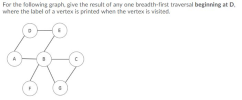 For the following graph, give the result of any one breadth-first traversal beginning at D, where the label of a vertex is printed when the vertex is visited. D E A B с F G
Programming Traversal Methods in C++ (depth first & breadth first) Need solution ASAP any help is...
Programming Traversal Methods in C++ (depth first & breadth first) Need solution ASAP any help is much appreciated. read a set of data representing a directed, unweighted graph build an in-memory graph structure using the data display the graph using depth-first traversal display the graph using breadth-first traversal Input data - The data consists of records like this: 16 3 15 4 -1 This represents a vertex 16 with neighbors 3, 15, and 4. The -1 is the indicator that...
Question 3 1 pts Select all of the following that are true: Breadth-First Search only adds...
 Question 3 1 pts Select all of the following that are true: Breadth-First Search only adds each vertex to the queue once. Breadth-First Search generally uses more space compared to Depth-First search. Breadth-First Search may not find the shortest path for an unweighted graph if the graph contains a cycle. At any time during Breadth-First Search, the queue holds at most two distinct dist values from all vertices in
Run BFS on the graph above starting from vertex 0 and list the vertices in order...
 Run BFS on the graph above
starting from vertex 0 and list the vertices in order of their
first visit.. Assume the adjacency list is in descending sorted
order based on the label of the vertices. For example, when
iterating through the edges pointing from 0, first consider the
edge 0 → 6, then 0 → 3, and finally 0 → 1.
راه من . 3 و 10 5
Run BFS on the graph above
starting from vertex 0 and list the vertices in order of their
first visit.. Assume the adjacency list is in descending sorted
order based on the label of the vertices. For example, when
iterating through the edges pointing from 0, first consider the
edge 0 → 6, then 0 → 3, and finally 0 → 1.
راه من . 3 و 10 5
7.[6] Consider the graph G below: a.[3] Find a Depth-First Search tree T for the above...
 7.[6] Consider the graph G below: a.[3] Find a Depth-First Search tree T for the above graph starting with the vertex 0. Show all the vertices as they are discovered in sequence starting from 1 to the last vertex included in T. b.[3] Find a Breadth-First Search tree T for the above graph starting with the vertex 0. Show all the vertices as they are discovered in sequence starting from 1 to the last vertex included in T.
 for this graph starting at vertex H. Ties should be resolved by
whichever vertex is alphabetically earlier.
list the order the vertices are removed during Dijkstra's
algorithm for this graph starting at vertex H. Also list any update
to the known distance values for neighboring vertices (including
the initial update from infinity to a known value). Also include a
list of edges (pairs of vertices) in the tree that is formed as
part of the traversal in Dijkstra's algorithm. Ties...
for this graph starting at vertex H. Ties should be resolved by
whichever vertex is alphabetically earlier.
list the order the vertices are removed during Dijkstra's
algorithm for this graph starting at vertex H. Also list any update
to the known distance values for neighboring vertices (including
the initial update from infinity to a known value). Also include a
list of edges (pairs of vertices) in the tree that is formed as
part of the traversal in Dijkstra's algorithm. Ties...
 (5 marks) a. The pseudo-code for breadth-first search, modified slightly from Drozdek,1 is as follows: void breadthFirstSearch (vertex w) for all vertices u num (u) 0 null edges i=1; num (w) i++ enqueue (w) while queue is not empty dequeue ( V= for all vertices u adjacent to v if num(u) is 0 num (u) = i++; enqueue (u) attach edge (vu) to edges; output edges; Now consider the following graph. Give the breadth-first traversal of the graph, starting from...
 4. A directed graph is given below. Answer the following questions. When there are multiple vertices that can be considered for a certain step, always operate on the vertex with the smallest ASCII value first. Note that with this consideration, each question has a unique answer. 1) What is the traversal result using breadth-first search starting from vertex A? 2) What is the traversal result using depth-first search starting from vertex A? thetopologicasing of this graph? 4
 For the following graph, give the result of any one breadth-first traversal beginning at A, where the label of a vertex is printed when the vertex is visited. A 8 4 7 1 D 2 3 N E F
 For the following graph, give the result of any one breadth-first traversal beginning at A, where the label of a vertex is printed when the vertex is visited. A 00 4 7 B с D 2 2 3 E F
 For the following graph, give the result of any one breadth-first traversal beginning at D, where the label of a vertex is printed when the vertex is visited. D E A B с F G
 Question 3 1 pts Select all of the following that are true: Breadth-First Search only adds each vertex to the queue once. Breadth-First Search generally uses more space compared to Depth-First search. Breadth-First Search may not find the shortest path for an unweighted graph if the graph contains a cycle. At any time during Breadth-First Search, the queue holds at most two distinct dist values from all vertices in
 Run BFS on the graph above
starting from vertex 0 and list the vertices in order of their
first visit.. Assume the adjacency list is in descending sorted
order based on the label of the vertices. For example, when
iterating through the edges pointing from 0, first consider the
edge 0 → 6, then 0 → 3, and finally 0 → 1.
راه من . 3 و 10 5
Run BFS on the graph above
starting from vertex 0 and list the vertices in order of their
first visit.. Assume the adjacency list is in descending sorted
order based on the label of the vertices. For example, when
iterating through the edges pointing from 0, first consider the
edge 0 → 6, then 0 → 3, and finally 0 → 1.
راه من . 3 و 10 5
 7.[6] Consider the graph G below: a.[3] Find a Depth-First Search tree T for the above graph starting with the vertex 0. Show all the vertices as they are discovered in sequence starting from 1 to the last vertex included in T. b.[3] Find a Breadth-First Search tree T for the above graph starting with the vertex 0. Show all the vertices as they are discovered in sequence starting from 1 to the last vertex included in T.
Most questions answered within 3 hours.
-
Where is the error in this code sequence?
String s1 = "Hello";
String s2 = "ello";...
asked 11 months ago -
Financial data for Joel de Paris, Inc., for last year
follow:
Joel de Paris, Inc.
Balance...
asked 11 months ago -
Consider this reaction:
Al2(SO4)3 (aq)+ BaCl3
(aq) Al2Cl6 (aq)- +
3BaSO4(s) . What is the...
asked 11 months ago -
Suppose that Savneet is considering increasing her
recent random sample from 20 car rentals to 40...
asked 11 months ago -
Trucks arrive at an unloading terminal at an average rate of 120
per hour.
Trucks arrive...
asked 11 months ago -
Why are methanol and ethanol completely soluble in water while
octanol is not very little soluble....
asked 11 months ago -
A facilities manager at a university reads in a research report
that the mean amount of...
asked 11 months ago -
When the CuSO4 is rehydrated by adding water to the anhydrous
compound, is this an endothermic...
asked 11 months ago -
A ray of sunlight is passing from diamond into crown glass; the
angle of incidence is...
asked 11 months ago -
A block of mass 0.249 kg is placed on top of a light, vertical
spring of...
asked 11 months ago -
how do the kidneys compensate in the presences of acidosis
a) trigger hyperventilate
b) reserve acid...
asked 11 months ago -
Question 501 pts
The rental rate of capital to the firm increases. Which of the
following...
asked 11 months ago