Consider a state space where the start state is number 1 and each state k has two successors
Question5: [9 points]
Consider a state space where the start state is number 1 and each state k has two successors: numbers 2k and 2k+1.
a. Draw the portion of the state space for states 1 to 15 .
b. Suppose the goal state is 11 . List the order in which nodes will be visited for breadth first search, depth-limited search with limit 3 , and iterative deepening search.
c. How well would bidirectional search work on this problem? What is the branching factor in each direction of the bidirectional search?
d. Does the answer to (c) suggest a reformulation of the problem that would allow you to solve the problem of getting from state 1 to a given goal state with almost no search?
e. Call the action going from k to 2 k Left, and the action going to 2 k+1 Right. Can you find an algorithm that outputs the solution to this problem without any search at all?
Homework Answers


Add Answer to:
Consider a state space where the start state is number 1 and each state k has two successors
Problem 2: Consider a state space where the start state is number 1 and the successor...
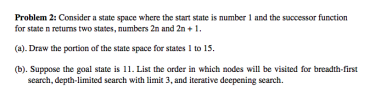 Problem 2: Consider a state space where the start state is number 1 and the successor function for state n returns two states, numbers 2n and 2n a). Draw the porion ates 1 to 15. (b). Suppose the goal state is l. List the order in which nodes will be visited for breadth-first search, depth-limited search with limit 3, and iterative deepening search.
2 pts Consider a state space where the start state is number 1 and the successor...
 2 pts Consider a state space where the start state is number 1 and the successor function for state n returns two states, numbers 2n and 2n+1 Draw the portion of the state space for states 1 to 15 (1 pt) Suppose the goal state is 11. List the order in which nodes will be visited for depth-limited search with limit 3 (0.5 pt), and iterative deepening search. (0.5 pt Figure 1 Set all nodes to "not visited" q new...
1. Search: In the state space shown, give the order in which the nodes are visited...
 1. Search: In the state space shown, give the order in which the nodes are visited (STOP WHEN THE FIRST GOAL IS REACHED) Goals are 5 and 8 der in which the nodes are visited (NOT the queue): no need to redraw the tree multiple times 1 5 a. Using Depth-First Search b. Using Breadth-First Search c. Using Iterative Deepening
(8) Consider the following problem space with the node "A" as the starting state and the node "H" as the goal state. Please describe how breadth-first search and depth-first search is...
 (8) Consider the following problem space with the node "A" as the starting state and the node "H" as the goal state. Please describe how breadth-first search and depth-first search is working with your problem space, and list the order that the nodes are traversed under these two search algorithms.
(8) Consider the following problem space with the node "A" as the starting state and the node "H" as the goal state. Please describe how breadth-first search and depth-first search...
(8) Consider the following problem space with the node "A" as the starting state and the node "H" as the goal state. Please describe how breadth-first search and depth-first search is working with your problem space, and list the order that the nodes are traversed under these two search algorithms.
(8) Consider the following problem space with the node "A" as the starting state and the node "H" as the goal state. Please describe how breadth-first search and depth-first search...
A social network graph (SNG) is a graph where each vertex is a person and each...
 A social network graph (SNG) is a graph where each vertex is a person and each edge represents an acquaintance. In other words, an SNG is a graph showing who knows who. For example, in the graph shown on Figure 2, George knows Mary and John, Mary knows Christine, Peter and George, John knows Christine, Helen and George, Christine knows Mary and John, Helen knows John, Peter knows Mary. The degrees of separation measure how closely connected two people are...
1) Consider the directed graph below. “S” is the start state and “G1,G2,G3” are 3 goal...
1) Consider the directed graph below. “S” is the start state and “G1,G2,G3” are 3 goal states. In traversing the graph one can move only in the direction indicated by the arrows. The numbers on the edges indicate the step-cost for traversing that edge. The numbers in the nodes represent the estimated cost to the nearest goal state. In the following you will be asked to search this graph using various search strategies. When you work out your answer, please...
Consider a search space, where each state can be a city, suburb, farmland, or mountain. The...
Consider a search space, where each state can be a city, suburb, farmland, or mountain. The goal is to reach any state that is a mountain. Here are some rules on the successors of different states: • Successors of a city are always suburbs. - Each city has at least one suburb as a successor . • Successors of a suburb can only be cities, or suburbs, or farms. - Each suburb has at least one city as a successor....
110Marks Question No. 4 Eight queens problem: place 8 queens on a chess board so that no two queens attack each other. -state: locations of 0 to 8 queens (with no two queens attacking each other) goa...
 110Marks Question No. 4 Eight queens problem: place 8 queens on a chess board so that no two queens attack each other. -state: locations of 0 to 8 queens (with no two queens attacking each other) goal test: 8 queens placed on the board (with none attacked) operator: place a queen in the left-most empty column such that it is not attacked by any other queen (and does not attack any other queen) path cost: 0 Depth first search: i....
Consider the following directed graph, which is given in adjacency list form and where vertexes have...
 Consider the following directed graph, which is given in adjacency list form and where vertexes have numerical labels: 1: 2, 4, 6 2: 4, 5 3: 1, 2, 6, 9 4: 5 5: 4, 7 6: 1, 5, 7 7: 3, 5 8: 2, 6, 7 9: 1, 7 The first line indicates that the graph contains a directed edge from vertex 1 to vertex 2, from 1 to vertex 4, and 1 to 6, and likewise for subsequent lines....
Could someone let me know the correct answers for these questions?
Question 1A finite-state machine (FSM) can serve as a useful model of a continuous (all its variables / attributes have real number values with infinite range and precision) environment. Yes or no?YesNo Question 2Breadth-first and depth-first tree searches always start the search process at the root of the tree. Yes or no?YesNo Question 3Consider a single-agent system where some agent A can travel to every place on the surface of the Earth (environment). Every place (environment state) on Earth can...
 Problem 2: Consider a state space where the start state is number 1 and the successor function for state n returns two states, numbers 2n and 2n a). Draw the porion ates 1 to 15. (b). Suppose the goal state is l. List the order in which nodes will be visited for breadth-first search, depth-limited search with limit 3, and iterative deepening search.
 2 pts Consider a state space where the start state is number 1 and the successor function for state n returns two states, numbers 2n and 2n+1 Draw the portion of the state space for states 1 to 15 (1 pt) Suppose the goal state is 11. List the order in which nodes will be visited for depth-limited search with limit 3 (0.5 pt), and iterative deepening search. (0.5 pt Figure 1 Set all nodes to "not visited" q new...
 1. Search: In the state space shown, give the order in which the nodes are visited (STOP WHEN THE FIRST GOAL IS REACHED) Goals are 5 and 8 der in which the nodes are visited (NOT the queue): no need to redraw the tree multiple times 1 5 a. Using Depth-First Search b. Using Breadth-First Search c. Using Iterative Deepening
 (8) Consider the following problem space with the node "A" as the starting state and the node "H" as the goal state. Please describe how breadth-first search and depth-first search is working with your problem space, and list the order that the nodes are traversed under these two search algorithms.
(8) Consider the following problem space with the node "A" as the starting state and the node "H" as the goal state. Please describe how breadth-first search and depth-first search...
(8) Consider the following problem space with the node "A" as the starting state and the node "H" as the goal state. Please describe how breadth-first search and depth-first search is working with your problem space, and list the order that the nodes are traversed under these two search algorithms.
(8) Consider the following problem space with the node "A" as the starting state and the node "H" as the goal state. Please describe how breadth-first search and depth-first search...
 A social network graph (SNG) is a graph where each vertex is a person and each edge represents an acquaintance. In other words, an SNG is a graph showing who knows who. For example, in the graph shown on Figure 2, George knows Mary and John, Mary knows Christine, Peter and George, John knows Christine, Helen and George, Christine knows Mary and John, Helen knows John, Peter knows Mary. The degrees of separation measure how closely connected two people are...
 110Marks Question No. 4 Eight queens problem: place 8 queens on a chess board so that no two queens attack each other. -state: locations of 0 to 8 queens (with no two queens attacking each other) goal test: 8 queens placed on the board (with none attacked) operator: place a queen in the left-most empty column such that it is not attacked by any other queen (and does not attack any other queen) path cost: 0 Depth first search: i....
 Consider the following directed graph, which is given in adjacency list form and where vertexes have numerical labels: 1: 2, 4, 6 2: 4, 5 3: 1, 2, 6, 9 4: 5 5: 4, 7 6: 1, 5, 7 7: 3, 5 8: 2, 6, 7 9: 1, 7 The first line indicates that the graph contains a directed edge from vertex 1 to vertex 2, from 1 to vertex 4, and 1 to 6, and likewise for subsequent lines....
Most questions answered within 3 hours.
-
Where is the error in this code sequence?
String s1 = "Hello";
String s2 = "ello";...
asked 10 months ago -
Financial data for Joel de Paris, Inc., for last year
follow:
Joel de Paris, Inc.
Balance...
asked 10 months ago -
Consider this reaction:
Al2(SO4)3 (aq)+ BaCl3
(aq) Al2Cl6 (aq)- +
3BaSO4(s) . What is the...
asked 10 months ago -
Suppose that Savneet is considering increasing her
recent random sample from 20 car rentals to 40...
asked 10 months ago -
Trucks arrive at an unloading terminal at an average rate of 120
per hour.
Trucks arrive...
asked 10 months ago -
Why are methanol and ethanol completely soluble in water while
octanol is not very little soluble....
asked 10 months ago -
A facilities manager at a university reads in a research report
that the mean amount of...
asked 10 months ago -
When the CuSO4 is rehydrated by adding water to the anhydrous
compound, is this an endothermic...
asked 10 months ago -
A ray of sunlight is passing from diamond into crown glass; the
angle of incidence is...
asked 10 months ago -
A block of mass 0.249 kg is placed on top of a light, vertical
spring of...
asked 10 months ago -
how do the kidneys compensate in the presences of acidosis
a) trigger hyperventilate
b) reserve acid...
asked 10 months ago -
Question 501 pts
The rental rate of capital to the firm increases. Which of the
following...
asked 10 months ago