The nation of Textilia does not allow imports of clothing. In its equilibrium without trade, a...
The nation of Textilia does not allow imports of clothing. In its equilibrium without trade, a T-shirt costs $20, and the equilibrium quantity is 3 million T- shirts. One day, after reading Adam Smith’s the Wealth of Nations while on vacation, the president decides to open the Textilian market to international trade. The market price of a T shirt falls to the world price of $16. The number of T shirts consumed in Textilia rises to 4 million, while the number of t shirts produced declines to 1 million.
- Illustrate the situation just described in a graph. Graph showing all numbers
- Calculate the change in consumer surplus, producer surplus, and total surplus that results from opening up trade. Area of triangle is ½ X base X height
Homework Answers
As per the information, the graph would be as follows:-
a)
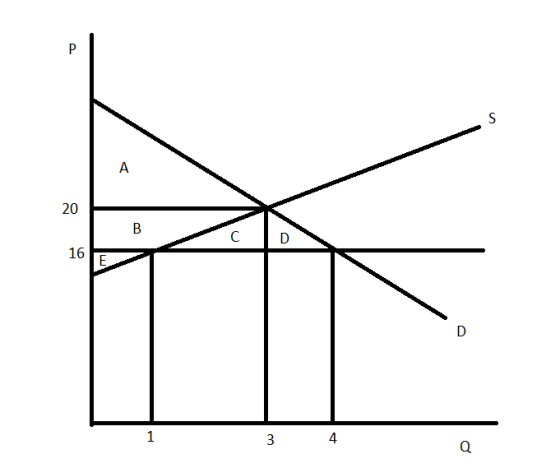
b) Change in CS = The CS will increase by area B+C+D
= 3 million*(20-16) + 0.5*(4m-3m)*(20-16)
= 12 million+2 million
= 14 milion
Change in PS = The PS will decrease by area B
= 1 m*(20-16) + 0.5*(3 m-1 m)*(20-16)
= 4 million+4 million
= 8 million
Change in TS = The TS will increase by area D+C
= 0.5*(4M-3M)*(20-16) + 0.5*(3M-1M)*(20-16)
= 2 million + 4 million
= 6 million
Add Answer to:
The nation of Textilia does not allow imports of clothing. In
its equilibrium without trade, a...
The nation of Textilia does not allow imports of clothing. In its equilibrium without trade, a T-shirt costs $20, and the equilibrium quantity is 3 million T-shirts. One day, after reading Adam Smith’s The Wealth of Nations while on vacation, the presiden
The nation of Textilia does not allow imports of clothing. In its equilibrium without trade, a T-shirt costs $20, and the equilibrium quantity is 3 million T-shirts. One day, after reading Adam Smith’s The Wealth of Nations while on vacation, the president decides to open the Textilian market to international trade. The market price of a T-shirt falls to the world price of $16. The number of T-shirts consumed in Textilia rises to 4 million, while the number of T-shirts...
5. Problems and Applications Q5 The nation of Textilia does not allow imports of clothing. In...
 5. Problems and Applications Q5 The nation of Textilia does not allow imports of clothing. In its equilibrium without trade, a T-shirt costs $20, and the equilibrium quantity is 3 million T-shirts. One day, after reading Adam Smith's The Wealth of Nations while on vacation, the president decides to open the Textilian market to international trade. The market price of a T-shirt falls to the world price of $16. The number of T-shirts consumed in Textilia rises to 4 million,...
5. Problems and Applications Q5 The nation of Textilia does not allow imports of clothing. In...
 5. Problems and Applications Q5 The nation of Textilia does not allow imports of clothing. In its equilibrium without trade, a T-shirt costs $24, and the equilibrium quantity is 4 million T-shirts. One day, after reading Adam Smith's The Wealth of Nations while on vacation, the president decides to open the Textilian market to international trade. The market price of a T-shirt falls to the world price of $16. The number of T-shirts consumed in Textilia rises to 8 million,...
The small nation of Tulipinia does not allow flowers to be imported. In its equilibrium without...
The small nation of Tulipinia does not allow flowers to be imported. In its equilibrium without trade, tulips cost $3 and the equilibrium quantity is 500,000 tulips. After thousands of Tulipinians complain to the government about not being able to get cheap tulips from abroad, the government decides to allow free trade with other countries. The world price of tulips is $1.50 and the number of tulips purchased in Tulipinia increases to 1.2 million, while the number of tulips harvested...
2. trade surplus 3. import quota 4. intra-industry trade 5. factor intensity 6. producer surplus II....
 2. trade surplus 3. import quota 4. intra-industry trade 5. factor intensity 6. producer surplus II. TRUE OR FALSE? (20%) 1, A production possibilities frontier graphically represents the maximum output of a country when the supply of resources and technology are constant.() 2. Absolute advantage theory shows that two nations could both gain from trade by exporting products in which their labor productivity was higher than that of the other nation. () 3, Mercantilists believed that each nation should try...
The following graph shows the domestic demand and domestic supply curves for lemons in Bolivia. Suppose Bolivia's government currently does not allow international trade in lemons.
 Consider the Bolivian market for lemons.The following graph shows the domestic demand and domestic
supply curves for lemons in Bolivia. Suppose Bolivia's government
currently does not allow international trade in lemons.Use the black point (plus symbol) to indicate the equilibrium
price of a ton of lemons and the equilibrium quantity of lemons in
Bolivia in the absence of international trade. Then, use the green
triangle (triangle symbol) to shade the area representing consumer
surplus in equilibrium. Finally, use the purple...
Consider the Bolivian market for lemons.The following graph shows the domestic demand and domestic
supply curves for lemons in Bolivia. Suppose Bolivia's government
currently does not allow international trade in lemons.Use the black point (plus symbol) to indicate the equilibrium
price of a ton of lemons and the equilibrium quantity of lemons in
Bolivia in the absence of international trade. Then, use the green
triangle (triangle symbol) to shade the area representing consumer
surplus in equilibrium. Finally, use the purple...
4. Kawmin is a small country that produces and consumes jelly beans. The world price of...
 4. Kawmin is a small country that produces and consumes jelly beans. The world price of jelly beans is $1 per bag, and Kawmin's domestic demand and supply for jelly beans are governed by the following equations: Demand: Q” = 8-P Supply: Q* =P where P is in dollars per bag and Q is in bags of jelly beans. a. Draw a well - labelled graph of the situation in Kawmin if the nation does not allow trade. Calculate the...
The following graph shows the domestic demand and domestic supply curves for tangerines in Sudan. Suppose Sudan's government currently does not allow international trade in tangerines.
 1. Welfare effects of free trade in an exporting country Consider the Sudanese market for tangerines. The following graph shows the domestic demand and domestic supply curves for tangerines in Sudan. Suppose Sudan's government currently does not allow international trade in tangerines. Use the black point (plus symbol) to indicate the equilibrium price of a ton of tangerines and the equilibrium quantity of tangerines in Sudan in the absence of international trade. Then, use the green triangle (triangle symbol) to shade the area...
The following graph shows the domestic demand and domestic supply curves for lemons in Kenya. Suppose Kenya's government currently does not allow international trade in lemons.
 1. Welfare effects of free trade in an exporting country Consider the Kenyan market for lemons. The following graph shows the domestic demand and domestic supply curves for lemons in Kenya. Suppose Kenya's government currently does not allow international trade in lemons. Use the black point (plus symbol) to indicate the equilibrium price of a ton of lemons and the equilibrium quantity of lemons in Kenya in the absence of international trade. Then, use the green triangle (triangle symbol) to shade the area...
Paradise is a small country that under free trade imports roses at $2.00 a dozen. Its...
Paradise is a small country that under free trade imports roses at $2.00 a dozen. Its domestic demand curve and domestic supply curve for roses are as follows: D = 100 - 10 P S = 10 + 10 P Calculate the equilibrium quantity imported under free trade. Under free trade: M = _________ If the government imposes a tariff of $1.00 on roses show graphically and calculate the impact of this tariff Graph: Under tariff: Domestic...
 5. Problems and Applications Q5 The nation of Textilia does not allow imports of clothing. In its equilibrium without trade, a T-shirt costs $20, and the equilibrium quantity is 3 million T-shirts. One day, after reading Adam Smith's The Wealth of Nations while on vacation, the president decides to open the Textilian market to international trade. The market price of a T-shirt falls to the world price of $16. The number of T-shirts consumed in Textilia rises to 4 million,...
 5. Problems and Applications Q5 The nation of Textilia does not allow imports of clothing. In its equilibrium without trade, a T-shirt costs $24, and the equilibrium quantity is 4 million T-shirts. One day, after reading Adam Smith's The Wealth of Nations while on vacation, the president decides to open the Textilian market to international trade. The market price of a T-shirt falls to the world price of $16. The number of T-shirts consumed in Textilia rises to 8 million,...
 2. trade surplus 3. import quota 4. intra-industry trade 5. factor intensity 6. producer surplus II. TRUE OR FALSE? (20%) 1, A production possibilities frontier graphically represents the maximum output of a country when the supply of resources and technology are constant.() 2. Absolute advantage theory shows that two nations could both gain from trade by exporting products in which their labor productivity was higher than that of the other nation. () 3, Mercantilists believed that each nation should try...
 4. Kawmin is a small country that produces and consumes jelly beans. The world price of jelly beans is $1 per bag, and Kawmin's domestic demand and supply for jelly beans are governed by the following equations: Demand: Q” = 8-P Supply: Q* =P where P is in dollars per bag and Q is in bags of jelly beans. a. Draw a well - labelled graph of the situation in Kawmin if the nation does not allow trade. Calculate the...
 1. Welfare effects of free trade in an exporting country Consider the Sudanese market for tangerines. The following graph shows the domestic demand and domestic supply curves for tangerines in Sudan. Suppose Sudan's government currently does not allow international trade in tangerines. Use the black point (plus symbol) to indicate the equilibrium price of a ton of tangerines and the equilibrium quantity of tangerines in Sudan in the absence of international trade. Then, use the green triangle (triangle symbol) to shade the area...
 1. Welfare effects of free trade in an exporting country Consider the Kenyan market for lemons. The following graph shows the domestic demand and domestic supply curves for lemons in Kenya. Suppose Kenya's government currently does not allow international trade in lemons. Use the black point (plus symbol) to indicate the equilibrium price of a ton of lemons and the equilibrium quantity of lemons in Kenya in the absence of international trade. Then, use the green triangle (triangle symbol) to shade the area...
Most questions answered within 3 hours.
-
Where is the error in this code sequence?
String s1 = "Hello";
String s2 = "ello";...
asked 11 months ago -
Financial data for Joel de Paris, Inc., for last year
follow:
Joel de Paris, Inc.
Balance...
asked 11 months ago -
Consider this reaction:
Al2(SO4)3 (aq)+ BaCl3
(aq) Al2Cl6 (aq)- +
3BaSO4(s) . What is the...
asked 11 months ago -
Suppose that Savneet is considering increasing her
recent random sample from 20 car rentals to 40...
asked 11 months ago -
Trucks arrive at an unloading terminal at an average rate of 120
per hour.
Trucks arrive...
asked 11 months ago -
Why are methanol and ethanol completely soluble in water while
octanol is not very little soluble....
asked 11 months ago -
A facilities manager at a university reads in a research report
that the mean amount of...
asked 11 months ago -
When the CuSO4 is rehydrated by adding water to the anhydrous
compound, is this an endothermic...
asked 11 months ago -
A ray of sunlight is passing from diamond into crown glass; the
angle of incidence is...
asked 11 months ago -
A block of mass 0.249 kg is placed on top of a light, vertical
spring of...
asked 11 months ago -
how do the kidneys compensate in the presences of acidosis
a) trigger hyperventilate
b) reserve acid...
asked 11 months ago -
Question 501 pts
The rental rate of capital to the firm increases. Which of the
following...
asked 11 months ago