The following graph shows the domestic demand and domestic supply curves for lemons in New Zealand.
The following graph shows the domestic demand and domestic supply curves for lemons in New Zealand. Suppose New Zealand's government currently does not allow international trade in lemons
Use the black point (plus symbol) to indicate the equilibrium price of a ton of lemons and the equilibrium quantity of lemons in New Zealand in the absence of international trade. Then, use the green triangle (triangle symbol) to shade the area representing consumer surplus in equilibrium. Finally, use the purple triangle (diamond symbol) to shade the area representing producer surplus in equilibrium.
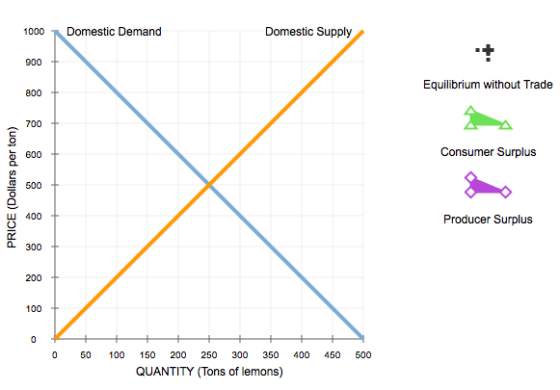
Based on the previous graph, total surplus in the absence of international trade is _______ .
The following graph shows the same domestic demand and supply curves for lemons in New Zealand. Suppose that the New Zealand government changes its international trade policy to allow free trade in lemons. The horizontal black line (Pw) represents the world price of lemons at $800 per ton. Assume that New Zealand's entry into the world market for lemons has no effect on the world price and there are no transportation or transaction costs associated with international trade in lemons. Also assume that domestic suppliers will satisfy domestic demand as much as possible before any exporting or importing takes place.
Use the green triangle (triangle symbol) to shade consumer surplus, and then use the purple triangle (diamond symbol) to shade producer surplus.
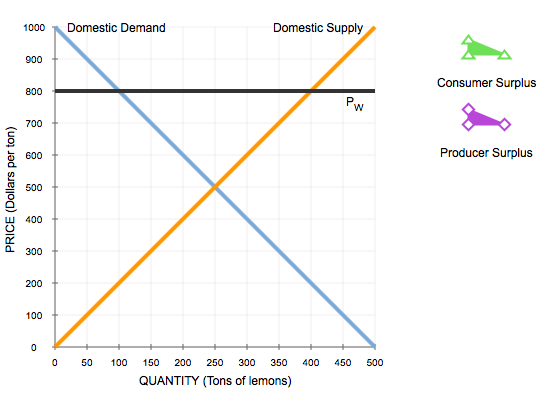
When New Zealand allows free trade of lemons, the price of a ton of lemons in New Zealand will be $800. At this price, _______ tons of lemons will be demanded in New Zealand, and _______ tons will be supplied by domestic suppliers. Therefore, New Zealand will export _______ tons of lemons.
Using the information from the previous tasks, complete the following table to analyze the welfare effect of allowing free trade.
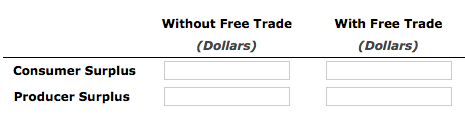
When New Zealand allows free trade, the country's consumer surplus _______ by _______ , and producer surplus _______ by _______ .So, the net effect of international trade on New Zealand's total surplus is a _______ of _______ .
Homework Answers

Add Answer to:
The following graph shows the domestic demand and domestic supply curves for lemons in New Zealand.
The following graph shows the domestic demand and domestic supply curves for lemons in New Zealand.
 5. Welfare effects of free trade in an exporting country Consider the New Zealand market for lemons. The following graph shows the domestic demand and domestic supply curves for lemons in New Zealand. Suppose New Zealand's government currently does not allow the international trade in lemons. Use the black point (plus symbol) to indicate the equilibrium price of a ton of lemons and the equilibrium quantity of lemons in New Zealand in the absence of international trade. Then, use the green point (triangle...
The following graph shows the domestic demand and domestic supply curves for lemons In Bolivia.
 Consider the Bolivian market for lemons. The following graph shows the domestic demand and domestic supply curves for lemons In Bolivia. Suppose Bolivia's government currently does not allow International trade In lemons. Use the black point (plus symbol) to Indicate the equilibrium price of a ton of lemons and the equilibrium quantity of lemons in Bolivia in the absence of International trade. Then, use the green triangle (triangle symbol) to shade the area representing consumer surplus In equilibrium. Finally, use the purple...
The following graph shows the domestic demand and domestic supply curves for lemons in Bolivia. Suppose Bolivia's government currently does not allow international trade in lemons.
 Consider the Bolivian market for lemons.The following graph shows the domestic demand and domestic
supply curves for lemons in Bolivia. Suppose Bolivia's government
currently does not allow international trade in lemons.Use the black point (plus symbol) to indicate the equilibrium
price of a ton of lemons and the equilibrium quantity of lemons in
Bolivia in the absence of international trade. Then, use the green
triangle (triangle symbol) to shade the area representing consumer
surplus in equilibrium. Finally, use the purple...
Consider the Bolivian market for lemons.The following graph shows the domestic demand and domestic
supply curves for lemons in Bolivia. Suppose Bolivia's government
currently does not allow international trade in lemons.Use the black point (plus symbol) to indicate the equilibrium
price of a ton of lemons and the equilibrium quantity of lemons in
Bolivia in the absence of international trade. Then, use the green
triangle (triangle symbol) to shade the area representing consumer
surplus in equilibrium. Finally, use the purple...
Consider the Bolivian market for lemons. The following graph shows the domestic demand and domestic supply...
 Consider the Bolivian market for lemons. The following graph shows the domestic demand and domestic supply curves for lemons in Bolivia. Suppose Bolivia's government currently does not allow international trade in lemons. Use the black point (plus symbol) to indicate the equilibrium price of a ton of lemons and the equilibrium quantity of lemons in Bolivia in the absence of international trade. Then, use the green triangle (triangle symbol) to shade the area representing consumer surplus in equilibrium. Finally, use...
The following graph shows the domestic demand and domestic supply curves for lemons in Kenya. Suppose Kenya's government currently does not allow international trade in lemons.
 1. Welfare effects of free trade in an exporting country Consider the Kenyan market for lemons. The following graph shows the domestic demand and domestic supply curves for lemons in Kenya. Suppose Kenya's government currently does not allow international trade in lemons. Use the black point (plus symbol) to indicate the equilibrium price of a ton of lemons and the equilibrium quantity of lemons in Kenya in the absence of international trade. Then, use the green triangle (triangle symbol) to shade the area...
please help with the whole problem. thank you the first and second drop down menu has...
 please help with the whole problem. thank you
the first and second drop down menu has options of: increase
or decrease. and the thrird drop down menu has an option of: gain
or loss
1. Welfare effects of free trade in an exporting country Consider the New Zealand market for lemons. The following graph shows the domestic demand and domestic supply curves for lemons in New Zealand. Suppose New Zealand's government currently does not allow international trade in lemons. Use...
please help with the whole problem. thank you
the first and second drop down menu has options of: increase
or decrease. and the thrird drop down menu has an option of: gain
or loss
1. Welfare effects of free trade in an exporting country Consider the New Zealand market for lemons. The following graph shows the domestic demand and domestic supply curves for lemons in New Zealand. Suppose New Zealand's government currently does not allow international trade in lemons. Use...
The following graph shows the domestic demand and domestic supply curves for tangerines in Panama. Suppose...
 The following graph shows the domestic demand and domestic supply curves for tangerines in Panama. Suppose Panama's government currently does not allow international trade in tangerines. Use the black point (plus symbol) to indicate the equilibrium price of a ton of tangerines and the equilibrium quantity of tangerines in Panama in the absence of international trade. Then, use the green triangle (triangle symbol) to shade the area representing consumer surplus in equilibrium. Finally, use the purple triangle (diamond symbol) to...
Consider the Colombian market for soybeans. The following graph shows the domestic demand and domestic supply...
 Consider the Colombian market for soybeans. The following graph shows the domestic demand and domestic supply curves for soybeans in Colombia. Suppose Colombia's government currently does not allow international trade in soybeans. Use the black point (plus symbol) to indicate the equilibrium price of a ton of soybeans and the equilibrium quantity of soybeans in Colombia in the absence of international trade. Then, use the green triangle (triangle symbol) to shade the area representing consumer surplus in equilibrium. Finally, use the purple...
The following graph shows the domestic demand and domestic supply curves for soybeans in Venezuela
 Consider the Venezuelan market for soybeans. The following graph shows the domestic demand and domestic supply curves for soybeans in Venezuela. Suppose Venezuela's government currently does not allow international trade in soybeans. Use the black point (plus symbol) to indicate the equilibrium price of a ton of soybeans and the equilibrium quantity of soybeans in Venezuela in the absence of international trade. Then, use the green triangle (triangle symbol) to shade the area representing consumer surplus in equilibrium. Finally, use the purple...
Consider the Guatemalan market for tangerines. The following graph shows the domestic demand and domestic supply...
 Consider the Guatemalan market for tangerines. The following graph shows the domestic demand and domestic supply curves for tangerines in Guatemala. Suppose Guatemala's government currently does not allow international trade in tangerines Use the black point (plus symbol) to indicate the equilibrium price of a ton of tangerines and the equilibrium quantity of tangerines in Guatemala in the absence of international trade. Then, use the green triangle (triangle symbol) to shade the area representing consumer surplus in equilibrium. Finally, use...
 Consider the Bolivian market for lemons. The following graph shows the domestic demand and domestic supply curves for lemons in Bolivia. Suppose Bolivia's government currently does not allow international trade in lemons. Use the black point (plus symbol) to indicate the equilibrium price of a ton of lemons and the equilibrium quantity of lemons in Bolivia in the absence of international trade. Then, use the green triangle (triangle symbol) to shade the area representing consumer surplus in equilibrium. Finally, use...
 1. Welfare effects of free trade in an exporting country Consider the Kenyan market for lemons. The following graph shows the domestic demand and domestic supply curves for lemons in Kenya. Suppose Kenya's government currently does not allow international trade in lemons. Use the black point (plus symbol) to indicate the equilibrium price of a ton of lemons and the equilibrium quantity of lemons in Kenya in the absence of international trade. Then, use the green triangle (triangle symbol) to shade the area...
 please help with the whole problem. thank you
the first and second drop down menu has options of: increase
or decrease. and the thrird drop down menu has an option of: gain
or loss
1. Welfare effects of free trade in an exporting country Consider the New Zealand market for lemons. The following graph shows the domestic demand and domestic supply curves for lemons in New Zealand. Suppose New Zealand's government currently does not allow international trade in lemons. Use...
please help with the whole problem. thank you
the first and second drop down menu has options of: increase
or decrease. and the thrird drop down menu has an option of: gain
or loss
1. Welfare effects of free trade in an exporting country Consider the New Zealand market for lemons. The following graph shows the domestic demand and domestic supply curves for lemons in New Zealand. Suppose New Zealand's government currently does not allow international trade in lemons. Use...
 The following graph shows the domestic demand and domestic supply curves for tangerines in Panama. Suppose Panama's government currently does not allow international trade in tangerines. Use the black point (plus symbol) to indicate the equilibrium price of a ton of tangerines and the equilibrium quantity of tangerines in Panama in the absence of international trade. Then, use the green triangle (triangle symbol) to shade the area representing consumer surplus in equilibrium. Finally, use the purple triangle (diamond symbol) to...
 Consider the Guatemalan market for tangerines. The following graph shows the domestic demand and domestic supply curves for tangerines in Guatemala. Suppose Guatemala's government currently does not allow international trade in tangerines Use the black point (plus symbol) to indicate the equilibrium price of a ton of tangerines and the equilibrium quantity of tangerines in Guatemala in the absence of international trade. Then, use the green triangle (triangle symbol) to shade the area representing consumer surplus in equilibrium. Finally, use...
Most questions answered within 3 hours.
-
Where is the error in this code sequence?
String s1 = "Hello";
String s2 = "ello";...
asked 11 months ago -
Financial data for Joel de Paris, Inc., for last year
follow:
Joel de Paris, Inc.
Balance...
asked 11 months ago -
Consider this reaction:
Al2(SO4)3 (aq)+ BaCl3
(aq) Al2Cl6 (aq)- +
3BaSO4(s) . What is the...
asked 11 months ago -
Suppose that Savneet is considering increasing her
recent random sample from 20 car rentals to 40...
asked 11 months ago -
Trucks arrive at an unloading terminal at an average rate of 120
per hour.
Trucks arrive...
asked 11 months ago -
Why are methanol and ethanol completely soluble in water while
octanol is not very little soluble....
asked 11 months ago -
A facilities manager at a university reads in a research report
that the mean amount of...
asked 11 months ago -
When the CuSO4 is rehydrated by adding water to the anhydrous
compound, is this an endothermic...
asked 11 months ago -
A ray of sunlight is passing from diamond into crown glass; the
angle of incidence is...
asked 11 months ago -
A block of mass 0.249 kg is placed on top of a light, vertical
spring of...
asked 11 months ago -
how do the kidneys compensate in the presences of acidosis
a) trigger hyperventilate
b) reserve acid...
asked 11 months ago -
Question 501 pts
The rental rate of capital to the firm increases. Which of the
following...
asked 11 months ago