Homework (Ch 09) Suppose that a firm produces tennis racquets in a monopolistically competitive market. The follow...
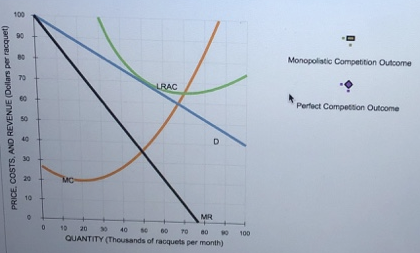
Suppose that a firm produces tennis racquets in a monopolistically competitive market. The following graph shows its demand curve (D), marginal revenue curve (MR), marginal cost curve (MC), and long-run average cost curve (LRAC). Assume that all firms in the industry face the same cost structure.
Place the tan point (dash symbol) on the graph to indicate the long-run monopolistically competitive equmbrium price and quantity for this firm. Next, place the purple point (diamond symbol) to indicate the point at which this firm would produce in the long run if it operated in a perfectly competitive market.
Note: Dashed drop lines will automatically extend to both axes.

Homework Answers

Add Answer to:
Homework (Ch 09) Suppose that a firm produces tennis racquets in a monopolistically competitive market. The follow...
Suppose that a firm produces baseball bats in a monopolistically competitive market. The following graph shows...
 Suppose that a firm produces baseball bats in a monopolistically competitive market. The following graph shows its demand curve, marginal revenue (MR) curve, marginal cost (MC) curve, and average total cost (ATC) curve.Place a block point (plus symbol) on the graph to indicate the long-run monopolistically competitive equilibrium price and quantity for this firm. Next, place a grey point (star symbol) to indicate the minimum average total cost the firm faces and the quantity associated with that cost.Because this market...
Suppose that a firm produces wooden train engines in a monopolistically competitive market. The following graph...
 Suppose that a firm produces wooden train engines in a monopolistically competitive market. The following graph shows its demand curve, marginal revenue (MR) curve, marginal cost (MC) curve, and average total cost (ATC) curve. Place a black point (plus symbol) on the graph to indicate the long-run monopolistically competitive equilibrium price and quantity for this firm. Next, place a grey point (star symbol) to indicate the minimum average total cost the firm faces and the quantity associated with that cost. Because this...
4. Is monopolistic competition efficient? Suppose that a firm produces wool jackets in a monopolistically competitive...
 4. Is monopolistic competition efficient? Suppose that a firm produces wool jackets in a monopolistically competitive market. The following graph shows its demand curve, marginal revenue (MR) curve, marginal cost (MC) curve, and average total cost (ATC) curve. Place a black point (plus symbol) on the graph to indicate the long-run monopolistically competitive equilibrium price and quantity for this firm. Next, place a grey point (star symbol) to indicate the minimum average total cost the firm faces and the quantity...
Suppose that a firm produces baseball bats in a monopolistically competitive market. The following graph shows its demand curve, marginal revenue (MR) curve, marginal cost (MC) curve, and average total cost (ATC) curve.
 3. Is monopolistic competition efficient? Suppose that a firm produces baseball bats in a monopolistically competitive market. The following graph shows its demand curve, marginal revenue (MR) curve, marginal cost (MC) curve, and average total cost (ATC) curve. Place a black point (plus symbol) on the graph to indicate the long-run monopolistically competitive equilibrium price and quantity for this firm. Next, place a grey point (star symbol) to indicate the minimum average total cost the firm faces and the quantity associated with...
4. Is monopolistic competition efficient? Suppose that a firm produces polo shirts in a monopolistically competitive...
 4. Is monopolistic competition efficient? Suppose that a firm produces polo shirts in a monopolistically competitive market. The following graph shows its demand curve, marginal revenue (MR) curve, marginal cost (MC) curve, and average total cost (ATC) curve. Place a black point (plus symbol) on the graph to indicate the long-run monopolistically competitive equilibrium price and quantity for this firm. Next, place a grey point (star symbol) to indicate the minimum average total cost the firm faces and the quantity...
1. Is monopolistic competition efficient? Suppose that a firm produces wooden train engines in a monopolistically...
 1. Is monopolistic competition efficient? Suppose that a firm produces wooden train engines in a monopolistically competitive market. The following graph shows its demand curve, marginal revenue (MR) curve, marginal cost (MC) curve, and average total cost (ATC) curve. Place a black point (plus symbol) on the graph to indicate the long-run monopolistically competitive equilibrium price and quan tity for this firm. Next, place a grey point (star symbol) to indicate the minimum average total cost the firm faces and...
Fantastique Bikes is a company that manufactures bikes in a monopolistically competitive market. The following graph...
 Fantastique Bikes is a company that manufactures bikes in a monopolistically competitive market. The following graph shows Fantastique's demand curve, marginal revenue curve (MR), marginal cost curve (MC), and average total cost curve (ATC) Place the black point (plus symbol) on the graph to indicate the short-run profit-maximizing price and quantity for this monopolistically competitive company. Then, use the green rectangle (triangle symbols) to shade the area representing the company's profit or loss.Given the profit-maximizing choice of output and price, the...
Suppose there is a monopolistically competitive market with n identical firms, such that each firm produces the same quantity, q. Further, the market is in the monopolistically competitive long-run e...
 Suppose there is a monopolistically competitive market with n identical firms, such that each firm produces the same quantity, q. Further, the market is in the monopolistically competitive long-run equilibrium. You are given the following: Inverse market demand: P 10-Q Total market output: Qnxq Marginal revenue: MR 10n+ 1)xq Total cost: C(q)-5+q Marginal cost: MC 2xq In long-run equilibrium, each firm earns zero economic profit. In long-run equilibrium, the number of firms, n, is and each firm produces units) of...
Consider the daily market for hot dogs in asmall city. Suppose that this market is...
 Consider the daily market for hot dogs in a
small city. Suppose that this market is in long-run competitive
equilibrium with many hot dog stands in the city, each one selling
the same kind of hot dogs. Therefore, each vendor is a price taker
and possesses no market power. The following graph shows the demand (D) and supply curves (S = MC) in the market for hot dogs. Place the black point (plus symbol) on the graph to indicate the market price...
Consider the daily market for hot dogs in a
small city. Suppose that this market is in long-run competitive
equilibrium with many hot dog stands in the city, each one selling
the same kind of hot dogs. Therefore, each vendor is a price taker
and possesses no market power. The following graph shows the demand (D) and supply curves (S = MC) in the market for hot dogs. Place the black point (plus symbol) on the graph to indicate the market price...
na monopolistically competitive market. The following graph shows its demand curve, marginal revenue ure, and total...
 na monopolistically competitive market. The following graph shows its demand curve, marginal revenue ure, and total cost (ATC) . C ck e Me place l) on the graph to indicate the long run mopolistically competitive equilibrium price and quantity for this form ) to indicate the em e rge total cost the firm faces and the quantity associated with that cost Next s Mon Como come Min Ust Cost
 4. Is monopolistic competition efficient? Suppose that a firm produces wool jackets in a monopolistically competitive market. The following graph shows its demand curve, marginal revenue (MR) curve, marginal cost (MC) curve, and average total cost (ATC) curve. Place a black point (plus symbol) on the graph to indicate the long-run monopolistically competitive equilibrium price and quantity for this firm. Next, place a grey point (star symbol) to indicate the minimum average total cost the firm faces and the quantity...
 4. Is monopolistic competition efficient? Suppose that a firm produces polo shirts in a monopolistically competitive market. The following graph shows its demand curve, marginal revenue (MR) curve, marginal cost (MC) curve, and average total cost (ATC) curve. Place a black point (plus symbol) on the graph to indicate the long-run monopolistically competitive equilibrium price and quantity for this firm. Next, place a grey point (star symbol) to indicate the minimum average total cost the firm faces and the quantity...
 1. Is monopolistic competition efficient? Suppose that a firm produces wooden train engines in a monopolistically competitive market. The following graph shows its demand curve, marginal revenue (MR) curve, marginal cost (MC) curve, and average total cost (ATC) curve. Place a black point (plus symbol) on the graph to indicate the long-run monopolistically competitive equilibrium price and quan tity for this firm. Next, place a grey point (star symbol) to indicate the minimum average total cost the firm faces and...
 Suppose there is a monopolistically competitive market with n identical firms, such that each firm produces the same quantity, q. Further, the market is in the monopolistically competitive long-run equilibrium. You are given the following: Inverse market demand: P 10-Q Total market output: Qnxq Marginal revenue: MR 10n+ 1)xq Total cost: C(q)-5+q Marginal cost: MC 2xq In long-run equilibrium, each firm earns zero economic profit. In long-run equilibrium, the number of firms, n, is and each firm produces units) of...
 na monopolistically competitive market. The following graph shows its demand curve, marginal revenue ure, and total cost (ATC) . C ck e Me place l) on the graph to indicate the long run mopolistically competitive equilibrium price and quantity for this form ) to indicate the em e rge total cost the firm faces and the quantity associated with that cost Next s Mon Como come Min Ust Cost
Most questions answered within 3 hours.
-
Where is the error in this code sequence?
String s1 = "Hello";
String s2 = "ello";...
asked 11 months ago -
Financial data for Joel de Paris, Inc., for last year
follow:
Joel de Paris, Inc.
Balance...
asked 11 months ago -
Consider this reaction:
Al2(SO4)3 (aq)+ BaCl3
(aq) Al2Cl6 (aq)- +
3BaSO4(s) . What is the...
asked 11 months ago -
Suppose that Savneet is considering increasing her
recent random sample from 20 car rentals to 40...
asked 11 months ago -
Trucks arrive at an unloading terminal at an average rate of 120
per hour.
Trucks arrive...
asked 11 months ago -
Why are methanol and ethanol completely soluble in water while
octanol is not very little soluble....
asked 11 months ago -
A facilities manager at a university reads in a research report
that the mean amount of...
asked 11 months ago -
When the CuSO4 is rehydrated by adding water to the anhydrous
compound, is this an endothermic...
asked 11 months ago -
A ray of sunlight is passing from diamond into crown glass; the
angle of incidence is...
asked 11 months ago -
A block of mass 0.249 kg is placed on top of a light, vertical
spring of...
asked 11 months ago -
how do the kidneys compensate in the presences of acidosis
a) trigger hyperventilate
b) reserve acid...
asked 11 months ago -
Question 501 pts
The rental rate of capital to the firm increases. Which of the
following...
asked 11 months ago