The following graph shows the market for loanable funds in a closed economy.
The following graph shows the market for loanable funds in a closed economy. The upward-sloping orange line represents the supply of loanable funds, and the downward-sloping blue line represents the demand for loanable funds.
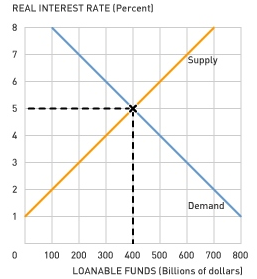
Saving is the source of the supply of loanable funds.
As the real interest rate rises, the quantity of loanable funds demanded decreases
Suppose the real interest rate is 7%. In this case, the quantity of loanable funds supplied is greater than the quantity of loans demanded, resulting In a surplus of loanable funds. This would encourage lenders to lower the real interest rates they charge, thereby Increasing the quantity of loanable funds supplied and Increasing the quantity of loanable funds demanded, moving the market toward the equilibrium real interest rate of 7%
Homework Answers

Add Answer to:
The following graph shows the market for loanable funds in a closed economy.
4. Supply and demand for loanable funds The following graph shows the market for loanable funds in a closed economy.
 4. Supply and demand for loanable funds The following graph shows the market for loanable funds in a closed economy. The upward-sloping orange line represents the supply of loanable funds, and the downward-sloping blue line represents the demand for loan funds _______ is the source of the demand for loanable funds. As the interest rate falls, the quantity of loanable funds demanded _______ Suppose the interest rate is 4.5%. Based on the previous graph, the quantity of loanable funds supplied is _______ than...
3. Supply and demand for loanable funds Aa Aa The following graph shows the market for...
 3. Supply and demand for loanable funds The following graph shows the market for loanable funds in a closed economy. The upward-sloping orange line represents the supply of loanable funds, and the downward-sloping blue line represents the demand for loanable funds.Investment is the source of the supply of loanable funds. As the interest rate falls, the quantity of loanable funds supplied increases. Suppose the interest rate is 7%. In this case, the quantity of loanable funds supplied is greater than the quantity of...
4. Supply and demand for loanable funds alog The following graph shows the market for loanable...
 4. Supply and demand for loanable funds alog The following graph shows the market for loanable funds in a closed economy. The upward sloping range line represents the supply of loanable funds, and the downward sloping blue line represents the demand for loanable funds ters ans access Tips ccess Tips 10 FOR YOU Suppo Tools NTEREST RATL Pent ar Principles of wand edback 100 LOANABLE FUNDS INTEREST RATE (Percent) Demand . 100 200 300 400 500 600 700 80000 1000...
As the real interest rate rises, the quantity of loanable funds: supplied also rises supplied is...
 As the real interest rate rises, the quantity of loanable funds: supplied also rises supplied is unchanged demanded also rises demanded is unchanged The supply curve in the loanable funds model is: upward sloping vertical. downward sloping horizontal.
QUESTION 40 The demand curve for loanable funds is A upward sloping, indicating that lower interest...
QUESTION 40 The demand curve for loanable funds is A upward sloping, indicating that lower interest rates are associated with a lower demand for loanable funds. B downward sloping, indicating that businesses will increase their demand at lower interest rates, but that consumers will probably decrease the supply of loanable funds at lower interest rates. C downward sloping, indicating that both businesses and consumers will increase the quantity demanded of loanable funds as the interest rate decreases. D horizontal at...
7. Understanding the Fisher effect Aa Aa The following graphs show the loanable funds market. The...
 7. Understanding the Fisher effect Aa Aa The following graphs show the loanable funds market. The upward-sloping orange line represents the supply of loanable funds, and the downward-sloping blue line represents the demand for loanable funds. For each of the following scenarios, use the graph to show how the market will react to the given change in the expected future inflation rate. The following graph shows the demand and supply curves for loanable funds when the expected future inflation rate...
For an imaginary economy, when the real interest rate is 7 percent, the quantity of loanable...
For an imaginary economy, when the real interest rate is 7 percent, the quantity of loanable funds demanded is $500 and the quantity of loanable funds supplied is $500. Currently, the nominal interest rate is 9 percent and the inflation rate is 4 percent. Currently, A. the quantity of loanable funds supplied exceeds the quantity of loanable funds demanded, and as a result the real interest rate will rise. B. the quantity of loanable funds supplied exceeds the quantity of...
which of the following statements about the loanable funds market is (are) correct? (x) When the...
which of the following statements about the loanable funds market is (are) correct? (x) When the supply of loanable funds shifts to the right then the equilibrium real interest rate decreases and the equilibrium quantity of loanable funds decreases. (y) When the demand for loanable funds shifts to the right then the equilibrium real interest rate increases and the equilibrium quantity of loanable funds increases. (z) If the demand for loanable funds shifts to the right and the supply of...
which of the following statements about the loanable funds market is (are) correct? (x) When the...
which of the following statements about the loanable funds market is (are) correct? (x) When the supply of loanable funds shifts to the right then the equilibrium real interest rate decreases and the equilibrium quantity of loanable funds decreases. (y) When the demand for loanable funds shifts to the right then the equilibrium real interest rate increases and the equilibrium quantity of loanable funds increases. (z) If the demand for loanable funds shifts to the right and the supply of...
The following table shows the supply and demand for loanable funds schedule in a small island...
 The following table shows the supply and demand for loanable funds schedule in a small island country in the Caribbean at the beginning of 2016. By the end of the year however, the demand for loanable funds increases by $2 billion at each level of the real interest rate and the supply of loanable funds increased by $1 billion at each interest rate. Predict the conditions of the loanable funds market in this country, under the following two scenarios: Scenario...
 4. Supply and demand for loanable funds alog The following graph shows the market for loanable funds in a closed economy. The upward sloping range line represents the supply of loanable funds, and the downward sloping blue line represents the demand for loanable funds ters ans access Tips ccess Tips 10 FOR YOU Suppo Tools NTEREST RATL Pent ar Principles of wand edback 100 LOANABLE FUNDS INTEREST RATE (Percent) Demand . 100 200 300 400 500 600 700 80000 1000...
 As the real interest rate rises, the quantity of loanable funds: supplied also rises supplied is unchanged demanded also rises demanded is unchanged The supply curve in the loanable funds model is: upward sloping vertical. downward sloping horizontal.
 7. Understanding the Fisher effect Aa Aa The following graphs show the loanable funds market. The upward-sloping orange line represents the supply of loanable funds, and the downward-sloping blue line represents the demand for loanable funds. For each of the following scenarios, use the graph to show how the market will react to the given change in the expected future inflation rate. The following graph shows the demand and supply curves for loanable funds when the expected future inflation rate...
 The following table shows the supply and demand for loanable funds schedule in a small island country in the Caribbean at the beginning of 2016. By the end of the year however, the demand for loanable funds increases by $2 billion at each level of the real interest rate and the supply of loanable funds increased by $1 billion at each interest rate. Predict the conditions of the loanable funds market in this country, under the following two scenarios: Scenario...
Most questions answered within 3 hours.
-
Where is the error in this code sequence?
String s1 = "Hello";
String s2 = "ello";...
asked 11 months ago -
Financial data for Joel de Paris, Inc., for last year
follow:
Joel de Paris, Inc.
Balance...
asked 11 months ago -
Consider this reaction:
Al2(SO4)3 (aq)+ BaCl3
(aq) Al2Cl6 (aq)- +
3BaSO4(s) . What is the...
asked 11 months ago -
Suppose that Savneet is considering increasing her
recent random sample from 20 car rentals to 40...
asked 11 months ago -
Trucks arrive at an unloading terminal at an average rate of 120
per hour.
Trucks arrive...
asked 11 months ago -
Why are methanol and ethanol completely soluble in water while
octanol is not very little soluble....
asked 11 months ago -
A facilities manager at a university reads in a research report
that the mean amount of...
asked 11 months ago -
When the CuSO4 is rehydrated by adding water to the anhydrous
compound, is this an endothermic...
asked 11 months ago -
A ray of sunlight is passing from diamond into crown glass; the
angle of incidence is...
asked 11 months ago -
A block of mass 0.249 kg is placed on top of a light, vertical
spring of...
asked 11 months ago -
how do the kidneys compensate in the presences of acidosis
a) trigger hyperventilate
b) reserve acid...
asked 11 months ago -
Question 501 pts
The rental rate of capital to the firm increases. Which of the
following...
asked 11 months ago