A pension fund manager is considering three mutual funds. The first is a stock fund, the...
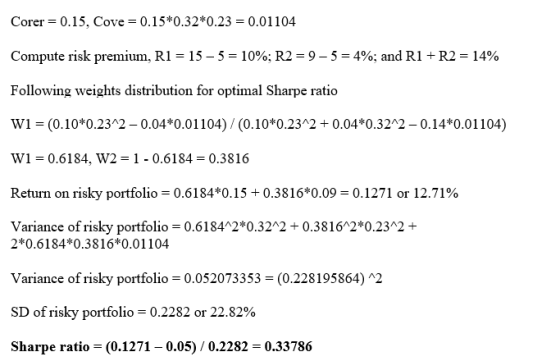
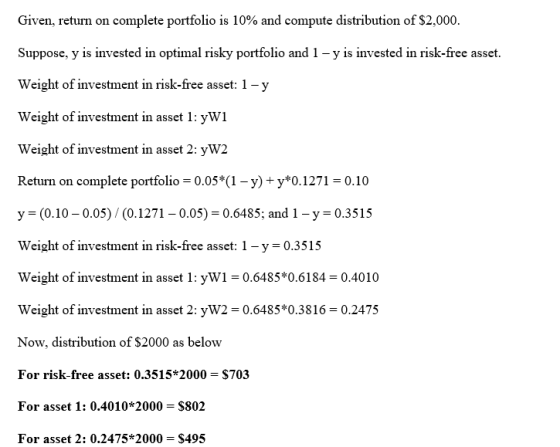
A pension fund manager is considering three mutual funds. The first is a stock fund, the second is a bond fund, and the third is a T-bill money market fund that yields a sure rate of 5.0%. The probability distributions of the risky funds are: (Total 20 points) Expected Return of Market Standard Deviation Stock funds (S) 15% 32% Bond funds (B) 9% 23% The correlation between the fund returns is 0.15. a. Use the formula below to compute the optimal portfolio weights. B. You manage $2000 for your client and your client wants an expected return of 10%. Using the optimal weights you got from part a, how much money do you invest in each of the three funds? (10 points) Hint: you need to compute the risky portfolio return using optimal weights from part a first.
Homework Answers
I have answered the question below
Please up vote for the same and thanks!!!
Do reach out in the comments for any queries
Answer:
Add Answer to:
A pension fund manager is considering three mutual funds. The
first is a stock fund, the...
A pension fund manager is considering three mutual funds. The first is a stock fund, the...
A pension fund manager is considering three mutual funds. The first is a stock fund, the second is a long-term government and corporate bond fund, and the third is a T-bill money market fund that yields a sure rate of 5.5%. The probability distributions of the risky funds are: Expected Return Standard Deviation Stock fund (S) 15 % 32 % Bond fund (B) 9 % 23 % The correlation between the fund returns is 0.15. a. What would be the...
A pension fund manager is considering three mutual funds. The first is a stock fund, the...
 A pension fund manager is considering three mutual funds. The first is a stock fund, the second is a long-term government and corporate bond fund, and the third is a T-bill money market fund that yields a rate of 5.5%. The probability distribution of the risky funds is as follows: Expected Return Standard Deviation Stock fund (5) Bond fund (B) The correlation between the fund returns is 0.15 Solve numerically for the proportions of each asset and for the expected...
A pension fund manager is considering three mutual funds. The first is a stock fund, the...
 A pension fund manager is considering three mutual funds. The first is a stock fund, the second is a long- term government and corporate bond fund, and the third is a T-bill money market fund that yields a sure rate of 5.5%. The probability distributions of the risky funds are: Expected Return 15% Stock fund (5) Bond fund (B) Standard Deviation 32% 23% 9% The correlation between the fund returns is 0.15. a. What would be the investment proportions of...
A pension fund manager is considering three mutual funds. The first is a stock fund, the...
 A pension fund manager is considering three mutual funds. The first is a stock fund, the second is a long-term government and corporate bond fund, and the third is a T-bill money market fund that yields a rate of 5.5%. The probability distribution of the risky funds is as follows: Expected Return Standard Deviation Stock fund (S) Bond fund (B) 168 45% 7 39 The correlation between the fund returns is 0.15. Solve numerically for the proportions of each asset...
A pension fund manager is considering three mutual funds. The first is a stock fund, the...
A pension fund manager is considering three mutual funds. The first is a stock fund, the second is a long-term government and corporate bond fund, and the third is a T-bill money market fund that yields a rate of 8%. The probability distribution of the risky funds is as follows: Expected Return Standard Deviation Stock fund (S) 23 % 29 % Bond fund (B) 14 17 The correlation between the fund returns is 0.12. Solve numerically for the proportions of...
A pension fund manager is considering three mutual funds. The first is a stock fund, the...
A pension fund manager is considering three mutual funds. The first is a stock fund, the second is a long-term government and corporate bond fund, and the third is a T-bill money market fund that yields a rate of 4.0%. The probability distribution of the risky funds is as follows: Expected Return STD DEV Stock fund (S) 10% 32% Bond fund (B) 7 24 The correlation between the fund returns is 0.13. Solve numerically for the proportions of each asset...
A pension fund manager is considering three mutual funds. The first is a stock fund, the...
 A pension fund manager is considering three mutual funds. The first is a stock fund, the second is a long- term government and corporate bond fund, and the third is a T-bill money market fund that yields a sure rate of 5.5%. The probability distributions of the risky funds are Expected ReturnStandard Deviation Stock fund (S) Bond fund (B) 15% 9% 32% 22% The correlation between the fund returns is 0.15. a. What would be the investment proportions of your...
A pension fund manager is considering three mutual funds. The first is a stock fund, the...
A pension fund manager is considering three mutual funds. The first is a stock fund, the second is a long-term government and corporate bond fund, and the third is a T-bill money market fund that yields a sure rate of 5.6%. The probability distributions of the risky funds are: Expected Return Standard Deviation Stock fund (S) 17% 46% Bond fund (B) 8% 40% The correlation between the fund returns is 0.0600. What is the expected return and standard deviation for...
A pension fund manager is considering three mutual funds. The first is a stock fund, the...
A pension fund manager is considering three mutual funds. The first is a stock fund, the second is a long-term government and corporate bond fund, and the third is a T-bill money market fund that yields a sure rate of 4.7%. The probability distributions of the risky funds are: Expected Return Standard Deviation Stock fund (S) 17% 37% Bond fund (B) 8% 31% The correlation between the fund returns is 0.1065. What is the expected return and standard deviation for...
A pension fund manager is considering three mutual funds. The first is a stock fund, the...
A pension fund manager is considering three mutual funds. The first is a stock fund, the second is a long-term government and corporate bond fund, and the third is a T-bill money market fund that yields a sure rate of 4.4%. The probability distributions of the risky funds are: Expected Return Standard Deviation Stock fund (S) 14% 34% Bond fund (B) 5% 28% The correlation between the fund returns is 0.0214. What is the expected return and standard deviation for...
 A pension fund manager is considering three mutual funds. The first is a stock fund, the second is a long-term government and corporate bond fund, and the third is a T-bill money market fund that yields a rate of 5.5%. The probability distribution of the risky funds is as follows: Expected Return Standard Deviation Stock fund (5) Bond fund (B) The correlation between the fund returns is 0.15 Solve numerically for the proportions of each asset and for the expected...
 A pension fund manager is considering three mutual funds. The first is a stock fund, the second is a long- term government and corporate bond fund, and the third is a T-bill money market fund that yields a sure rate of 5.5%. The probability distributions of the risky funds are: Expected Return 15% Stock fund (5) Bond fund (B) Standard Deviation 32% 23% 9% The correlation between the fund returns is 0.15. a. What would be the investment proportions of...
 A pension fund manager is considering three mutual funds. The first is a stock fund, the second is a long-term government and corporate bond fund, and the third is a T-bill money market fund that yields a rate of 5.5%. The probability distribution of the risky funds is as follows: Expected Return Standard Deviation Stock fund (S) Bond fund (B) 168 45% 7 39 The correlation between the fund returns is 0.15. Solve numerically for the proportions of each asset...
 A pension fund manager is considering three mutual funds. The first is a stock fund, the second is a long- term government and corporate bond fund, and the third is a T-bill money market fund that yields a sure rate of 5.5%. The probability distributions of the risky funds are Expected ReturnStandard Deviation Stock fund (S) Bond fund (B) 15% 9% 32% 22% The correlation between the fund returns is 0.15. a. What would be the investment proportions of your...
Most questions answered within 3 hours.
-
Where is the error in this code sequence?
String s1 = "Hello";
String s2 = "ello";...
asked 10 months ago -
Financial data for Joel de Paris, Inc., for last year
follow:
Joel de Paris, Inc.
Balance...
asked 10 months ago -
Consider this reaction:
Al2(SO4)3 (aq)+ BaCl3
(aq) Al2Cl6 (aq)- +
3BaSO4(s) . What is the...
asked 10 months ago -
Suppose that Savneet is considering increasing her
recent random sample from 20 car rentals to 40...
asked 10 months ago -
Trucks arrive at an unloading terminal at an average rate of 120
per hour.
Trucks arrive...
asked 10 months ago -
Why are methanol and ethanol completely soluble in water while
octanol is not very little soluble....
asked 10 months ago -
A facilities manager at a university reads in a research report
that the mean amount of...
asked 10 months ago -
When the CuSO4 is rehydrated by adding water to the anhydrous
compound, is this an endothermic...
asked 10 months ago -
A ray of sunlight is passing from diamond into crown glass; the
angle of incidence is...
asked 10 months ago -
A block of mass 0.249 kg is placed on top of a light, vertical
spring of...
asked 10 months ago -
how do the kidneys compensate in the presences of acidosis
a) trigger hyperventilate
b) reserve acid...
asked 10 months ago -
Question 501 pts
The rental rate of capital to the firm increases. Which of the
following...
asked 10 months ago