The bar shown in figure below can rotate around the axis indicated by the dot counter clockwise.
The bar shown in figure below can rotate around the axis indicated by the dot counter clockwise. If a net torque of 3.5 N.m is experienced by the bar about the axis.
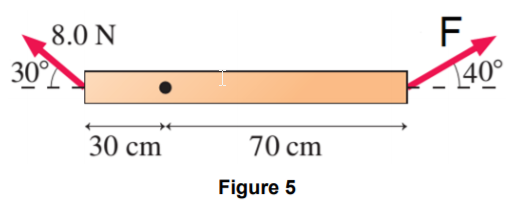
(a) Draw a free body diagram, showing all horizontal and vertical forces acting on the bar.
(b) Calculate the acting force F on the bar in N.
(c) Calculate the angular acceleration in rad/s2 if the moment of inertia of the bar's is 0.5 kg.m?
Homework Answers

Add Answer to:
The bar shown in figure below can rotate around the axis indicated by the dot counter clockwise.
In the figure below, the bar has moment of inertia 0.4 Kgm^2 and is spinning clockwise,...
 In the figure below, the bar has moment of inertia 0.4 Kgm^2 and is spinning clockwise, around an axis passing through the depicted point and perpendicular to the plane of the page, with angular speed of 10 1/s (or 10 rad/s). The 4 N depicted force, generates a constant torque (which slows down the bar rotation) for 2 seconds. Calculate the magnitude of the applied torque. Calculate the angular speed of the torque at t = 2 s.
For the mechanism shown below, WAB = 3 rad/s counter clockwise and QAB = 14 rad/s2...
 For the mechanism shown below, WAB = 3 rad/s counter clockwise and QAB = 14 rad/s2 counter clockwise. Calculate the angular velocity of BCD (WBCD) if the horizontal distances ABx = 290 mm, BCx = 590 mm, CDx = 170 mm and DEx = 290 mm. 400 mm 600 mm 500 mm AT A BCx AB, 1 CD, DE Answer: -2.73 rad/s (Continued from the previous question) For the mechanism above, calculate the angular acceleration of BCD (asco). Answer: Check...
A rigid system is made of three rods fastened together in the form of letter H (see figure). Two ...
 A rigid system is made of three rods fastened together in the form of letter H (see figure). Two rods (A and B) are identical with length hA, radius rA and mass mA. The central rod (C) has length hc radius rc and mass mc The system is free to rotate in the horizontal xy plane around the vertical z axis passing through the centre of the system. Identify the moment of inertia of the rigid system 12 mc, Consider...
In the figure below a cylinder having a mass of 3.0 kg can rotate about its...
In the figure below a cylinder having a mass of 3.0 kg can rotate about its central axis through point O. Forces are applied as shown: 1 = 3.0 N, 2 = 2.0 N, 3 = 1.0 N, and 4 = 2.0 N. Also, r = 5.0 cm and R = 12 cm. Find the magnitude and direction of the angular acceleration of the cylinder. (During the rotation, the forces maintain their same angles relative to the cylinder.) magnitude ___...
A uniform wooden bar (M = 6.81 kg, L = 51.2 cm) is free to rotate...
 A uniform wooden bar (M = 6.81 kg, L = 51.2
cm) is free to rotate about a frictionless axis in the center. If
forceF1 = 40 N acts at angle
θ1 = 67o at distance L/3
from the left end, and force F2 = 89.1 N acting
at angle θ2 = 59.8o on the right
end, calculate α, the angular acceleration of the bar, in
rad/s2. The direction is given by the sign: positive if
it is counter-clockwise, and...
A uniform wooden bar (M = 6.81 kg, L = 51.2
cm) is free to rotate about a frictionless axis in the center. If
forceF1 = 40 N acts at angle
θ1 = 67o at distance L/3
from the left end, and force F2 = 89.1 N acting
at angle θ2 = 59.8o on the right
end, calculate α, the angular acceleration of the bar, in
rad/s2. The direction is given by the sign: positive if
it is counter-clockwise, and...
A square plate with sides 1.min length can rotate around an axle passing through its center...
 A square plate with sides 1.min length can rotate around an axle passing through its center of mass (CM) and perpendicular to its surface (see Figure below). There are four forces acting on the plate at different points. The rotational inertia of the plate is 16 kg ml. Use the values given in the figure to answer the following questions (Assume 0 400 Express your answers in vector form) 1200N 400N (a) What is the net torque acting on the...
Problem 3 A 60.0-kgrunner runs clockwise around the edge of a horizontal turntable mounted on a...
 Problem 3 A 60.0-kgrunner runs clockwise around the edge of a horizontal turntable mounted on a vertical, frictionless axis through its center. The runner's velocity relative to the ground has magnitude 2.00 m/s. The turntable is rotating in the opposite direction (counterclockwise) with an angular velocity of magnitude 0.300 rad/s relative to the ground. The radius of the turntable is 2.90 m, and its moment of inertia about the axis of rotation is 80.0 kg m2. Questions 4 and 5...
Learning Goal: To understand and apply the formula τ=Iα to rigid objects rotating about a fixed axis. To fin...
 Learning Goal:
To understand and apply the formula
τ=Iα to rigid objects rotating about a
fixed axis.
To find the acceleration a of a particle of mass
m, we use Newton's second law: F⃗
net=ma⃗ , where F⃗ net is the net force
acting on the particle.
To find the angular acceleration α of a rigid object
rotating about a fixed axis, we can use a similar formula:
τnet=Iα, where τnet=∑τ
is the net torque acting on the object and...
Learning Goal:
To understand and apply the formula
τ=Iα to rigid objects rotating about a
fixed axis.
To find the acceleration a of a particle of mass
m, we use Newton's second law: F⃗
net=ma⃗ , where F⃗ net is the net force
acting on the particle.
To find the angular acceleration α of a rigid object
rotating about a fixed axis, we can use a similar formula:
τnet=Iα, where τnet=∑τ
is the net torque acting on the object and...
The moment of inertia of the human body about an axis through its center of mass is important in the application of bio...
 The moment of inertia of the human body about an axis through
its center of mass is important in the application of biomechanics
to sports such as diving and gymnastics. We can measure the body's
moment of inertia in a particular position while a person remains
in that position on a horizontal turntable, with the bodys center
of mass on the turntable's rotational axis. The turntable with the
person on it is then accelerated from rest by a torque that...
The moment of inertia of the human body about an axis through
its center of mass is important in the application of biomechanics
to sports such as diving and gymnastics. We can measure the body's
moment of inertia in a particular position while a person remains
in that position on a horizontal turntable, with the bodys center
of mass on the turntable's rotational axis. The turntable with the
person on it is then accelerated from rest by a torque that...
Consider a turntable to be a circular disk of moment of inertia 0.142 kg⋅m2 rotating at...
Consider a turntable to be a circular disk of moment of inertia 0.142 kg⋅m2 rotating at a constant angular velocity 4.80 rad/s2 around an axis through the center and perpendicular to the plane of the disk (the disk's "primary axis of symmetry"). The axis of the disk is vertical and the disk is supported by frictionless bearings. The motor of the turntable is off, so there is no external torque being applied to the axis. Another disk (a record) is...
 In the figure below, the bar has moment of inertia 0.4 Kgm^2 and is spinning clockwise, around an axis passing through the depicted point and perpendicular to the plane of the page, with angular speed of 10 1/s (or 10 rad/s). The 4 N depicted force, generates a constant torque (which slows down the bar rotation) for 2 seconds. Calculate the magnitude of the applied torque. Calculate the angular speed of the torque at t = 2 s.
 For the mechanism shown below, WAB = 3 rad/s counter clockwise and QAB = 14 rad/s2 counter clockwise. Calculate the angular velocity of BCD (WBCD) if the horizontal distances ABx = 290 mm, BCx = 590 mm, CDx = 170 mm and DEx = 290 mm. 400 mm 600 mm 500 mm AT A BCx AB, 1 CD, DE Answer: -2.73 rad/s (Continued from the previous question) For the mechanism above, calculate the angular acceleration of BCD (asco). Answer: Check...
 A rigid system is made of three rods fastened together in the form of letter H (see figure). Two rods (A and B) are identical with length hA, radius rA and mass mA. The central rod (C) has length hc radius rc and mass mc The system is free to rotate in the horizontal xy plane around the vertical z axis passing through the centre of the system. Identify the moment of inertia of the rigid system 12 mc, Consider...
 A uniform wooden bar (M = 6.81 kg, L = 51.2
cm) is free to rotate about a frictionless axis in the center. If
forceF1 = 40 N acts at angle
θ1 = 67o at distance L/3
from the left end, and force F2 = 89.1 N acting
at angle θ2 = 59.8o on the right
end, calculate α, the angular acceleration of the bar, in
rad/s2. The direction is given by the sign: positive if
it is counter-clockwise, and...
A uniform wooden bar (M = 6.81 kg, L = 51.2
cm) is free to rotate about a frictionless axis in the center. If
forceF1 = 40 N acts at angle
θ1 = 67o at distance L/3
from the left end, and force F2 = 89.1 N acting
at angle θ2 = 59.8o on the right
end, calculate α, the angular acceleration of the bar, in
rad/s2. The direction is given by the sign: positive if
it is counter-clockwise, and...
 A square plate with sides 1.min length can rotate around an axle passing through its center of mass (CM) and perpendicular to its surface (see Figure below). There are four forces acting on the plate at different points. The rotational inertia of the plate is 16 kg ml. Use the values given in the figure to answer the following questions (Assume 0 400 Express your answers in vector form) 1200N 400N (a) What is the net torque acting on the...
 Problem 3 A 60.0-kgrunner runs clockwise around the edge of a horizontal turntable mounted on a vertical, frictionless axis through its center. The runner's velocity relative to the ground has magnitude 2.00 m/s. The turntable is rotating in the opposite direction (counterclockwise) with an angular velocity of magnitude 0.300 rad/s relative to the ground. The radius of the turntable is 2.90 m, and its moment of inertia about the axis of rotation is 80.0 kg m2. Questions 4 and 5...
 Learning Goal:
To understand and apply the formula
τ=Iα to rigid objects rotating about a
fixed axis.
To find the acceleration a of a particle of mass
m, we use Newton's second law: F⃗
net=ma⃗ , where F⃗ net is the net force
acting on the particle.
To find the angular acceleration α of a rigid object
rotating about a fixed axis, we can use a similar formula:
τnet=Iα, where τnet=∑τ
is the net torque acting on the object and...
Learning Goal:
To understand and apply the formula
τ=Iα to rigid objects rotating about a
fixed axis.
To find the acceleration a of a particle of mass
m, we use Newton's second law: F⃗
net=ma⃗ , where F⃗ net is the net force
acting on the particle.
To find the angular acceleration α of a rigid object
rotating about a fixed axis, we can use a similar formula:
τnet=Iα, where τnet=∑τ
is the net torque acting on the object and...
 The moment of inertia of the human body about an axis through
its center of mass is important in the application of biomechanics
to sports such as diving and gymnastics. We can measure the body's
moment of inertia in a particular position while a person remains
in that position on a horizontal turntable, with the bodys center
of mass on the turntable's rotational axis. The turntable with the
person on it is then accelerated from rest by a torque that...
The moment of inertia of the human body about an axis through
its center of mass is important in the application of biomechanics
to sports such as diving and gymnastics. We can measure the body's
moment of inertia in a particular position while a person remains
in that position on a horizontal turntable, with the bodys center
of mass on the turntable's rotational axis. The turntable with the
person on it is then accelerated from rest by a torque that...
Most questions answered within 3 hours.
-
Where is the error in this code sequence?
String s1 = "Hello";
String s2 = "ello";...
asked 10 months ago -
Financial data for Joel de Paris, Inc., for last year
follow:
Joel de Paris, Inc.
Balance...
asked 10 months ago -
Consider this reaction:
Al2(SO4)3 (aq)+ BaCl3
(aq) Al2Cl6 (aq)- +
3BaSO4(s) . What is the...
asked 10 months ago -
Suppose that Savneet is considering increasing her
recent random sample from 20 car rentals to 40...
asked 10 months ago -
Trucks arrive at an unloading terminal at an average rate of 120
per hour.
Trucks arrive...
asked 10 months ago -
Why are methanol and ethanol completely soluble in water while
octanol is not very little soluble....
asked 10 months ago -
A facilities manager at a university reads in a research report
that the mean amount of...
asked 10 months ago -
When the CuSO4 is rehydrated by adding water to the anhydrous
compound, is this an endothermic...
asked 10 months ago -
A ray of sunlight is passing from diamond into crown glass; the
angle of incidence is...
asked 10 months ago -
A block of mass 0.249 kg is placed on top of a light, vertical
spring of...
asked 10 months ago -
how do the kidneys compensate in the presences of acidosis
a) trigger hyperventilate
b) reserve acid...
asked 10 months ago -
Question 501 pts
The rental rate of capital to the firm increases. Which of the
following...
asked 10 months ago