Engineering Thermodynamics
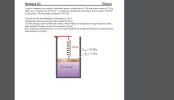
Figure P1.30 (attached) shows a gas contained in a vertical piston-cylinder assembly. A vertical shaft whose cross-sectional area is0.8 cm2 is attached to the top of the piston. Determine the magnitude, F, of the force acting on the shaft, in N, required if the gas pressure is 3 bar. The masses of the piston and attached shaft are 24.5kg and 0.5kg respectively. The piston diameter is 10cm. The local atmospheric pressure is 1 bar. The piston moves smoothly in the cylinder and g=9.81 m/s2

Homework Answers
Draw the free body diagram of the piston and the shaft together.

Consider the equilibrium of forces along the vertical direction.


 …… (1)
Here,  is the external force acting on the shaft,
  is the force due to atmospheric pressure,
  is the weight of the piston and the shaft together,
 is the gas pressure,
  is the cross sectional area of the piston,
  is the atmospheric pressure,
  is the cross sectional area of the shaft,
  is the mass of the piston,
  is the mass of the shaft, and
  is the acceleration due to gravity.
Calculate the cross sectional area of the piston.

Here,  is the diameter of the piston.
Substitute 0.1 m (10 cm) for 

Convert the units of gas pressure from bar to N/m2.

Convert the units of atmospheric pressure from bar to N/m2.

Substitute  for
for 
 for
for 
 for
for 
 for
for  24.5 kg for
  0.5 kg for
  and
and  for
for  in equation (1).

Therefore, the force acting on the shaft is .
.
Thermodynamics: Vertical shaft, piston and a gas, Determine heat transfer
 Figure P2.70 shows a gas contained in a vertical piston-cylinder assembly. A vertical shaft whose cross-sectional area is 0.8 cm2 is attached to the top of the piston. The total mass of the piston and shaft is 25 kg. while the gas is slowly heated, the internal energy of the gas increases by 0.1 kJ, the potential energy of the piston-shaft combination increases by 0.2 kJ, and a force of 1334 N is exerted on the shaft as shown in...
Problem 2.054 SI The figure below shows a gas contained in a vertical piston-cylinder assembly, where...
 Problem 2.054 SI The figure below shows a gas contained in a vertical piston-cylinder assembly, where D = 15 cm. A vertical shaft whose cross-sectional area is 0.8 cm is attached to the top of the piston. The total mass of the piston and shaft is 25 kg. While the gas is slowly heated, the internal energy of the gas increases by 0.1 k), the potential energy of the piston-shaft combination increases by 0.2 k), and a force of F...
thermodynamics question
 A gas is contained in a vertical, frictionless piston–cylinder device. The piston has a mass of 3.2 kg
and a cross sectional area of 35 cm2
. A compressed spring above the piston exerts a force of 150 N
on the piston. The atmospheric pressure is 95 kPa.
A gas is contained in a vertical, frictionless piston–cylinder device. The piston has a mass of 3.2 kg
and a cross sectional area of 35 cm2
. A compressed spring above the piston exerts a force of 150 N
on the piston. The atmospheric pressure is 95 kPa.
Thermodynamics: Work & Heat Transfer in Piston-Cylinder
 for part a) got W = 4kJ, dQ = 4.25 kJfor part b) got w = 2kJ...How do you find ΔPE without mass? Do you use the conservation of energy equation?As shown in Fig. P2.56, a gas contained within a piston–cylinder assembly, initially at a volume of 0.1 m3, undergoesa constant-pressure expansion at 2 bar to a final volume of0.12 m3, while being slowly heated through the base. Thechange in internal energy of the gas is 0.25 kJ. The pistonand...
finding work and heat transfer given a piston-cylinder assembly
 As shown in Fig. P2.56, a gas contained within a piston–cylinder assembly, initially at a volume of 0.1 m3, undergoesa constant-pressure expansion at 2 bar to a final volume of0.12 m3, while being slowly heated through the base. Thechange in internal energy of the gas is 0.25 kJ. The pistonand cylinder walls are fabricated from heat-resistant material,and the piston moves smoothly in the cylinder. The localatmospheric pressure is 1 bar.(a) For the gas as the system, evaluate work and heat...
As shown in the figure below, 0.5 kg of water is contained within a piston-cylinder assembly...
 As shown in the figure below, 0.5 kg of water is contained within a piston-cylinder assembly at 100°C. The piston has a mass of 90 kg and is free to move smoothly in the cylinder. The local atmospheric pressure and acceleration of gravity are 100 kPa and 9.81 m/s2, respectively. g=9.81 m/s2 Patm = 100 kPa Piston Water at 100°C A = 0.01 m2 For the water, determine the pressure, in kPa, and volume, in cm?
Help I System Announcements is ul Englheering Thermodynamics, 9e PRINTER VERSION BACK NEXT Problem 2.045 SI...
 Help I System Announcements is ul Englheering Thermodynamics, 9e PRINTER VERSION BACK NEXT Problem 2.045 SI As shown in the figure below, a gas contained within a piston-cylinder assembly, initially at a volume of 0.1 m3, undergoes a expansion at p 3 bar to a final volume of V2 - 0.16 m3, while being slowly heated through the base. The change in internal energy of the gas is 0.25 KJ. The piston and cylinder walls are fabricated from heat-resistant material,...
A gas is contained in a vertical, frictionless piston-cylinder device. The piston has a mass of...
 A gas is contained in a vertical, frictionless piston-cylinder device. The piston has a mass of 3.2 kg and a cross-sectional area of 35 cm2. A compressed spring above the piston exerts a force of 110 N on the piston. If the atmospheric pressure is 95 kPa, determine the pressure inside the cylinder. The pressure inside the cylinder is _______ kPa.
Question 5. (20 points) A gas is contained in a vertical frictionless piston-cylinder device. The piston...
 Question 5. (20 points) A gas is contained in a vertical frictionless piston-cylinder device. The piston has a mass of 2.9 kg and cross-sectional area of 40 cm2. A compressed spring above the piston exerts a force of 170 N on the piston. If the atmospheric pressure is 97 kPa, determine the pressure inside the cylinder
Problem 2. As shown in the figure, a gas contained within a piston-cylinder assembly, initially at...
 Problem 2. As shown in the figure, a gas contained within a piston-cylinder assembly, initially at a volume of 0.1 m3, undergoes a constant-pressure expansion at 2 bar to a final volume of 0.12 m3, while being slowly heated through the base. The change in internal energy of the gas is 0.25 kJ. The piston and cylinder walls are fabricated fronm heat-resistant material, and the piston moves smoothly in the cylinder. The local atmospheric pressure is 1 bar. (a) For...
 Problem 2.054 SI The figure below shows a gas contained in a vertical piston-cylinder assembly, where D = 15 cm. A vertical shaft whose cross-sectional area is 0.8 cm is attached to the top of the piston. The total mass of the piston and shaft is 25 kg. While the gas is slowly heated, the internal energy of the gas increases by 0.1 k), the potential energy of the piston-shaft combination increases by 0.2 k), and a force of F...
 As shown in the figure below, 0.5 kg of water is contained within a piston-cylinder assembly at 100°C. The piston has a mass of 90 kg and is free to move smoothly in the cylinder. The local atmospheric pressure and acceleration of gravity are 100 kPa and 9.81 m/s2, respectively. g=9.81 m/s2 Patm = 100 kPa Piston Water at 100°C A = 0.01 m2 For the water, determine the pressure, in kPa, and volume, in cm?
 Help I System Announcements is ul Englheering Thermodynamics, 9e PRINTER VERSION BACK NEXT Problem 2.045 SI As shown in the figure below, a gas contained within a piston-cylinder assembly, initially at a volume of 0.1 m3, undergoes a expansion at p 3 bar to a final volume of V2 - 0.16 m3, while being slowly heated through the base. The change in internal energy of the gas is 0.25 KJ. The piston and cylinder walls are fabricated from heat-resistant material,...
 Question 5. (20 points) A gas is contained in a vertical frictionless piston-cylinder device. The piston has a mass of 2.9 kg and cross-sectional area of 40 cm2. A compressed spring above the piston exerts a force of 170 N on the piston. If the atmospheric pressure is 97 kPa, determine the pressure inside the cylinder
 Problem 2. As shown in the figure, a gas contained within a piston-cylinder assembly, initially at a volume of 0.1 m3, undergoes a constant-pressure expansion at 2 bar to a final volume of 0.12 m3, while being slowly heated through the base. The change in internal energy of the gas is 0.25 kJ. The piston and cylinder walls are fabricated fronm heat-resistant material, and the piston moves smoothly in the cylinder. The local atmospheric pressure is 1 bar. (a) For...
Most questions answered within 3 hours.
-
Where is the error in this code sequence?
String s1 = "Hello";
String s2 = "ello";...
asked 11 months ago -
Financial data for Joel de Paris, Inc., for last year
follow:
Joel de Paris, Inc.
Balance...
asked 11 months ago -
Consider this reaction:
Al2(SO4)3 (aq)+ BaCl3
(aq) Al2Cl6 (aq)- +
3BaSO4(s) . What is the...
asked 11 months ago -
Suppose that Savneet is considering increasing her
recent random sample from 20 car rentals to 40...
asked 11 months ago -
Trucks arrive at an unloading terminal at an average rate of 120
per hour.
Trucks arrive...
asked 11 months ago -
Why are methanol and ethanol completely soluble in water while
octanol is not very little soluble....
asked 11 months ago -
A facilities manager at a university reads in a research report
that the mean amount of...
asked 11 months ago -
When the CuSO4 is rehydrated by adding water to the anhydrous
compound, is this an endothermic...
asked 11 months ago -
A ray of sunlight is passing from diamond into crown glass; the
angle of incidence is...
asked 11 months ago -
A block of mass 0.249 kg is placed on top of a light, vertical
spring of...
asked 11 months ago -
how do the kidneys compensate in the presences of acidosis
a) trigger hyperventilate
b) reserve acid...
asked 11 months ago -
Question 501 pts
The rental rate of capital to the firm increases. Which of the
following...
asked 11 months ago