Chapter 8—Intrapartum assessment and interventions As the nurse, you admit Margarite Sanchez to the labor and...
Chapter 8—Intrapartum assessment and interventions
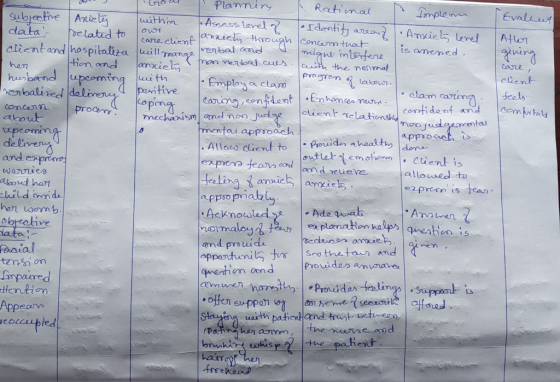
As the nurse, you admit Margarite Sanchez to the labor and delivery unit. She arrived in the triage unit at midnight in early labor. She presented with uterine contractions that were 5 minutes apart for 3 hours. The patient is a 28-year-old G3 P1011 Hispanic woman. She is at 39 weeks’ gestation. José, her husband, has accompanied her to the unit. Two years ago, she had a normal spontaneous vaginal delivery after an 18-hour labor for a baby girl, Sonya, who weighed 7 lb, 3 oz. Margarite’s cervix is now 4 cm/80%/0 station, and the fetal position is left occiput anterior.
Prenatal Labs:
- Blood type O+
- RPR NR
- GBS negative
- Hgb 11.7
- Hct 4
- Hepatitis negative
Vital signs:
- Blood pressure 110/60
- pulse 84 bpm
- respiratory rate 18
- temperature 98.6°F (37°C)
Margarite received regular prenatal care, beginning at 10 weeks of gestation. She gained 22 lb during pregnancy, and her current weight is 164 lb. She is 5 ft, 4 in. tall. She has no prior medical complications and has experienced a normal pregnancy. Her first pregnancy ended in miscarriage at 8 weeks’ gestation. She has no allergies to food or medication. She does not have a birth plan and says, “I just hope for a normal delivery and a healthy baby.”
- Detail the aspects of your initial assessment.
Electronic fetal monitoring reveals an FHR pattern that is normal, category I, with an FHR baseline in the 140s, with moderate variability. Margarite is uncomfortable with the contractions and rates her pain at 5. She requests ambulation, because she feels more comfortable walking.
At 1:20 a.m., she has a spontaneous rupture of membranes (SROM), releasing a large amount of clear amniotic fluid. FHR baseline is in the 130s, with moderate variability, and accelerations and contractions are every 3 minutes and feel moderate when palpitated. Her sterile vaginal examination (SVE) reveals that her cervix is 5 cm/90%/0 station. She is very uncomfortable with the contractions but does not want pain medication at this time. José appears anxious and at a loss as to how to help his wife.
- What are your immediate priorities in nursing care for Margarite and José Sanchez?
- Discuss the rationale for the priorities.
- What teaching would you include?
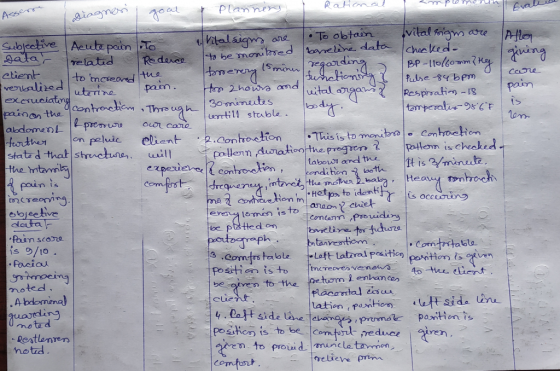
- Discuss nursing diagnosis, expected outcome, and interventions related to managing Margarite’s labor pain.
- What are appropriate nonpharmacological interventions for managing Margarite’s labor pain?
At 2 a.m., Margarite is increasingly uncomfortable with contractions and cries out that she can no longer take the pain. Her cervical examination reveals that her cervix is 6 cm/100%/0 station. She requests pain medication and is given a dose of Nubain at 2:15 a.m. for pain relief in active labor. José asks how much longer the labor will be and when the baby will be born.
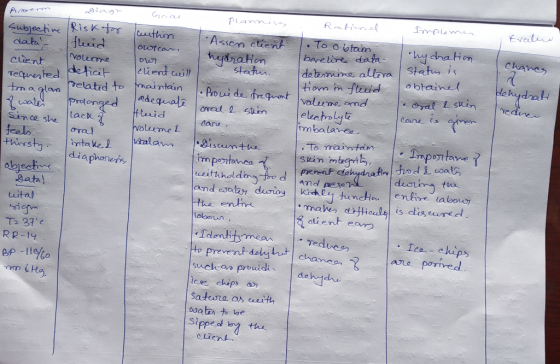
- Provide details of what you include in your ongoing assessment.
- What are your current priorities in nursing care for Margarite Sanchez?
- Discuss the rationale for your priorities.
10. State (3) nursing diagnosis, expected outcome, and interventions related to this problem.
Homework Answers
Add Answer to:
Chapter 8—Intrapartum assessment and
interventions
As the nurse, you admit Margarite Sanchez to the labor and...
Labor and delivery Scenario At 0830 hrs. - Leanne arrived by car to your unit, with her...
Labor and delivery Scenario At 0830 hrs. - Leanne arrived by car to your unit, with her husband George and her mother Catherine. She states the membranes ruptured at 0800 hrs and is feeling uncomfortable With contractions that started at 0500 hrs. She is G1 P0 A0, Her LMP was April 2nd 2019. The Ultrasound and dates confirmed her. EDD to be January 9th; making her 40+1 today. Leanne last ate at 1800 hrs the night before and has been drinking...
Prepare a nursing care plan for a client with a condition described as preterm labor secondary...
Prepare a nursing care plan for a client with a condition described as preterm labor secondary to PROM Formulate nursing diagnoses and nursing care interventions related to the physiologic, psychologic and emotional aspects of the pregnant client with preterm labor and PROM both actual and potential problems Establish expected outcomes to meet the needs of the pregnant client with preterm labor and PROM Establish criteria to evaluate the effectiveness of nursing interventions enumerated. Mechanics From a hypothetical case scenario: A...
Postpartum Case Study
As the nurse, you admit Margarite Sanchez to the postpartum unit at 10:50 am, and receive the transfer report from Labor and Delivery stating the following:Patient is a 28 year old G3 P2 Hispanic woman, who gave birth at 8:39 a.m., vaginal delivery with a second-degree laceration.She received 2 doses of Nubain in labor at 2:15 am, and 4:40 am, for pain relief in active labor.Both mother and baby are stable.The mother's bleeding in labor and delivery was moderate.VS 120/68-72-20-98.2MS....
From a hypothetical case scenario: A 22-year-old woman presents to the hospital at 34 weeks gestation....
From a hypothetical case scenario: A 22-year-old woman presents to the hospital at 34 weeks gestation. She is G1P1. It was an uncomplicated pregnancy until 12 hours prior to admission, she experienced escape of fluid from the vagina, non-foul smelling. She developed fever (38.2 degrees centigrade) around 6 hours prior to admission and she currently experiencing mild to moderate uterine contractions. She was started on antimicrobial treatment per IV. FHR is 118 bpm, RR=28 PR=90 BP= 110/70 Identify at least...
A 22-year-old woman presents to the hospital at 34 weeks gestation. She is G1P1. It was...
A 22-year-old woman presents to the hospital at 34 weeks gestation. She is G1P1. It was an uncomplicated pregnancy until 12 hours prior to admission, she experienced escape of fluid from the vagina, non-foul smelling. She developed fever (38.2 degrees centigrade) around 6 hours prior to admission and she currently experiencing mild to moderate uterine contractions. She was started on antimicrobial treatment per IV. FHR is 118 bpm, RR=28 PR=90 BP= 110/70 Identify at least 2 -3 actual nursing problems...
A 22-year-old woman presents to the hospital at 34 weeks gestation. She is G1P1. It was...
A 22-year-old woman presents to the hospital at 34 weeks gestation. She is G1P1. It was an uncomplicated pregnancy until 12 hours prior to admission, she experienced escape of fluid from the vagina, non-foul smelling. She developed fever (38.2 degrees centigrade) around 6 hours prior to admission and she currently experiencing mild to moderate uterine contractions. She was started on antimicrobial treatment per IV. FHR is 118 bpm, RR=28 PR=90 BP= 110/70 2. Identify 1 Actual problem AND 1 potential...
A 22-year-old woman presents to the hospital at 34 weeks gestation. She is G1P1. It was...
A 22-year-old woman presents to the hospital at 34 weeks gestation. She is G1P1. It was an uncomplicated pregnancy until 12 hours prior to admission, she experienced escape of fluid from the vagina, non-foul smelling. She developed fever (38.2 degrees centigrade) around 6 hours prior to admission and she currently experiencing mild to moderate uterine contractions. She was started on antimicrobial treatment per IV. FHR is 118 bpm, RR=28 PR=90 BP= 110/70 2. Identify 1 Actual problem AND 1 potential...
L&D Scenario At 0830 hrs. - Leanne arrived by car to your unit, with her husband...
L&D Scenario At 0830 hrs. - Leanne arrived by car to your unit, with her husband George and her mother Catherine. She states the membranes ruptured at 0800 hrs and is feeling uncomfortable With contractions that started at 0500 hrs. She is G1 P0 A0, Her LMP was April 2nd 2019. The Ultrasound and dates confirmed her. EDD to be January 9th; making her 40+1 today. Leanne last ate at 1800 hrs the night before and has been drinking clear...
Essentials of Maternity, Newborn, and Women's Health Nursing Chapter 14: Nursing Management During Labor and Birth...
Essentials of Maternity, Newborn, and Women's Health Nursing Chapter 14: Nursing Management During Labor and Birth 1. Desiree, a 28-year-old G2P1, is admitted to the labor and birth unit. Her birth plan indicates that she is planning natural childbirth without pharmacological interventions. She has attended childbirth education classes. Desiree is considered low risk based on her personal and family health history and physical exam. Her pregnancy has progressed without complications. She is approximately 38 weeks pregnant. Vaginal assessment reveals cervical...
L&D Scenario At 0830 hrs. - Leanne arrived by car to your unit, with her husband...
L&D Scenario At 0830 hrs. - Leanne arrived by car to your unit, with her husband George and her mother Catherine. She states the membranes ruptured at 0800 hrs and is feeling uncomfortable With contractions that started at 0500 hrs. She is G1 P0 A0, Her LMP was April 2nd 2019. The Ultrasound and dates confirmed her. EDD to be January 9th; making her 40+1 today. Leanne last ate at 1800 hrs the night before and has been drinking clear...
Most questions answered within 3 hours.
-
Where is the error in this code sequence?
String s1 = "Hello";
String s2 = "ello";...
asked 10 months ago -
Financial data for Joel de Paris, Inc., for last year
follow:
Joel de Paris, Inc.
Balance...
asked 10 months ago -
Consider this reaction:
Al2(SO4)3 (aq)+ BaCl3
(aq) Al2Cl6 (aq)- +
3BaSO4(s) . What is the...
asked 10 months ago -
Suppose that Savneet is considering increasing her
recent random sample from 20 car rentals to 40...
asked 10 months ago -
Trucks arrive at an unloading terminal at an average rate of 120
per hour.
Trucks arrive...
asked 10 months ago -
Why are methanol and ethanol completely soluble in water while
octanol is not very little soluble....
asked 10 months ago -
A facilities manager at a university reads in a research report
that the mean amount of...
asked 10 months ago -
When the CuSO4 is rehydrated by adding water to the anhydrous
compound, is this an endothermic...
asked 10 months ago -
A ray of sunlight is passing from diamond into crown glass; the
angle of incidence is...
asked 10 months ago -
A block of mass 0.249 kg is placed on top of a light, vertical
spring of...
asked 10 months ago -
how do the kidneys compensate in the presences of acidosis
a) trigger hyperventilate
b) reserve acid...
asked 10 months ago -
Question 501 pts
The rental rate of capital to the firm increases. Which of the
following...
asked 10 months ago