You are a nurse on a medical-surgical unit in a hospital caring for a 68-year-old brick mason who had surgery 2 days ago...
You are a nurse on a medical-surgical unit in a hospital caring for a 68-year-old brick mason who had surgery 2 days ago for repair both of his knees. The surgery went smoothly and you are responsible for his postoperative care. He will have limited weight-bearing on both legs until his first follow up with the physician. Physical therapy will be working with this patient.
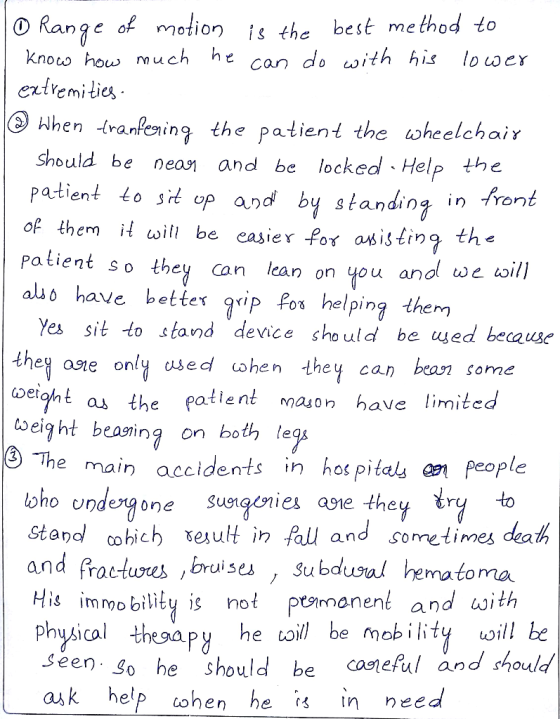
1) What assessments do you need to do to determine the best method of transfer for this patient from bed to chair?
2)What type of equipment might you use to transfer this patient? Would a sit-to-stand be possible? How would you keep yourself as staff safe in doing this transfer?
3)What teaching points could you provide to the patient about his immobility and risk prevention?
4) Identify a nursing diagnosis, goal and 2 interventions.
Homework Answers

Add Answer to:
You are a nurse on a medical-surgical unit in a hospital caring for a 68-year-old brick mason who had surgery 2 days ago...
You are a nurse in a medical–surgical unit in a hospital caring for a 68-year-old brick...
You are a nurse in a medical–surgical unit in a hospital caring for a 68-year-old brick mason who returned to your floor after surgery to repair both knees 2 days ago. The surgery went smoothly and you are responsible for his postoperative care. a. What activity assessments are instrumental to determine the best method to transfer this patient from bed to chair? b. How can tubes, IV lines, incisions, and medical equipment affect the patient positioning procedure? c. Outline the rationale for encouraging your...
You are a nurse in a medical–surgical hospital unit caring for a patient who had an...
You are a nurse in a medical–surgical hospital unit caring for a patient who had an open cholecystectomy 3 days earlier. Subsequently, the patient developed a parlay tic ileus. Additional complications require continued postoperative antibiotic infusions. a. What nursing assessment finding could indicate the presence of a paralytic ileus? b. Which medical interventions could have contributed to the development of your patient’s paralytic ileus? c. How long would you expect the paralytic ileus to last? d. In what ways would you expect a...
You are a nurse in a medical–surgical hospital unit caring for a patient who had an...
You are a nurse in a medical–surgical hospital unit caring for a patient who had an open cholecystectomy 3 days earlier. Subsequently, the patient developed a parlay tic ileus. Additional complications require continued postoperative antibiotic infusions. a. What nursing assessment finding could indicate the presence of a paralytic ileus? b. Which medical interventions could have contributed to the development of your patient’s paralytic ileus? c. How long would you expect the paralytic ileus to last? d. In what ways would you expect a...
You are the nurse caring for Mr. Noah Poupe, a patient on a medical-surgical acute care...
You are the nurse caring for Mr. Noah Poupe, a patient on a medical-surgical acute care unit. Mr. Poupe is 3 days post-op from an appendectomy. You perform an assessment of Mr. Poupe. You find he has decreased PO intake, absent bowel sounds, and no reports of flatus. His last BM was 4 days before surgery. Today, he has been experiencing bouts of N/V without relief, despite receiving anti-emetics. 1. What is your main concern for Mr. Poupe? (Hint: Pick...
You as a nurse are caring for a 62-year old male patient in the hospital who...
You as a nurse are caring for a 62-year old male patient in the hospital who has an exacerbation of his emphysema. The patient currently takes the following medications lorazepam, Xanax, Cardizem, Flonase, prednisone, Advair, aspirin and uses 2 L of O2 via NC. Based off these medications what other medical conditions do you think has? How do these medical conditions impact this patients emphysema? What diagnostics would you want to see on this patient and why? What nursing interventions...
Musculoskeletal Nursing The nurse is caring for a patient who has had blood work done. Lab...
Musculoskeletal Nursing The nurse is caring for a patient who has had blood work done. Lab results show significantly elevated sed rate (ESR) and the presence of rheumatoid factor (RF). Which of the following illnesses is suspected when these findings are present? A. osteoporosis B. rheumatoid arthritis C. gout D. osteoarthritis The nurse caring for a 55 year old client who is undergoing a total hip arthroplasty. The client is aware that there will be activity...
You are a nurse working in a hospital. You are caring for a newly admitted 70-year-old...
You are a nurse working in a hospital. You are caring for a newly admitted 70-year-old man who has a diagnosis of pneumonia. He has a productive cough and decreased lung sounds in the bases of his lungs. His oxygen saturation is 92% on 3L of oxygen via NC. While completing the nursing admission history you learn he has a history of smoking one pack of cigarettes per day for 53 years; although he tries to eat well, his source...
You are a nurse working in a hospital. You are caring for a newly admitted 70-year-old...
You are a nurse working in a hospital. You are caring for a newly admitted 70-year-old man who has a diagnosis of pneumonia. He has a productive cough and decreased lung sounds in the bases of his lungs. His oxygen saturation is 92% on 3L of oxygen via NC. While completing the nursing admission history you learn he has a history of smoking one pack of cigarettes per day for 53 years; although he tries to eat well, his source...
you as a nurse are caring for 62 year old Male patient in the hospital who has an exacerbation of his emphysema. the pat...
you as a nurse are caring for 62 year old Male patient in the hospital who has an exacerbation of his emphysema. the patient currently takes the following medications lorazepam, xanax, cardizem, flonase, prednisone, advair, aspirin and uses 2 L of 02 via NC. based off these medications what medical conditions do you think he has? how do these medical conditions impact this patient's emphysema?. what diagnostics would you want to see on this patient and why? what nursing interventions...
424. You are the nurse caring for 82 year old women in the PACU. The woman...
424. You are the nurse caring for 82 year old women in the PACU. The woman begins to awaken and responds to her name but is confused, restless and agitated. What are you aware of? A. Postoperative confusion is an indication of an oxygen problem or possibly a stroke during surgery. B. Confusion, restlessness, and agitation are normal postoperative findings and will diminish in time C. Postoperative confusion is common in the elderly, but it could also indicate a significant...
Most questions answered within 3 hours.
-
Where is the error in this code sequence?
String s1 = "Hello";
String s2 = "ello";...
asked 11 months ago -
Financial data for Joel de Paris, Inc., for last year
follow:
Joel de Paris, Inc.
Balance...
asked 11 months ago -
Consider this reaction:
Al2(SO4)3 (aq)+ BaCl3
(aq) Al2Cl6 (aq)- +
3BaSO4(s) . What is the...
asked 11 months ago -
Suppose that Savneet is considering increasing her
recent random sample from 20 car rentals to 40...
asked 11 months ago -
Trucks arrive at an unloading terminal at an average rate of 120
per hour.
Trucks arrive...
asked 11 months ago -
Why are methanol and ethanol completely soluble in water while
octanol is not very little soluble....
asked 11 months ago -
A facilities manager at a university reads in a research report
that the mean amount of...
asked 11 months ago -
When the CuSO4 is rehydrated by adding water to the anhydrous
compound, is this an endothermic...
asked 11 months ago -
A ray of sunlight is passing from diamond into crown glass; the
angle of incidence is...
asked 11 months ago -
A block of mass 0.249 kg is placed on top of a light, vertical
spring of...
asked 11 months ago -
how do the kidneys compensate in the presences of acidosis
a) trigger hyperventilate
b) reserve acid...
asked 11 months ago -
Question 501 pts
The rental rate of capital to the firm increases. Which of the
following...
asked 11 months ago