During a baseball game, a baseball is struck at ground level by a batter.
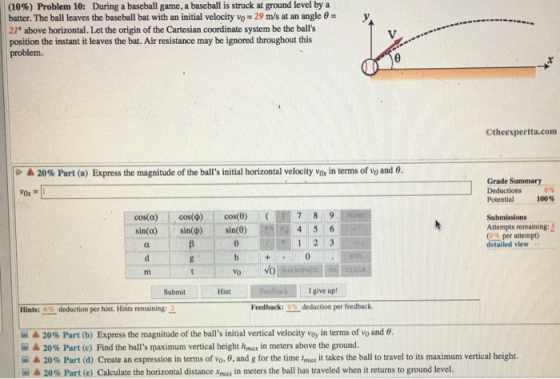
Problem 10: During a baseball game, a baseball is struck at ground level by a batter. The ball leaves the baseball bat with an initial velocity v0=29m/s at an angle θ= 21° above horizontal. Let the origin of the Cartesian coordinate system be the ball's position the instant it leaves the bat. Air resistance may be ignored throughout this. problem.
Homework Answers

Add Answer to:
During a baseball game, a baseball is struck at ground level by a batter.
A baseball slugger smacks a pitch and watches the ball float into the bleachers for a home run
 Problem 5: A baseball slugger smacks a pitch and watches the ball float into the bleachers for a home run, landing h=6.5m higher than it was struck. When visiting with the fan that caught the ball, he learned the ball was moving with final velocity vf= 39.15m/s at an angle θf=26.5° below horizontal when caught. Assume the ball encountered no air resistance, and use a Cartesian coordinate system with the origin located at the ball's initial position.Part (a) Create an...
A baseball slugger hits a pitch and watches the ball fly into the bleachers for a home run, landing h=8.5 m higher than it was struck
 A baseball slugger hits a pitch and watches the ball fly into the bleachers for a home run, landing h=8.5 m higher than it was struck. When visiting with the fan that caught the ball, he learned the ball was moving with final velocity vf= 39.45 m / s at an angle θf=29.5° below horizontal when caught. Assume the ball encountered no air resistance, and use a Cartesian coordinate system with the origin located at the ball's initial position.
A baseball is hit by the batter when the ball is 2.5 feet above the ground....
A baseball is hit by the batter when the ball is 2.5 feet above the ground. The ball leaves the bat with a velocity of 85 miles per hour at an angle of 50° above the horizontal. a. What is the maximum height of the baseball? b. When does the baseball reached its maximum height? c. If the ball does not hit anything, how many seconds is the ball in the air? d. If the ball does not hit anything,...
Water leaves a fireman's hose (held near the ground) with an initial velocity v0=19m/s at an angle θ=25°
 Problem 6: Water leaves a fireman's hose (held near the ground) with an initial velocity v0=19m/s at an angle θ=25° above horizontal Assume the water acts as a projectile that moves without air resistance. Use a Cartesian coordinate system with the. origin at the hose nozzle position.
A batter hits a baseball so that it leaves the bat at a speed of 32...
A batter hits a baseball so that it leaves the bat at a speed of 32 m/s at an angle 51 degrees to the horizontal. How far (in meters) from where it was struck will it land? Assume no air resistance and g=-9.8 m/s2 2DP? A motorcycle stunt rider rides off the edge of a 500 m cliff. Just at the edge, his velocity is horizontal, with magnitude 16 m/s. What is the magnitude of the motorcycle's velocity (in m/s)...
A baseball is thrown at an angle = 21° above the horizontal with an initial vertical velocity v0y = 9.75 m/s
 A baseball is thrown at an angle = 21° above the horizontal with an initial vertical velocity v0y = 9.75 m/s. Use a Cartesian coordinate system with the origin at the baseball's initial position.Part (a) Create an expression for the ball's initial horizontal velocity component, v0x, in terms of v0y, sin(θ), and cos(θ).Part (b) Calculate the initial horizontal velocity component, v0x in m/s. Part (c) Find the ball's initial velocity magnitude, v0 in m/s.
During a baseball game, a batter hits a pop-up. The ball goes straight upwards into the...
During a baseball game, a batter hits a pop-up. The ball goes straight upwards into the air and then comes back down to the ground in 6.0 seconds, calculate how fast the ball came off the bat and how high the ball went.
A batter hits a foul ball. The not-so-fast 0.140-kg baseball that was approaching him horizontally leaves...
A batter hits a foul ball. The not-so-fast 0.140-kg baseball that was approaching him horizontally leaves the bat at 30.0 m/s in the opposite direction, causing the ball's initial kinetic energy (i.e. the ball's kinetic energy before it was struck with the bat) to increase by 125%. What is the magnitude of the impulse delivered to the baseball?
A 125 g baseball is thrown at a speed of 127ft/sec at a batter, the ball...
A 125 g baseball is thrown at a speed of 127ft/sec at a batter, the ball is hit by 1.1 kg such that it leaves the bat horizontally from a point 3 feet above the ground it eventually hits the ground 100 ft from the batter. It is determined that the bat was moving at a speed of 50 ft/sec just after it hit the ball. a. How long did the baseball take to hit the ground? b. What is...
A baseball player hit a ball from the ground with a speed of 30 m/s and...
A baseball player hit a ball from the ground with a speed of 30 m/s and an angle of 36.9 above the horizontal. Ignore air resistance. What is the ball's velocity when it returns to the ground? when is the ball 10 m above the ground?
 Problem 5: A baseball slugger smacks a pitch and watches the ball float into the bleachers for a home run, landing h=6.5m higher than it was struck. When visiting with the fan that caught the ball, he learned the ball was moving with final velocity vf= 39.15m/s at an angle θf=26.5° below horizontal when caught. Assume the ball encountered no air resistance, and use a Cartesian coordinate system with the origin located at the ball's initial position.Part (a) Create an...
 A baseball slugger hits a pitch and watches the ball fly into the bleachers for a home run, landing h=8.5 m higher than it was struck. When visiting with the fan that caught the ball, he learned the ball was moving with final velocity vf= 39.45 m / s at an angle θf=29.5° below horizontal when caught. Assume the ball encountered no air resistance, and use a Cartesian coordinate system with the origin located at the ball's initial position.
 Problem 6: Water leaves a fireman's hose (held near the ground) with an initial velocity v0=19m/s at an angle θ=25° above horizontal Assume the water acts as a projectile that moves without air resistance. Use a Cartesian coordinate system with the. origin at the hose nozzle position.
Most questions answered within 3 hours.
-
Where is the error in this code sequence?
String s1 = "Hello";
String s2 = "ello";...
asked 10 months ago -
Financial data for Joel de Paris, Inc., for last year
follow:
Joel de Paris, Inc.
Balance...
asked 10 months ago -
Consider this reaction:
Al2(SO4)3 (aq)+ BaCl3
(aq) Al2Cl6 (aq)- +
3BaSO4(s) . What is the...
asked 10 months ago -
Suppose that Savneet is considering increasing her
recent random sample from 20 car rentals to 40...
asked 10 months ago -
Trucks arrive at an unloading terminal at an average rate of 120
per hour.
Trucks arrive...
asked 10 months ago -
Why are methanol and ethanol completely soluble in water while
octanol is not very little soluble....
asked 10 months ago -
A facilities manager at a university reads in a research report
that the mean amount of...
asked 10 months ago -
When the CuSO4 is rehydrated by adding water to the anhydrous
compound, is this an endothermic...
asked 10 months ago -
A ray of sunlight is passing from diamond into crown glass; the
angle of incidence is...
asked 10 months ago -
A block of mass 0.249 kg is placed on top of a light, vertical
spring of...
asked 10 months ago -
how do the kidneys compensate in the presences of acidosis
a) trigger hyperventilate
b) reserve acid...
asked 10 months ago -
Question 501 pts
The rental rate of capital to the firm increases. Which of the
following...
asked 10 months ago