Cathode-ray tubes (CRTs) are often found in oscilloscopes and computer monitors
Cathode-ray tubes (CRTs) are often found in oscilloscopes and computer monitors. In the figure (Figure 1)an electron with an initial speed of 6.30x10⁶ m/s is projected along the axis midway between the deflection plates of a cathode-ray tube. The potential difference between the two plates is 18.0 V and the lower plate is the one at higher potential.
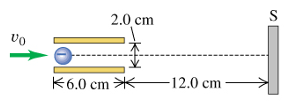
Part A
What is the magnitude of the force on the electron when it is between the plates?
Part B
What is the direction of the force on the electron when it is between the plates?
Upward
Downward
Part C
What is the magnitude of the acceleration of the electron when acted on by the force in part (a)?
Homework Answers
Concept: first we find out the electric field using the voltage and distance between plates, and then we use field to find the force and then we use Newton's law of motion to find the acceleration of the electron,

***************************************************************************************************
This concludes the answers. If there is any mistake,
let me know immediately and I will fix it....
Add Answer to:
Cathode-ray tubes (CRTs) are often found in oscilloscopes and computer monitors
Cathode-ray tubes (CRTS) are often found in oscilloscopes and computer monitors
 Cathode-ray tubes (CRTS) are often found in oscilloscopes and computer monitors. In (Figure 1) an electron with an initial speed of 6.90x10⁶ m/s is projected along the axis midway between the deflection plates of a cathode-ray tube. The potential difference between the two plates is 26.0 V and the lower plate is the one at higher potential. Part D What is the direction of the acceleration of the electron when acted on by the force in part A? Part E How far...
Cathode-ray tubes (CRTs) are often found in oscilloscopes and computer monitors
 Cathode-ray tubes (CRTs) are often found in oscilloscopes and computer monitors. In the figure (Figure 1)an electron with an initial speed of 7.00x10⁶ m/s is projected along the axis midway between the deflection plates of a cathode-ray tube. The potential difference between the two plates is 25.0 V and the lower plate is the one at higher potential. Part E How far below the axis has the electron moved when it reaches the end of the plates? Part FAt what angle with the...
what is part E,F? Cathode-ray tubes (CRTs) are often found in oscilloscopes and computer monitors. In...
 what
is part E,F?
Cathode-ray tubes (CRTs) are often found in oscilloscopes and computer monitors. In the figure (Figure 1)an electron with an initial speed of 7.00x10⁶ m/s is projected along the axis midway between the deflection plates of a cathode-ray tube. The potential difference between the two plates is 25.0 V and the lower plate is the one at higher potential. Part E How far below the axis has the electron moved when it reaches the end of the...
what
is part E,F?
Cathode-ray tubes (CRTs) are often found in oscilloscopes and computer monitors. In the figure (Figure 1)an electron with an initial speed of 7.00x10⁶ m/s is projected along the axis midway between the deflection plates of a cathode-ray tube. The potential difference between the two plates is 25.0 V and the lower plate is the one at higher potential. Part E How far below the axis has the electron moved when it reaches the end of the...
Cathode-ray tubes (CRTs) are often found in oscilloscopes and computer monitors. In the figure (Figure 1) an electron with an initial speed of 6.70×10⁶m/s is projected along the axis midway between the deflection plates of a cathode-ray tube.
Cathode-ray tubes (CRTs) are often found in oscilloscopes and computer monitors. In the figure (Figure 1) an electron with an initial speed of 6.70×10⁶m/s is projected along the axis midway between the deflection plates of a cathode-ray tube. The potential difference between the two plates is 26.0V and the lower plate is the one at higher potential.a)What is the magnitude of the force on the electron when it is between the plates?What is the direction of the force on the...
Cathode ray tubes (CRTs) used in old-style televisions have been replaced by modern LCD and LED...
Cathode ray tubes (CRTs) used in old-style televisions have been replaced by modern LCD and LED screens. Part of the CRT included a set of accelerating plates separated by a distance of about 1.52 cm. If the potential difference across the plates was 26.5 kV, find the magnitude of the electric field (in V/m) in the region between the plates. _________V/m
What is E-Waste (Electronic Waste)? CRTs (Cathode Ray Tubes) are the video display components of television...
What is E-Waste (Electronic Waste)? CRTs (Cathode Ray Tubes) are the video display components of television and computer monitors. Used, broken CRT are not regulated as hazardous waste as long as the several conditions are met, that include…. What is universal waste? Give one example? How many States with laws abandon CRTs dump into landfills? List them! What are ROHS and WEEE? please type
Part B please? A cathode ray tube (CRT) is used to accelerate electrons in some televisions,...
 Part B please?
A cathode ray tube (CRT) is used to accelerate electrons in some televisions, computer monitors, oscilloscopes, and x- ray tubes. Electrons from a heated filament pass through a hole in the cathode; they are then accelerated by an electric field between the cathode and the anode (see the figure below). + Assist Che ry View Show Guid rcal deflertion Print Ques Repa te) 1 out of 3 attempts Atter the electrons pass through the anode, they are...
Part B please?
A cathode ray tube (CRT) is used to accelerate electrons in some televisions, computer monitors, oscilloscopes, and x- ray tubes. Electrons from a heated filament pass through a hole in the cathode; they are then accelerated by an electric field between the cathode and the anode (see the figure below). + Assist Che ry View Show Guid rcal deflertion Print Ques Repa te) 1 out of 3 attempts Atter the electrons pass through the anode, they are...
1. The screens of cathode ray tubes in CRT television sets and oscilloscopes emit light when...
 1. The screens of cathode ray tubes in CRT television sets and oscilloscopes emit light when they are struck by rapidly moving electrons. Electrical deflecting plates are used to control where the electrons strike. In the figure, electron with an initial horizontal velocity of 2 x 10⁷ m/s experience a vertical acceleration of 1.2 x 10¹⁴ m/s while they are between the plates, which are 0.2 m long. (a) How long will the electrons be between the plates? (b) In...
In a cathode-ray tube, a beam of electrons (the cathode ray) is deflected in a region...
In a cathode-ray tube, a beam of electrons (the cathode ray) is deflected in a region of electric field on its way to a fluorescent screen, as shown in the figure. Consider the parallel-plate arrangement in the figure, and assume that the electric field E = 400 N/C is uniform between the plates and that E = 0outside the plates. The beam of electrons is injected horizontally with velocity v0 = 5.0 × 10⁶ m/s. If the width of the...
 what
is part E,F?
Cathode-ray tubes (CRTs) are often found in oscilloscopes and computer monitors. In the figure (Figure 1)an electron with an initial speed of 7.00x10⁶ m/s is projected along the axis midway between the deflection plates of a cathode-ray tube. The potential difference between the two plates is 25.0 V and the lower plate is the one at higher potential. Part E How far below the axis has the electron moved when it reaches the end of the...
what
is part E,F?
Cathode-ray tubes (CRTs) are often found in oscilloscopes and computer monitors. In the figure (Figure 1)an electron with an initial speed of 7.00x10⁶ m/s is projected along the axis midway between the deflection plates of a cathode-ray tube. The potential difference between the two plates is 25.0 V and the lower plate is the one at higher potential. Part E How far below the axis has the electron moved when it reaches the end of the...
 Part B please?
A cathode ray tube (CRT) is used to accelerate electrons in some televisions, computer monitors, oscilloscopes, and x- ray tubes. Electrons from a heated filament pass through a hole in the cathode; they are then accelerated by an electric field between the cathode and the anode (see the figure below). + Assist Che ry View Show Guid rcal deflertion Print Ques Repa te) 1 out of 3 attempts Atter the electrons pass through the anode, they are...
Part B please?
A cathode ray tube (CRT) is used to accelerate electrons in some televisions, computer monitors, oscilloscopes, and x- ray tubes. Electrons from a heated filament pass through a hole in the cathode; they are then accelerated by an electric field between the cathode and the anode (see the figure below). + Assist Che ry View Show Guid rcal deflertion Print Ques Repa te) 1 out of 3 attempts Atter the electrons pass through the anode, they are...
 1. The screens of cathode ray tubes in CRT television sets and oscilloscopes emit light when they are struck by rapidly moving electrons. Electrical deflecting plates are used to control where the electrons strike. In the figure, electron with an initial horizontal velocity of 2 x 10⁷ m/s experience a vertical acceleration of 1.2 x 10¹⁴ m/s while they are between the plates, which are 0.2 m long. (a) How long will the electrons be between the plates? (b) In...
Most questions answered within 3 hours.
-
Where is the error in this code sequence?
String s1 = "Hello";
String s2 = "ello";...
asked 10 months ago -
Financial data for Joel de Paris, Inc., for last year
follow:
Joel de Paris, Inc.
Balance...
asked 10 months ago -
Consider this reaction:
Al2(SO4)3 (aq)+ BaCl3
(aq) Al2Cl6 (aq)- +
3BaSO4(s) . What is the...
asked 10 months ago -
Suppose that Savneet is considering increasing her
recent random sample from 20 car rentals to 40...
asked 10 months ago -
Trucks arrive at an unloading terminal at an average rate of 120
per hour.
Trucks arrive...
asked 10 months ago -
Why are methanol and ethanol completely soluble in water while
octanol is not very little soluble....
asked 10 months ago -
A facilities manager at a university reads in a research report
that the mean amount of...
asked 10 months ago -
When the CuSO4 is rehydrated by adding water to the anhydrous
compound, is this an endothermic...
asked 10 months ago -
A ray of sunlight is passing from diamond into crown glass; the
angle of incidence is...
asked 10 months ago -
A block of mass 0.249 kg is placed on top of a light, vertical
spring of...
asked 10 months ago -
how do the kidneys compensate in the presences of acidosis
a) trigger hyperventilate
b) reserve acid...
asked 10 months ago -
Question 501 pts
The rental rate of capital to the firm increases. Which of the
following...
asked 10 months ago