Use the work–energy theorem to solve each of these problems. You can use Newton’s laws to...
Use the work–energy theorem to solve each of these problems. You can use Newton’s laws to check your answers.
A)
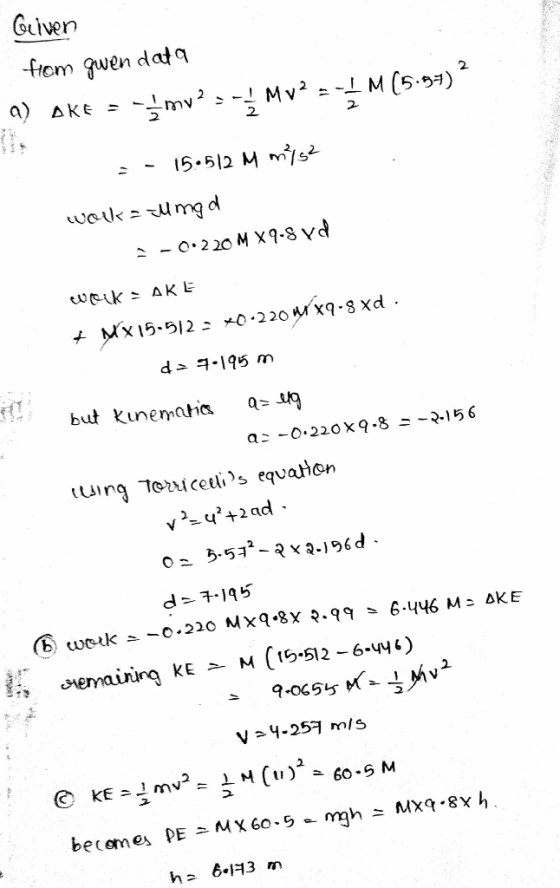
A skier moving at 5.57 m/s encounters a long, rough, horizontal patch of snow having a coefficient of kinetic friction of 0.220 with her skis. How far does she travel on this patch before stopping?
Express your answer with the appropriate units.
B)
Suppose the rough patch in part A was only 2.99 m long. How fast would the skier be moving when she reached the end of the patch?
Express your answer with the appropriate units.
C)
At the base of a frictionless icy hill that rises at 25.0∘ above the horizontal, a toboggan has a speed of 11.9 m/s toward the hill. How high vertically above the base will it go before stopping?
Express your answer with the appropriate units.
Homework Answers
Add Answer to:
Use the work–energy theorem to solve each of these problems. You
can use Newton’s laws to...
Use the work–energy theorem to solve each of these problems. You can use Newton’s laws to...
Use the work–energy theorem to solve each of these problems. You can use Newton’s laws to check your answers. A)A skier moving at 4.25 m/s encounters a long, rough, horizontal patch of snow having a coefficient of kinetic friction of 0.220 with her skis. How far does she travel on this patch before stopping? B)Suppose the rough patch in part A was only 2.89 m long. How fast would the skier be moving when she reached the end of the...
A 62.0 kg skier is moving at 6.50 m/s on a frictionless, horizontal snow covered plateau when she encounters a rough patch 3.50 m long
A 62.0 kg skier is moving at 6.50 m/s on a frictionless, horizontal snow covered plateau when she encounters a rough patch 3.50 m long. The coefficient of kinetic friction between this patch and returning to friction-free snow, she skis down an icy, frictionless hill 2.50 m high. (a) How fast is the skier moving when she gets to the bottom of the hill? (b) How much internal energy was generated in crossing the rough patch?
12. A 62 kg skier is moving at 6.5 m/s on frictionless horizontal snow-covered plateau when...
 12. A 62 kg skier is moving at 6.5 m/s on frictionless horizontal snow-covered plateau when she encounters a rough patch 3.50 m long. The coefficient of kinetic friction between this patch and her skis is 0.30. After crossing the rough patch and returning to friction free snow, she skis down an icy frictionless hell 2.5 m high. A) How much work is done by friction in crossing the patch? B) How fast is the skier moving when she gets...
Need the exercise portion Hit the Ski Slopes EXAMPLE 5.8 GOAL Combine conservation of mechanical energy...
 Need the exercise portion
Hit the Ski Slopes EXAMPLE 5.8 GOAL Combine conservation of mechanical energy with the work-energy theorem involving friction on a horizontal surface. h = 20.0 m у A skier starts PROBLEM from rest at the top of a frictionless incline of height (В С) 20.0 m, as in the figure. At the bottom of the incline, the skier The skier slides down the slope and onto a level surface, stopping after encounters a horizontal traveling a...
Need the exercise portion
Hit the Ski Slopes EXAMPLE 5.8 GOAL Combine conservation of mechanical energy with the work-energy theorem involving friction on a horizontal surface. h = 20.0 m у A skier starts PROBLEM from rest at the top of a frictionless incline of height (В С) 20.0 m, as in the figure. At the bottom of the incline, the skier The skier slides down the slope and onto a level surface, stopping after encounters a horizontal traveling a...
A horizontal spring with spring constant 130 N/m is compressed 19 cm and used to launch...
A horizontal spring with spring constant 130 N/m is compressed 19 cm and used to launch a 2.8 kg box across a frictionless, horizontal surface. After the box travels some distance, the surface becomes rough. The coefficient of kinetic friction of the box on the surface is 0.15. Use work and energy to find how far the box slides across the rough surface before stopping. Express your answer to two significant figures and include the appropriate units.
2 55 pes) Use work energy theorem to solve 1650 kg) is at the soap of...
 2 55 pes) Use work energy theorem to solve 1650 kg) is at the soap of a menge there to solve this problem. A rocket powered sled ( pot a ll that is angled at 28. that is angleda alsave the horizontal. The coefficient concc friction between the constant chest of 175 and the sledis 0.136. The rockets on the sled provide a and the stad is 0.136. The rockets on SR The sled travels a da The sled travels...
(52) everything applepro - YouTux Course Home X Mastering Physics: CH10HW X + € → e...
 (52) everything applepro - YouTux Course Home X Mastering Physics: CH10HW X + € → e session.masteringphysics.com/myct/itemView?assignmentProblemID=127529212&offset=next Fall 2019 Physics 231-70 <CH10HW Problem 10.49 A horizontal spring with spring constant 110 N/m is compressed 20 cm and used to launch a 2.0 kg box across a frictionless, horizontal surface. After the box travels some distance, the surface becomes rough. The coefficient of kinetic friction of the box on the surface is 0.15. Part A Use work and energy to find...
A Review Constants Periodic Table Part A You are driving your 1400 kg car at 19...
 A Review Constants Periodic Table Part A You are driving your 1400 kg car at 19 m/s down a hill with a 5.0° slope when a deer suddenly jumps out onto the roadway. You slam on your brakes, skidding to a stop. How far do you skid before stopping if the kinetic friction force between your tires and the road is 1.1x10⁴ N ? Solve this problem using conservation of energy. Express your answer with the appropriate units. μΑ 2)...
Please let it be legible, thanks in advance! You can, in an emergency, start a manual...
 Please let it be legible, thanks in advance!
You can, in an emergency, start a manual transmission car by putting it in neutral, letting the car roll down a hill to pick up speed, then putting it in gear and quickly letting out the clutch Part A If the car needs to be moving at 3.3 m/s for this to work, how high a hill do you need? (You can ignore friction and drag.) Express your answer with the appropriate...
Please let it be legible, thanks in advance!
You can, in an emergency, start a manual transmission car by putting it in neutral, letting the car roll down a hill to pick up speed, then putting it in gear and quickly letting out the clutch Part A If the car needs to be moving at 3.3 m/s for this to work, how high a hill do you need? (You can ignore friction and drag.) Express your answer with the appropriate...
orms. at, or is of Part A If two FA The energy required for the hypothetical...
 orms. at, or is of Part A If two FA The energy required for the hypothetical reaction 2A +B=2C + 2D is 303 kJ as written How much heat is absorbed when 3 60 mol of A reacts ? Express your answer to three significant figures and include the appropriate units. View Available Hint(s) 13A 5 - 0 - ? Value Submit Part B Complete previous part(s) Provide Feedback es > Week Eleven HOMEWUIR? Part A Classily the following examples...
 12. A 62 kg skier is moving at 6.5 m/s on frictionless horizontal snow-covered plateau when she encounters a rough patch 3.50 m long. The coefficient of kinetic friction between this patch and her skis is 0.30. After crossing the rough patch and returning to friction free snow, she skis down an icy frictionless hell 2.5 m high. A) How much work is done by friction in crossing the patch? B) How fast is the skier moving when she gets...
 Need the exercise portion
Hit the Ski Slopes EXAMPLE 5.8 GOAL Combine conservation of mechanical energy with the work-energy theorem involving friction on a horizontal surface. h = 20.0 m у A skier starts PROBLEM from rest at the top of a frictionless incline of height (В С) 20.0 m, as in the figure. At the bottom of the incline, the skier The skier slides down the slope and onto a level surface, stopping after encounters a horizontal traveling a...
Need the exercise portion
Hit the Ski Slopes EXAMPLE 5.8 GOAL Combine conservation of mechanical energy with the work-energy theorem involving friction on a horizontal surface. h = 20.0 m у A skier starts PROBLEM from rest at the top of a frictionless incline of height (В С) 20.0 m, as in the figure. At the bottom of the incline, the skier The skier slides down the slope and onto a level surface, stopping after encounters a horizontal traveling a...
 2 55 pes) Use work energy theorem to solve 1650 kg) is at the soap of a menge there to solve this problem. A rocket powered sled ( pot a ll that is angled at 28. that is angleda alsave the horizontal. The coefficient concc friction between the constant chest of 175 and the sledis 0.136. The rockets on the sled provide a and the stad is 0.136. The rockets on SR The sled travels a da The sled travels...
 (52) everything applepro - YouTux Course Home X Mastering Physics: CH10HW X + € → e session.masteringphysics.com/myct/itemView?assignmentProblemID=127529212&offset=next Fall 2019 Physics 231-70 <CH10HW Problem 10.49 A horizontal spring with spring constant 110 N/m is compressed 20 cm and used to launch a 2.0 kg box across a frictionless, horizontal surface. After the box travels some distance, the surface becomes rough. The coefficient of kinetic friction of the box on the surface is 0.15. Part A Use work and energy to find...
 A Review Constants Periodic Table Part A You are driving your 1400 kg car at 19 m/s down a hill with a 5.0° slope when a deer suddenly jumps out onto the roadway. You slam on your brakes, skidding to a stop. How far do you skid before stopping if the kinetic friction force between your tires and the road is 1.1x10⁴ N ? Solve this problem using conservation of energy. Express your answer with the appropriate units. μΑ 2)...
 Please let it be legible, thanks in advance!
You can, in an emergency, start a manual transmission car by putting it in neutral, letting the car roll down a hill to pick up speed, then putting it in gear and quickly letting out the clutch Part A If the car needs to be moving at 3.3 m/s for this to work, how high a hill do you need? (You can ignore friction and drag.) Express your answer with the appropriate...
Please let it be legible, thanks in advance!
You can, in an emergency, start a manual transmission car by putting it in neutral, letting the car roll down a hill to pick up speed, then putting it in gear and quickly letting out the clutch Part A If the car needs to be moving at 3.3 m/s for this to work, how high a hill do you need? (You can ignore friction and drag.) Express your answer with the appropriate...
 orms. at, or is of Part A If two FA The energy required for the hypothetical reaction 2A +B=2C + 2D is 303 kJ as written How much heat is absorbed when 3 60 mol of A reacts ? Express your answer to three significant figures and include the appropriate units. View Available Hint(s) 13A 5 - 0 - ? Value Submit Part B Complete previous part(s) Provide Feedback es > Week Eleven HOMEWUIR? Part A Classily the following examples...
Most questions answered within 3 hours.
-
Where is the error in this code sequence?
String s1 = "Hello";
String s2 = "ello";...
asked 11 months ago -
Financial data for Joel de Paris, Inc., for last year
follow:
Joel de Paris, Inc.
Balance...
asked 11 months ago -
Consider this reaction:
Al2(SO4)3 (aq)+ BaCl3
(aq) Al2Cl6 (aq)- +
3BaSO4(s) . What is the...
asked 11 months ago -
Suppose that Savneet is considering increasing her
recent random sample from 20 car rentals to 40...
asked 11 months ago -
Trucks arrive at an unloading terminal at an average rate of 120
per hour.
Trucks arrive...
asked 11 months ago -
Why are methanol and ethanol completely soluble in water while
octanol is not very little soluble....
asked 11 months ago -
A facilities manager at a university reads in a research report
that the mean amount of...
asked 11 months ago -
When the CuSO4 is rehydrated by adding water to the anhydrous
compound, is this an endothermic...
asked 11 months ago -
A ray of sunlight is passing from diamond into crown glass; the
angle of incidence is...
asked 11 months ago -
A block of mass 0.249 kg is placed on top of a light, vertical
spring of...
asked 11 months ago -
how do the kidneys compensate in the presences of acidosis
a) trigger hyperventilate
b) reserve acid...
asked 11 months ago -
Question 501 pts
The rental rate of capital to the firm increases. Which of the
following...
asked 11 months ago