Four particles with masses 4 kg, 6 kg, 4 kg, and 6 kg are connected by rigid rods of negligible mass as shown.
011. Four particles with masses 4 kg, 6 kg, 4 kg, and 6 kg are connected by rigid rods of negligible mass as shown. The origin is centered on the mass in the lower left corner. The rectangle is 6 m wide and 5 m long.
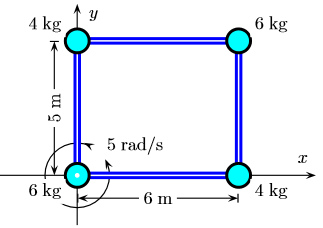
If the system rotates in the xy plane about the z axis (origin, O) with an angular speed of 5 rad/s, calculate the moment of inertia of the system about the z axis.
012. Find the moment of inertia of the four-particle system about an axis that is perpendicular to the plane of the configuration and passing through the center of mass of the system.
013. For the four-particle system find the moment of inertia about the y-axis, which passes through the two masses on the left-hand side of the system.
Homework Answers

Add Answer to:
Four particles with masses 4 kg, 6 kg, 4 kg, and 6 kg are connected by rigid rods of negligible mass as shown.
The four particles shown below are connected by rigid rods of negligible mass where y1 = 6.60 m.
 The four particles shown below are connected by rigid rods of negligible mass where y1 = 6.60 m. The origin is at the center of the rectangle. The system rotates in the xy plane about the z axis with an angular speed of 6.40 rad/s. (a) Calculate the moment of inertia of the system about the z axis.(b) Calculate the rotational kinetic energy of the system.
Four 8.00 kg masses are bound into a square by four mass-less rigid rods that are...
Four 8.00 kg masses are bound into a square by four mass-less rigid rods that are 2.00 m long and form the sides of the square. Find the moment inertia, I, of this object for rotation about an axis perpendicular to plane of the object and through the center of one of the rods.
Three masses are connected by rigid massless rods, as shown. The 200-g mass (B) is located...
 Three masses are connected by rigid massless rods, as shown. The 200-g mass (B) is located at the origin (0, 0). (a) Find the x- and y-coordinates of the center of mass. (b) Find the moment of inertia of this system of three connected masses when rotated about the r-axis that passes through mass B? (c) If this system is rotated about the r-axis, from rest to an angular speed of 6 rad/s in time t = 3 s, what...
The four masses shown in FIGURE EX12.13 are connected by massless, rigid rods.
 14. Il The four masses shown in FIGURE EX12.13 are connected by massless, rigid rods. a. Find the coordinates of the center of mass. b. Find the moment of inertia about a diagonal axis that passes through masses B and D.
The four particles shown in Fig. connected by rigid rods. The or igin is at the...
 The four particles shown in Fig. connected by rigid rods. The or igin is at the center of the rectangle. If the system rotate in the xy plane about the z axis with an angular speed of 8.00 rad/s, calculate yim) 9.00 kg 2.00kg 04: The moment of inertia of the system about the z axis (A) 143Kg. m2 (B) 65Kg.m2 (C) 78Kg. m2 (D) 52Kg m2 (E) 91Kg.m2 6.00 m x(m) 0 CS: The rotational kinetic energy of the...
Problem 9-43: Four particles at the corners of a square with a side length L-5.00m are connected by massless rods. The...
 Problem 9-43: Four particles at the corners of a square with a side length L-5.00m are connected by massless rods. The particle masses are m1= m4=5.00kg and m2= m3 particles with equal masses are located at opposite corners of the square. Find the moment of inertia of the system about the z-axis that passes through a corner of the square where the particle has a mass of m=15.00kg. 15.0 kg. Pairs of Tries 0/10 Submit Answer
Four particles at the corners of a square with a side length L=2.00m are connected by...
Four particles at the corners of a square with a side length L=2.00m are connected by massless rods. The particle masses are m1= m4=4.00kg and m2= m3 = 16.0 kg. Pairs of particles with equal masses are located at opposite corners of the square. Find the moment of inertia of the system about the z-axis that passes through a corner of the square where the particle has a mass of m=16.00kg.
Four particles at the corners of a square with a side length L=4.00m are connected by...
Four particles at the corners of a square with a side length L=4.00m are connected by massless rods. The particle masses are m1= m4=2.00kg and m2= m3 = 16.0 kg. Pairs of particles with equal masses are located at opposite corners of the square. Find the moment of inertia of the system about the z-axis that passes through a corner of the square where the particle has a mass of m=16.00kg.
Four masses are at corners of a rectangle connected by massless rods as shown in Figure...
 Four masses are at corners of a rectangle connected by massless
rods as shown in Figure 0.27.
(i) What is the moment of inertia of the system when the axis of
rotation is along the x-axis?
(ii) What is the moment of inertia of the system when the axis
of rotation is along the y-axis?
(iIi) What is the moment of inertia of the system when the axis of
rotation goes through point O and is perpendicular to the
xy-plane....
Four masses are at corners of a rectangle connected by massless
rods as shown in Figure 0.27.
(i) What is the moment of inertia of the system when the axis of
rotation is along the x-axis?
(ii) What is the moment of inertia of the system when the axis
of rotation is along the y-axis?
(iIi) What is the moment of inertia of the system when the axis of
rotation goes through point O and is perpendicular to the
xy-plane....
 The four particles shown in Fig. connected by rigid rods. The or igin is at the center of the rectangle. If the system rotate in the xy plane about the z axis with an angular speed of 8.00 rad/s, calculate yim) 9.00 kg 2.00kg 04: The moment of inertia of the system about the z axis (A) 143Kg. m2 (B) 65Kg.m2 (C) 78Kg. m2 (D) 52Kg m2 (E) 91Kg.m2 6.00 m x(m) 0 CS: The rotational kinetic energy of the...
 Problem 9-43: Four particles at the corners of a square with a side length L-5.00m are connected by massless rods. The particle masses are m1= m4=5.00kg and m2= m3 particles with equal masses are located at opposite corners of the square. Find the moment of inertia of the system about the z-axis that passes through a corner of the square where the particle has a mass of m=15.00kg. 15.0 kg. Pairs of Tries 0/10 Submit Answer
 Four masses are at corners of a rectangle connected by massless
rods as shown in Figure 0.27.
(i) What is the moment of inertia of the system when the axis of
rotation is along the x-axis?
(ii) What is the moment of inertia of the system when the axis
of rotation is along the y-axis?
(iIi) What is the moment of inertia of the system when the axis of
rotation goes through point O and is perpendicular to the
xy-plane....
Four masses are at corners of a rectangle connected by massless
rods as shown in Figure 0.27.
(i) What is the moment of inertia of the system when the axis of
rotation is along the x-axis?
(ii) What is the moment of inertia of the system when the axis
of rotation is along the y-axis?
(iIi) What is the moment of inertia of the system when the axis of
rotation goes through point O and is perpendicular to the
xy-plane....
Most questions answered within 3 hours.
-
Where is the error in this code sequence?
String s1 = "Hello";
String s2 = "ello";...
asked 10 months ago -
Financial data for Joel de Paris, Inc., for last year
follow:
Joel de Paris, Inc.
Balance...
asked 10 months ago -
Consider this reaction:
Al2(SO4)3 (aq)+ BaCl3
(aq) Al2Cl6 (aq)- +
3BaSO4(s) . What is the...
asked 10 months ago -
Suppose that Savneet is considering increasing her
recent random sample from 20 car rentals to 40...
asked 10 months ago -
Trucks arrive at an unloading terminal at an average rate of 120
per hour.
Trucks arrive...
asked 10 months ago -
Why are methanol and ethanol completely soluble in water while
octanol is not very little soluble....
asked 10 months ago -
A facilities manager at a university reads in a research report
that the mean amount of...
asked 10 months ago -
When the CuSO4 is rehydrated by adding water to the anhydrous
compound, is this an endothermic...
asked 10 months ago -
A ray of sunlight is passing from diamond into crown glass; the
angle of incidence is...
asked 10 months ago -
A block of mass 0.249 kg is placed on top of a light, vertical
spring of...
asked 10 months ago -
how do the kidneys compensate in the presences of acidosis
a) trigger hyperventilate
b) reserve acid...
asked 10 months ago -
Question 501 pts
The rental rate of capital to the firm increases. Which of the
following...
asked 10 months ago