A 190 g ball is dropped from a height of 2.2 m, bounces on a hard floor, and rebounds to a height of 1.1 m
A 190 g ball is dropped from a height of 2.2 m, bounces on a hard floor, and rebounds to a height of 1.1 m. The figure(Figure 1) shows the impulse received from the floor.
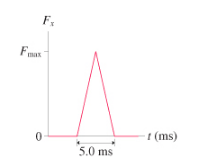
Part A
What maximum force does the floor exert on the ball? Express your answer to two significant figures and include the appropriate units.
Homework Answers

Add Answer to:
A 190 g ball is dropped from a height of 2.2 m, bounces on a hard floor, and rebounds to a height of 1.1 m
A 300 g ball is dropped from a height of 2.2 m , bounces on a...
 A 300 g ball is dropped from a height of 2.2 m , bounces on a
hard floor, and rebounds to a height of 1.7 m . The figure shows
the impulse received from the floor. (Figure 1)What maximum force
does the floor exert on the ball? Express your answer using two
significant figures.
max. 5 ms t (ms)
A 300 g ball is dropped from a height of 2.2 m , bounces on a
hard floor, and rebounds to a height of 1.7 m . The figure shows
the impulse received from the floor. (Figure 1)What maximum force
does the floor exert on the ball? Express your answer using two
significant figures.
max. 5 ms t (ms)
A 150 g ball is dropped from a height of 1.8 m , bounces on a...
 A 150 g ball is dropped from a height of 1.8 m , bounces on a
hard floor, and rebounds to a height of 1.4 m . The figure(Figure
1) shows the impulse received from the floor.What maximum force does the floor exert on the ball? Express
your answer to two significant figures and include the appropriate
units
A 150 g ball is dropped from a height of 1.8 m , bounces on a
hard floor, and rebounds to a height of 1.4 m . The figure(Figure
1) shows the impulse received from the floor.What maximum force does the floor exert on the ball? Express
your answer to two significant figures and include the appropriate
units
A 290 g ball is dropped from a height of 2.2 m , bounces on a...
 A 290 g ball is dropped from a height of 2.2 m , bounces on a
hard floor, and rebounds to a height of 1.7 m .
(Figure 1) shows the impulse received from the floor.
What maximum force does the floor exert on the ball?
A 290 g ball is dropped from a height of 2.2 m , bounces on a
hard floor, and rebounds to a height of 1.7 m .
(Figure 1) shows the impulse received from the floor.
What maximum force does the floor exert on the ball?
A 160g ball is dropped from a height of 1.8m , bounces on a hard floor,...
 A 160g
ball is dropped from a height of
1.8m
, bounces on a hard floor, and rebounds to a
height of 1.1m
. The figure(Figure 1) shows the impulse received from the floor.
What maximum force does the floor exert on
the ball?
Please do not post the answer to a similar
problem. I have already looked at those and worked it and keep
getting it wrong. Please solve this one.
A 160g
ball is dropped from a height of
1.8m
, bounces on a hard floor, and rebounds to a
height of 1.1m
. The figure(Figure 1) shows the impulse received from the floor.
What maximum force does the floor exert on
the ball?
Please do not post the answer to a similar
problem. I have already looked at those and worked it and keep
getting it wrong. Please solve this one.
Review Constants Periodic Table A 180 g ball is dropped from a height of 2.4 m,...
 Review Constants Periodic Table A 180 g ball is dropped from a height of 2.4 m, bounces on a hard floor, and rebounds to a height of 1.9 m (Figure 1) shows the impulse received from the floor. Express your answer to two significant figures and include the appropriate units. 0 UA ? Figure < 1 of 1 Fas Value Units Submit Previous Answers Request Answer max X Incorrect; Try Again 0 1 (ms) Provide Feedback Next >
Please answer part 1 and 2 carefully. Again, please and thank you Part 1: The spring...
 Please answer part 1 and 2 carefully. Again, please and thank
you
Part 1:
The spring in the figure has a spring constant of 1000 N/m . It
is compressed 15.0 cm , then launches a 200 g block. The horizontal
surface is frictionless, but the block's coefficient of kinetic
friction on the incline is 0.180. (Figure 1)
What distance d does the block sail through the
air?
Express your answer with the appropriate
units.
---------------------------
Part 2:
A 190...
Please answer part 1 and 2 carefully. Again, please and thank
you
Part 1:
The spring in the figure has a spring constant of 1000 N/m . It
is compressed 15.0 cm , then launches a 200 g block. The horizontal
surface is frictionless, but the block's coefficient of kinetic
friction on the incline is 0.180. (Figure 1)
What distance d does the block sail through the
air?
Express your answer with the appropriate
units.
---------------------------
Part 2:
A 190...
A 90 gram ball dropped from a height of 3m strikes the floor and rebounds to...
A 90 gram ball dropped from a height of 3m strikes the floor and rebounds to a height of 1 m. Determine the average impulse force if the impulse duration is 2 miliseconds. Report the result in newtons. Please show steps.
A steel ball is dropped onto a hard floor from a height of 1.575 m and rebounds to a height of 1.3 m
A steel ball is dropped onto a hard floor from a height of 1.575 m and rebounds to a height of 1.3 m. Use a coordinate system in which the vertical component of velocity is positive in the upwards direction. Part (a) Calculate its velocity, in meters per second, just before it strikes the floor.
A 299-g steel ball is dropped straight down on to a hard, horizontal floor and bounces...
A 299-g steel ball is dropped straight down on to a hard, horizontal floor and bounces straight up. Its speed just before impact with the floor is 14.3 m/s and just after impact with the floor is 10.8 m/s. Determine the magnitude of the impulse delivered to the floor by the steel ball in LaTeX: N\cdot sN ⋅ s. Leave your answer to two decimal places, and do not include the units because Canvas does not allow units in the...
A golf ball is dropped on a sidewalk from a height of 2 m and rebounds...
A golf ball is dropped on a sidewalk from a height of 2 m and rebounds to a height of 1.50 m. The mass of the ball is 45.8 g. a) What was the impulse? b) Assuming that the ball was in contact with the concrete for 7 ms, find the average force.
 A 300 g ball is dropped from a height of 2.2 m , bounces on a
hard floor, and rebounds to a height of 1.7 m . The figure shows
the impulse received from the floor. (Figure 1)What maximum force
does the floor exert on the ball? Express your answer using two
significant figures.
max. 5 ms t (ms)
A 300 g ball is dropped from a height of 2.2 m , bounces on a
hard floor, and rebounds to a height of 1.7 m . The figure shows
the impulse received from the floor. (Figure 1)What maximum force
does the floor exert on the ball? Express your answer using two
significant figures.
max. 5 ms t (ms)
 A 150 g ball is dropped from a height of 1.8 m , bounces on a
hard floor, and rebounds to a height of 1.4 m . The figure(Figure
1) shows the impulse received from the floor.What maximum force does the floor exert on the ball? Express
your answer to two significant figures and include the appropriate
units
A 150 g ball is dropped from a height of 1.8 m , bounces on a
hard floor, and rebounds to a height of 1.4 m . The figure(Figure
1) shows the impulse received from the floor.What maximum force does the floor exert on the ball? Express
your answer to two significant figures and include the appropriate
units
 A 290 g ball is dropped from a height of 2.2 m , bounces on a
hard floor, and rebounds to a height of 1.7 m .
(Figure 1) shows the impulse received from the floor.
What maximum force does the floor exert on the ball?
A 290 g ball is dropped from a height of 2.2 m , bounces on a
hard floor, and rebounds to a height of 1.7 m .
(Figure 1) shows the impulse received from the floor.
What maximum force does the floor exert on the ball?
 A 160g
ball is dropped from a height of
1.8m
, bounces on a hard floor, and rebounds to a
height of 1.1m
. The figure(Figure 1) shows the impulse received from the floor.
What maximum force does the floor exert on
the ball?
Please do not post the answer to a similar
problem. I have already looked at those and worked it and keep
getting it wrong. Please solve this one.
A 160g
ball is dropped from a height of
1.8m
, bounces on a hard floor, and rebounds to a
height of 1.1m
. The figure(Figure 1) shows the impulse received from the floor.
What maximum force does the floor exert on
the ball?
Please do not post the answer to a similar
problem. I have already looked at those and worked it and keep
getting it wrong. Please solve this one.
 Review Constants Periodic Table A 180 g ball is dropped from a height of 2.4 m, bounces on a hard floor, and rebounds to a height of 1.9 m (Figure 1) shows the impulse received from the floor. Express your answer to two significant figures and include the appropriate units. 0 UA ? Figure < 1 of 1 Fas Value Units Submit Previous Answers Request Answer max X Incorrect; Try Again 0 1 (ms) Provide Feedback Next >
 Please answer part 1 and 2 carefully. Again, please and thank
you
Part 1:
The spring in the figure has a spring constant of 1000 N/m . It
is compressed 15.0 cm , then launches a 200 g block. The horizontal
surface is frictionless, but the block's coefficient of kinetic
friction on the incline is 0.180. (Figure 1)
What distance d does the block sail through the
air?
Express your answer with the appropriate
units.
---------------------------
Part 2:
A 190...
Please answer part 1 and 2 carefully. Again, please and thank
you
Part 1:
The spring in the figure has a spring constant of 1000 N/m . It
is compressed 15.0 cm , then launches a 200 g block. The horizontal
surface is frictionless, but the block's coefficient of kinetic
friction on the incline is 0.180. (Figure 1)
What distance d does the block sail through the
air?
Express your answer with the appropriate
units.
---------------------------
Part 2:
A 190...
Most questions answered within 3 hours.
-
Where is the error in this code sequence?
String s1 = "Hello";
String s2 = "ello";...
asked 11 months ago -
Financial data for Joel de Paris, Inc., for last year
follow:
Joel de Paris, Inc.
Balance...
asked 11 months ago -
Consider this reaction:
Al2(SO4)3 (aq)+ BaCl3
(aq) Al2Cl6 (aq)- +
3BaSO4(s) . What is the...
asked 11 months ago -
Suppose that Savneet is considering increasing her
recent random sample from 20 car rentals to 40...
asked 11 months ago -
Trucks arrive at an unloading terminal at an average rate of 120
per hour.
Trucks arrive...
asked 11 months ago -
Why are methanol and ethanol completely soluble in water while
octanol is not very little soluble....
asked 11 months ago -
A facilities manager at a university reads in a research report
that the mean amount of...
asked 11 months ago -
When the CuSO4 is rehydrated by adding water to the anhydrous
compound, is this an endothermic...
asked 11 months ago -
A ray of sunlight is passing from diamond into crown glass; the
angle of incidence is...
asked 11 months ago -
A block of mass 0.249 kg is placed on top of a light, vertical
spring of...
asked 11 months ago -
how do the kidneys compensate in the presences of acidosis
a) trigger hyperventilate
b) reserve acid...
asked 11 months ago -
Question 501 pts
The rental rate of capital to the firm increases. Which of the
following...
asked 11 months ago