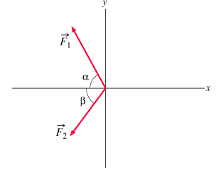
Two forces, F⃗1 and F⃗2, act at a point, as shown in the picture.
Two forces, F⃗1 and F⃗2, act at a point, as shown in the picture. (Figure 1) F⃗1 has a magnitude of 8.80 N and is directed at an angle of α = 62.0 ∘ above the negative x axis in the second quadrant. F⃗2 has a magnitude of 7.00 N and is directed at an angle of β = 52.3 ∘ below the negative x axis in the third quadrant.
Part A
What is the x component Fx of the resultant force?
Part B
What is the y component Fy of the resultant force?
Part C
What is the magnitude F of the resultant force?
Part D
What is the angle y that the resultant force forms with the negative x axis? In this problem, assume that positive angles are measured clockwise from the negative e axis.
Homework Answers

Two forces, F1 and F2, act at a point, as shown in the picture
 Two forces, F1 and F2, act at a point, as shown in the picture. F1 has a magnitude of 9.60 N and is directed at an angle of α = 58.0° above the negative x axis in the second quadrant. F2 has a magnitude of 5.80 N and is directed at an angle of β = 52.5° below the negative x axis in the third quadrant.Part A What is the x component Fx of the resultant force? Part B What is...
Two forces, F⃗ 1 and F⃗ 2, act at a point, as shown in the picture....
Two forces, F⃗ 1 and F⃗ 2, act at a point, as shown in the picture. (Figure 1) F⃗ 1 has a magnitude of 9.00 N and is directed at an angle of α = 58.0 ∘ above the negative x axis in the second quadrant. F⃗ 2 has a magnitude of 7.00 N and is directed at an angle of β = 52.9 ∘ below the negative x axis in the third quadrant. PART A: What is the x...
Two forces, F⃗ 1 and F⃗ 2, act at a point, as shown in the picture....
Two forces, F⃗ 1 and F⃗ 2, act at a point, as shown in the picture. (Figure 1) F⃗ 1 has a magnitude of 8.00 N and is directed at an angle of α = 61.0 ∘∘ above the negative x axis in the second quadrant. F⃗ 2 has a magnitude of 5.20 N and is directed at an angle of β = 54.1 ∘∘ below the negative x axis in the third quadrant. What is the x component Fx...
Two forces, F? 1 and F? 2, act at a point, as shown in the picture....
 Two forces, F? 1 and F? 2, act at a point, as
shown in the picture. (Figure 1) F? 1 has a magnitude of
9.20 N and is directed at an angle of ? = 65.0 ? above the
negative xaxis in the second quadrant. F? 2 has a
magnitudeof 5.80 N and is directed at an angle of ? = 53.9
? below the negative x axis in the third quadrant.
Part A
What is the x component Fx...
Two forces, F? 1 and F? 2, act at a point, as
shown in the picture. (Figure 1) F? 1 has a magnitude of
9.20 N and is directed at an angle of ? = 65.0 ? above the
negative xaxis in the second quadrant. F? 2 has a
magnitudeof 5.80 N and is directed at an angle of ? = 53.9
? below the negative x axis in the third quadrant.
Part A
What is the x component Fx...
Two forces, F1 and F2, act at a point, as shown in the picture. (Figure 1)...
 Two forces, F1 and F2, act at a point, as
shown in the picture. (Figure 1) F1 has a magnitude of
8.40 N and is directed at an angle of a = 59.0 ? above the
negative xaxis in the second quadrant. F2 has a
magnitude of 6.40 N and is directed at an angle of b =
54.1 ? below the negative x axis in the third
quadrant.
a) What is the x component Fx of the resultant
force? Express...
Two forces, F1 and F2, act at a point, as
shown in the picture. (Figure 1) F1 has a magnitude of
8.40 N and is directed at an angle of a = 59.0 ? above the
negative xaxis in the second quadrant. F2 has a
magnitude of 6.40 N and is directed at an angle of b =
54.1 ? below the negative x axis in the third
quadrant.
a) What is the x component Fx of the resultant
force? Express...
Two forces, F⃗ 1F→1F_1_vec and F⃗ 2F→2F_2_vec, act at a point. F⃗ 1F→1F_1_vec has a magnitude...
Two forces, F⃗ 1F→1F_1_vec and F⃗ 2F→2F_2_vec, act at a point. F⃗ 1F→1F_1_vec has a magnitude of 8.80 NN and is directed at an angle of 64.0 ∘∘ above the negative x axis in the second quadrant. F⃗ 2F→2F_2_vec has a magnitude of 5.40 NN and is directed at an angle of 52.3 ∘∘ below the negative x axis in the third quadrant. 1.What is the x component of the resultant force? 2.What is the y component of the resultant...
Two forces, F1 and F2, act at a point
Two forces, F1 and F2, act at a point. F1 has a magnitude of 8.20 N and is directed at an angle of 61.0° above, the negative x axis in the second quadrant. F2 has a magnitude of 5.60 N and is directed at an angle of 53.4° below the negative x axis in the third quadrant.Part A What is the x component of the resultant force? Part B What is the y component of the resultant force? Part C What is the...
Two forces, F⃗ 1 and F⃗ 2, act at a point. F⃗ 1 has a magnitude...
Two forces, F⃗ 1 and F⃗ 2, act at a point. F⃗ 1 has a magnitude of 8.00 N and is directed at an angle of 65.0 ∘ above the negative x axis in the second quadrant. F⃗ 2 has a magnitude of 7.00 N and is directed at an angle of 53.9 ∘ below the negative x axis in the third quadrant. Part A What is the x component of the resultant force? Express your answer in newtons. N...
Two forces, F⃗ 1 and F⃗ 2, act at a point. F⃗ 1 has a magnitude...
Two forces, F⃗ 1 and F⃗ 2, act at a point. F⃗ 1 has a magnitude of 9.80 N and is directed at an angle of 60.0 ∘ above the negative x axis in the second quadrant. F⃗ 2 has a magnitude of 6.00 N and is directed at an angle of 52.1 ∘ below the negative x axis in the third quadrant. What is the x component of the resultant force? What is the y component of the resultant...
Two forces, F⃗ 1 and F⃗ 2, act at a point. F⃗ 1 has a magnitude...
Two forces, F⃗ 1 and F⃗ 2, act at a point. F⃗ 1 has a magnitude of 9.40 N and is directed at an angle of 58.0 ∘ above the negative x axis in the second quadrant. F⃗ 2 has a magnitude of 6.20 N and is directed at an angle of 53.1 ∘ below the negative x axis in the third quadrant. A)What is the x component of the resultant force? B)What is the y component of the resultant...
 Two forces, F? 1 and F? 2, act at a point, as
shown in the picture. (Figure 1) F? 1 has a magnitude of
9.20 N and is directed at an angle of ? = 65.0 ? above the
negative xaxis in the second quadrant. F? 2 has a
magnitudeof 5.80 N and is directed at an angle of ? = 53.9
? below the negative x axis in the third quadrant.
Part A
What is the x component Fx...
Two forces, F? 1 and F? 2, act at a point, as
shown in the picture. (Figure 1) F? 1 has a magnitude of
9.20 N and is directed at an angle of ? = 65.0 ? above the
negative xaxis in the second quadrant. F? 2 has a
magnitudeof 5.80 N and is directed at an angle of ? = 53.9
? below the negative x axis in the third quadrant.
Part A
What is the x component Fx...
 Two forces, F1 and F2, act at a point, as
shown in the picture. (Figure 1) F1 has a magnitude of
8.40 N and is directed at an angle of a = 59.0 ? above the
negative xaxis in the second quadrant. F2 has a
magnitude of 6.40 N and is directed at an angle of b =
54.1 ? below the negative x axis in the third
quadrant.
a) What is the x component Fx of the resultant
force? Express...
Two forces, F1 and F2, act at a point, as
shown in the picture. (Figure 1) F1 has a magnitude of
8.40 N and is directed at an angle of a = 59.0 ? above the
negative xaxis in the second quadrant. F2 has a
magnitude of 6.40 N and is directed at an angle of b =
54.1 ? below the negative x axis in the third
quadrant.
a) What is the x component Fx of the resultant
force? Express...
Most questions answered within 3 hours.
-
Where is the error in this code sequence?
String s1 = "Hello";
String s2 = "ello";...
asked 11 months ago -
Financial data for Joel de Paris, Inc., for last year
follow:
Joel de Paris, Inc.
Balance...
asked 11 months ago -
Consider this reaction:
Al2(SO4)3 (aq)+ BaCl3
(aq) Al2Cl6 (aq)- +
3BaSO4(s) . What is the...
asked 11 months ago -
Suppose that Savneet is considering increasing her
recent random sample from 20 car rentals to 40...
asked 11 months ago -
Trucks arrive at an unloading terminal at an average rate of 120
per hour.
Trucks arrive...
asked 11 months ago -
Why are methanol and ethanol completely soluble in water while
octanol is not very little soluble....
asked 11 months ago -
A facilities manager at a university reads in a research report
that the mean amount of...
asked 11 months ago -
When the CuSO4 is rehydrated by adding water to the anhydrous
compound, is this an endothermic...
asked 11 months ago -
A ray of sunlight is passing from diamond into crown glass; the
angle of incidence is...
asked 11 months ago -
A block of mass 0.249 kg is placed on top of a light, vertical
spring of...
asked 11 months ago -
how do the kidneys compensate in the presences of acidosis
a) trigger hyperventilate
b) reserve acid...
asked 11 months ago -
Question 501 pts
The rental rate of capital to the firm increases. Which of the
following...
asked 11 months ago