The figure shows a position-versus-time graph for a moving object. At which lettered point or points
The figure shows a position-versus-time graph for a moving object. At which lettered point or points
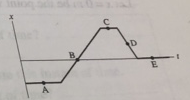
a. Is the object moving the slowest without being at rest?
b. Is the object moving the fastest?
c. Is the object at rest?
d. Does the object have a constant nonzero velocity?
e. Is the object moving to the left?
Homework Answers

Add Answer to:
The figure shows a position-versus-time graph for a moving object. At which lettered point or points
The figure shows a position-versus-time graph for a moving object. At which lettered point or points
 The figure shows a position-versus-time graph for a moving object. At which lettered point or points a. Is the object moving the slowest without being at rest? b. Is the object moving the fastest? c. Is the object at rest? d. Does the object have a constant nonzero velocity? e. Is the object moving to the left?
The figure shows a position versus time graph for a moving object. At which lettered point is the object moving the fastest?
 The figure shows a position versus time graph for a moving object. At which lettered point is the object moving the fastest?The figure shows a position versus time graph for a moving object. At which lettered point is the object moving the fastest?
4. Draw both a position-versus-time graph and a velocity-versus-time graph for an object at rest at...
 4. Draw both a position-versus-time graph and a velocity-versus-time graph for an object at rest at x=1m. 5. The figure shows the position-versus-time graphs for two objects, A and B, that are moving along the same axis. At the instant t1 s, is the speed of A greater than, less than, or equa to the speed of B? Explain. b. Do objects A and B ever have the same speed? If so, at what time or times? Explain. 6. Below...
The figure (Figure 1)shows the angular-velocity-versus-time graph for a particle moving in a circle.
 The figure (Figure 1)shows the angular-velocity-versus-time graph for a particle moving in a circle. You may want to review (Page). For help with math skills, you may want to review.Part A How many revolutions does the object make during the first 3.8 s.
Part A: An object is moving with constant non-zero velocity in the +x axis. The position...
Part A: An object is moving with constant non-zero velocity in the +x axis. The position versus time graph of this object is Part B: An object is moving with constant non-zero acceleration in the +x axis. The position versus time graph of this object is Part C: An object is moving with constant non-zero velocity in the +x axis. The velocity versus time graph of this object is Part D: An object is moving with constant non-zero acceleration in...
Why is the answer A? I thought E was the answer, because it has the least...
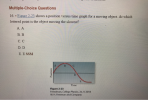 Why
is the answer A? I thought E was the answer, because it has the
least steep slope?
Multiple-Choice Questions 16. Figure 2-23 shows a position versus time graph for a moving object. At which lettered point is the object moving the slowest? A. A B. B С.С D. D E. E SSM Time Figure 2-23 Freedman. College Physics. 2e, 0 2018 W. H. Freeman and Company
Why
is the answer A? I thought E was the answer, because it has the
least steep slope?
Multiple-Choice Questions 16. Figure 2-23 shows a position versus time graph for a moving object. At which lettered point is the object moving the slowest? A. A B. B С.С D. D E. E SSM Time Figure 2-23 Freedman. College Physics. 2e, 0 2018 W. H. Freeman and Company
Problem 7. Below you are supplied a position versus time graph. Draw velocity versus time and...
 Problem 7. Below you are supplied a position versus time graph. Draw velocity versus time and acceleration versus time graphs consistent with this position versus time graph. Assume that this is one dimensional motion along the x axis, that you are standing on the origin (x = 0) with positive x off to your right and negative x off to your left. Describe the motion of the object in everyday terms without using the words velocity, acceleration, slope, positive or...
In-Class Assignment 2. The figure shows a position-versus-time graph for an oscillating mass m = 0.5...
 In-Class Assignment 2. The figure shows a position-versus-time graph for an oscillating mass m = 0.5 kg. x (cm) 20 10 0 -10 -20 I(s) 4 a. Determine the period of the motion. b. Determnine the angular frecquemcy of the motion c. Determine the amplitude of the motion. d. Determine the phase constant of the motion. e. Determine the maximum speed of the mass. f. Determine the maximum acceleration of the mass. g. Determine the total energy of the system....
Figure 2 S. If Figure 2 represents a position versus time plot, in which segment is...
 Figure 2 S. If Figure 2 represents a position versus time plot, in which segment is there a constant positive velocity A)AB B) BC C)CD D)DE E) There isn't a constant positive velocity Figure 2 represents a position versus time plot, in which segment is there a zero velocity? A) AB B) BC C) CD D) DE E) The velocity is never zero. 7. If Figure 2 represents a velocity versus time plot, in which segment is the acceleration constant...
Angular-Velocity-versus-time graph
The figure shows the angular-velocity-versus-time graph for a particle moving in a circle. How many revolutions does the object make during the first 4 s?
 4. Draw both a position-versus-time graph and a velocity-versus-time graph for an object at rest at x=1m. 5. The figure shows the position-versus-time graphs for two objects, A and B, that are moving along the same axis. At the instant t1 s, is the speed of A greater than, less than, or equa to the speed of B? Explain. b. Do objects A and B ever have the same speed? If so, at what time or times? Explain. 6. Below...
 Why
is the answer A? I thought E was the answer, because it has the
least steep slope?
Multiple-Choice Questions 16. Figure 2-23 shows a position versus time graph for a moving object. At which lettered point is the object moving the slowest? A. A B. B С.С D. D E. E SSM Time Figure 2-23 Freedman. College Physics. 2e, 0 2018 W. H. Freeman and Company
Why
is the answer A? I thought E was the answer, because it has the
least steep slope?
Multiple-Choice Questions 16. Figure 2-23 shows a position versus time graph for a moving object. At which lettered point is the object moving the slowest? A. A B. B С.С D. D E. E SSM Time Figure 2-23 Freedman. College Physics. 2e, 0 2018 W. H. Freeman and Company
 Problem 7. Below you are supplied a position versus time graph. Draw velocity versus time and acceleration versus time graphs consistent with this position versus time graph. Assume that this is one dimensional motion along the x axis, that you are standing on the origin (x = 0) with positive x off to your right and negative x off to your left. Describe the motion of the object in everyday terms without using the words velocity, acceleration, slope, positive or...
 In-Class Assignment 2. The figure shows a position-versus-time graph for an oscillating mass m = 0.5 kg. x (cm) 20 10 0 -10 -20 I(s) 4 a. Determine the period of the motion. b. Determnine the angular frecquemcy of the motion c. Determine the amplitude of the motion. d. Determine the phase constant of the motion. e. Determine the maximum speed of the mass. f. Determine the maximum acceleration of the mass. g. Determine the total energy of the system....
 Figure 2 S. If Figure 2 represents a position versus time plot, in which segment is there a constant positive velocity A)AB B) BC C)CD D)DE E) There isn't a constant positive velocity Figure 2 represents a position versus time plot, in which segment is there a zero velocity? A) AB B) BC C) CD D) DE E) The velocity is never zero. 7. If Figure 2 represents a velocity versus time plot, in which segment is the acceleration constant...
Most questions answered within 3 hours.
-
Where is the error in this code sequence?
String s1 = "Hello";
String s2 = "ello";...
asked 11 months ago -
Financial data for Joel de Paris, Inc., for last year
follow:
Joel de Paris, Inc.
Balance...
asked 11 months ago -
Consider this reaction:
Al2(SO4)3 (aq)+ BaCl3
(aq) Al2Cl6 (aq)- +
3BaSO4(s) . What is the...
asked 11 months ago -
Suppose that Savneet is considering increasing her
recent random sample from 20 car rentals to 40...
asked 11 months ago -
Trucks arrive at an unloading terminal at an average rate of 120
per hour.
Trucks arrive...
asked 11 months ago -
Why are methanol and ethanol completely soluble in water while
octanol is not very little soluble....
asked 11 months ago -
A facilities manager at a university reads in a research report
that the mean amount of...
asked 11 months ago -
When the CuSO4 is rehydrated by adding water to the anhydrous
compound, is this an endothermic...
asked 11 months ago -
A ray of sunlight is passing from diamond into crown glass; the
angle of incidence is...
asked 11 months ago -
A block of mass 0.249 kg is placed on top of a light, vertical
spring of...
asked 11 months ago -
how do the kidneys compensate in the presences of acidosis
a) trigger hyperventilate
b) reserve acid...
asked 11 months ago -
Question 501 pts
The rental rate of capital to the firm increases. Which of the
following...
asked 11 months ago