The screw eye is subjected to the two forces shown in (Figure 1)
The screw eye is subjected to the two forces shown in (Figure 1)
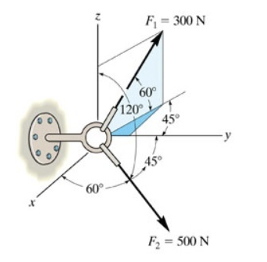
Part E Find the coordinate direction angle α of the resultant force
Part F Find the coordinate direction angle β of the resultant force
Homework Answers


The bracket is subjected to the two forces shown.
 The bracket is subjected to the two forces shown. Express each force in Cartesian vector form and then determine the resultant force FR. Given that F2 = 480 N (Figure 1)Part A Find the magnitude of the resultant forcePart B Find coordinate direction angle α of the resultant force
The bracket is subjected to the two forces shown. Express eachforce in Cartesian vector form...
 The bracket is subjected to the two forces shown. Express each
force in Cartesian vector form and then determine the resultant
force FR. Given that F2 = 500 NFind the magnitude of the resultant force.Find coordinate direction angle α of the resultant force.Find coordinate direction angle β of the resultant force.Find coordinate direction angle γ of the resultant force.
The bracket is subjected to the two forces shown. Express each
force in Cartesian vector form and then determine the resultant
force FR. Given that F2 = 500 NFind the magnitude of the resultant force.Find coordinate direction angle α of the resultant force.Find coordinate direction angle β of the resultant force.Find coordinate direction angle γ of the resultant force.
[1] The screw is subjected to the four forces shown. Express each force in Cartesian vector...
 [1] The screw is subjected to the four forces shown. Express each force in Cartesian vector form and then determine the resultant force. Find the magnitude and direction angles of the resultant force. F1-400 N F-150N 600 120 45° Fs-250 N 45 60- F:-600 N
Suppose that θ = 63° Two force vectors acting on a screw eye attached to a left vertical wall are shown in the xyz space.
 Suppose that θ = 63°. (Figure 1)Two force vectors acting on a screw eye attached to a left
vertical wall are shown in the xyz space. The wall lies in the xz
plane, and the screw eye is located at the origin. Force F 1 is 300
newtons, and it is located in the second octant, 60 degrees above
the xy plane. The projection of the vector in the xy plane makes an
angle of 45 degrees with the positive...
Suppose that θ = 63°. (Figure 1)Two force vectors acting on a screw eye attached to a left
vertical wall are shown in the xyz space. The wall lies in the xz
plane, and the screw eye is located at the origin. Force F 1 is 300
newtons, and it is located in the second octant, 60 degrees above
the xy plane. The projection of the vector in the xy plane makes an
angle of 45 degrees with the positive...
Use the non-rectangular component approach. The screw eye shown is subjected to two forces F1 and...
 Use the non-rectangular component approach. The screw eye shown is subjected to two forces F1 and F2. Draw and determine the magnitude of the resultant of the two forces using the Parallelogram Law. Find its orientation theta with respect to the plus x-axis? Test Problem 3 Use the non-rectangular component approach. The engine block shown is suspended by a system of cables. The mass of the engine block is 200 kg. For equilibrium, determine the tension in cable AD and...
Problem 2.23 Part A Two forces act on the screw eye. Figure 1) lf Fi =...
 Problem 2.23 Part A Two forces act on the screw eye. Figure 1) lf Fi = 420 N and F2-650 N, determine the angle 0(0° θ 180° ) between them, so that the resultant force has a magnitud9 of FR = 760 N Express your answer to two significant ligures and include the appropriate units. Value Submit X Incorrect, Try Again; 4 attempts remaining Provide Feedback Figure 1of1
If F = 8.0 kN, determine the magnitude of the resultant force acting on the screw eye.(Figure 1)
 Part A If F = 8.0 kN, determine the magnitude of the resultant force acting on the screw eye.(Figure 1) Part B Determine the direction of the resultant force acting on the screw eye measured clockwise from the x axis.
1-P4. Two forces F1 and F2 act on the screw eye.
 1-P4. Two forces F1 and F2 act on the screw eye. If their t lines of action are at an angle θ apart and the magnitude of ng each force is F1 = F2 = 2F, determine the magnitude of the resultant force FR and the angle between FR and Fi.
Uetii2015Marks) (CLOI : 100%) The eye-bot " shown in the figure is subjected to forces F30 KN, an...
 uetii2015Marks) (CLOI : 100%) The eye-bot " shown in the figure is subjected to forces F30 KN, and F2 -50 KN. Determine: a) The magnitude of the resultant of forces Fi and F2 b) The angles that the resultant make with x, y, and z axes B Sn 2 m c)The moment vector produced by forces F, and F, about c line AB
uetii2015Marks) (CLOI : 100%) The eye-bot " shown in the figure is subjected to forces F30 KN,...
uetii2015Marks) (CLOI : 100%) The eye-bot " shown in the figure is subjected to forces F30 KN, and F2 -50 KN. Determine: a) The magnitude of the resultant of forces Fi and F2 b) The angles that the resultant make with x, y, and z axes B Sn 2 m c)The moment vector produced by forces F, and F, about c line AB
uetii2015Marks) (CLOI : 100%) The eye-bot " shown in the figure is subjected to forces F30 KN,...
3. The bracket is subjected to the two forces shown. Express each force in Cartesian vector...
 3. The bracket is subjected to the two forces shown. Express each force in Cartesian vector form and then determine the resultant force FR. Find the magnitude and coordinate direction angles of the resultant force. F, = 400 N 60° 45° 120 25° 35° F, = 250 N
 The bracket is subjected to the two forces shown. Express each
force in Cartesian vector form and then determine the resultant
force FR. Given that F2 = 500 NFind the magnitude of the resultant force.Find coordinate direction angle α of the resultant force.Find coordinate direction angle β of the resultant force.Find coordinate direction angle γ of the resultant force.
The bracket is subjected to the two forces shown. Express each
force in Cartesian vector form and then determine the resultant
force FR. Given that F2 = 500 NFind the magnitude of the resultant force.Find coordinate direction angle α of the resultant force.Find coordinate direction angle β of the resultant force.Find coordinate direction angle γ of the resultant force.
 [1] The screw is subjected to the four forces shown. Express each force in Cartesian vector form and then determine the resultant force. Find the magnitude and direction angles of the resultant force. F1-400 N F-150N 600 120 45° Fs-250 N 45 60- F:-600 N
 Suppose that θ = 63°. (Figure 1)Two force vectors acting on a screw eye attached to a left
vertical wall are shown in the xyz space. The wall lies in the xz
plane, and the screw eye is located at the origin. Force F 1 is 300
newtons, and it is located in the second octant, 60 degrees above
the xy plane. The projection of the vector in the xy plane makes an
angle of 45 degrees with the positive...
Suppose that θ = 63°. (Figure 1)Two force vectors acting on a screw eye attached to a left
vertical wall are shown in the xyz space. The wall lies in the xz
plane, and the screw eye is located at the origin. Force F 1 is 300
newtons, and it is located in the second octant, 60 degrees above
the xy plane. The projection of the vector in the xy plane makes an
angle of 45 degrees with the positive...
 Use the non-rectangular component approach. The screw eye shown is subjected to two forces F1 and F2. Draw and determine the magnitude of the resultant of the two forces using the Parallelogram Law. Find its orientation theta with respect to the plus x-axis? Test Problem 3 Use the non-rectangular component approach. The engine block shown is suspended by a system of cables. The mass of the engine block is 200 kg. For equilibrium, determine the tension in cable AD and...
 Problem 2.23 Part A Two forces act on the screw eye. Figure 1) lf Fi = 420 N and F2-650 N, determine the angle 0(0° θ 180° ) between them, so that the resultant force has a magnitud9 of FR = 760 N Express your answer to two significant ligures and include the appropriate units. Value Submit X Incorrect, Try Again; 4 attempts remaining Provide Feedback Figure 1of1
 uetii2015Marks) (CLOI : 100%) The eye-bot " shown in the figure is subjected to forces F30 KN, and F2 -50 KN. Determine: a) The magnitude of the resultant of forces Fi and F2 b) The angles that the resultant make with x, y, and z axes B Sn 2 m c)The moment vector produced by forces F, and F, about c line AB
uetii2015Marks) (CLOI : 100%) The eye-bot " shown in the figure is subjected to forces F30 KN,...
uetii2015Marks) (CLOI : 100%) The eye-bot " shown in the figure is subjected to forces F30 KN, and F2 -50 KN. Determine: a) The magnitude of the resultant of forces Fi and F2 b) The angles that the resultant make with x, y, and z axes B Sn 2 m c)The moment vector produced by forces F, and F, about c line AB
uetii2015Marks) (CLOI : 100%) The eye-bot " shown in the figure is subjected to forces F30 KN,...
 3. The bracket is subjected to the two forces shown. Express each force in Cartesian vector form and then determine the resultant force FR. Find the magnitude and coordinate direction angles of the resultant force. F, = 400 N 60° 45° 120 25° 35° F, = 250 N
Most questions answered within 3 hours.
-
Where is the error in this code sequence?
String s1 = "Hello";
String s2 = "ello";...
asked 10 months ago -
Financial data for Joel de Paris, Inc., for last year
follow:
Joel de Paris, Inc.
Balance...
asked 10 months ago -
Consider this reaction:
Al2(SO4)3 (aq)+ BaCl3
(aq) Al2Cl6 (aq)- +
3BaSO4(s) . What is the...
asked 10 months ago -
Suppose that Savneet is considering increasing her
recent random sample from 20 car rentals to 40...
asked 10 months ago -
Trucks arrive at an unloading terminal at an average rate of 120
per hour.
Trucks arrive...
asked 10 months ago -
Why are methanol and ethanol completely soluble in water while
octanol is not very little soluble....
asked 10 months ago -
A facilities manager at a university reads in a research report
that the mean amount of...
asked 10 months ago -
When the CuSO4 is rehydrated by adding water to the anhydrous
compound, is this an endothermic...
asked 10 months ago -
A ray of sunlight is passing from diamond into crown glass; the
angle of incidence is...
asked 10 months ago -
A block of mass 0.249 kg is placed on top of a light, vertical
spring of...
asked 10 months ago -
how do the kidneys compensate in the presences of acidosis
a) trigger hyperventilate
b) reserve acid...
asked 10 months ago -
Question 501 pts
The rental rate of capital to the firm increases. Which of the
following...
asked 10 months ago