A cart of mass M traveling to the right on a frictionless track with a speed...
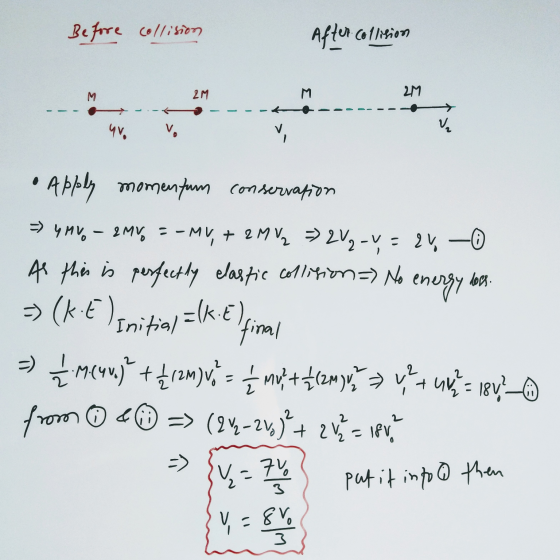
A cart of mass M traveling to the right on a frictionless track with a speed 4v0 collides with another cart of mass 2M traveling to the left with a speed v0. If this collision is perfectly elastic, and carts travel in opposite directions after collision, determine the speeds of the two carts immediately after the collision in terms of M and v0.
Homework Answers
Thankyou
Add Answer to:
A cart of mass M traveling to the right on a frictionless track
with a speed...
A cart of mass M traveling to the right on a frictionless track with a speed...
A cart of mass M traveling to the right on a frictionless track with a speed 4v0 collides with another cart of mass 2M traveling to the left with a speed v0. If this collision is perfectly elastic, and carts travel in opposite directions after collision, determine the speeds of the two carts immediately after the collision in terms of M and v0
A cart of mass M traveling to the right on a frictionless track with a speed...
A cart of mass M traveling to the right on a frictionless track with a speed 4v0 collides with another cart of mass 2M traveling to the left with a speed v0. If this collision is perfectly elastic, and carts travel in opposite directions after collision, determine the speeds of the two carts immediately after the collision in terms of M and v0.
A cart of mass M traveling to the right on a frictionless track with a speed...
A cart of mass M traveling to the right on a frictionless track with a speed 4v0 collides with another cart of mass 2M traveling to the left with a speed v0. If this collision is perfectly elastic, and carts travel in opposite directions after collision, determine the speeds of the two carts immediately after the collision in terms of M and v0.
A cart of mass M traveling to the right on a frictionless track with a speed...
A cart of mass M traveling to the right on a frictionless track with a speed 4v0 collides with another cart of mass 2M traveling to the left with a speed v0. If this collision is perfectly elastic, and carts travel in opposite directions after collision, determine the speeds of the two carts immediately after the collision in terms of M and v0.
A cart of mass M traveling to the right on a frictionless track with a speed...
 A cart of mass M traveling to the right on a frictionless track with a speed 4vo collides with another cart of mass 2M traveling to the left with a speed vo. If this collision is perfectly elastic, and carts travel in opposite directions after collision, determine the speeds of the two carts immediately after the collision in terms of Mand Vo
Two small carts are set up on a horizontal track. Cart A (mass 0.6 kg )...
Two small carts are set up on a horizontal track. Cart A (mass 0.6 kg ) sits at rest. Cart B (mass 1.3 kg ) moves to the right with a speed of 3 m/s , colliding with cart A. A) If the collision is perfectly elastic, what is the speed of cart A after the collision? B) If the collision is perfectly elastic, what's the speed of cart B after the collision? C) If the collision is perfectly inelastic,...
Two carts are rolling to the right along the same level track. Cart 1, with a...
Two carts are rolling to the right along the same level track. Cart 1, with a mass m1 = 3.4 kg, is in the rear, rolling at a speed of 6.2 m/s and catching up to cart 2, which is rolling at a speed of 3.2 m/s. Choose signs carefully; only speeds are given. a) Cart 1 overtakes and collides with cart 2, sticking to it (both have Velcro pads). Afterward, they both continue rolling right, now at a speed...
cart a has a mass of 5.0kg and is going to the right at a speed...
cart a has a mass of 5.0kg and is going to the right at a speed of 0.5 m/s and strikes cart B which is traveling to the left at an unknown speed. After the collision cart a and cart bbare stuck togethet and are both traveling to the left with a speed of 0.4 m/s. what is the velocity of cart b immediately before the collision? mass of cart b id 2.0kg
Two carts are sitting on air track (frictionless surface). Assume cart A has mass of .50...
Two carts are sitting on air track (frictionless surface). Assume cart A has mass of .50 kg, cart B has mass of 1.0 kg. You push cart A and give it an initial speed of 5.0 m/s toward B which was originally at rest. The two carts stick together and move together. Right after collision, the air is turned off so the two carts slide to a stop due to kinetic friction. Assume the coefficient of kinetic friction is .20....
8. A mass of 3 kg is traveling across a frictionless surface to the right at...
8. A mass of 3 kg is traveling across a frictionless surface to the right at a speed of 3 m/s. It collides with a 1 kg mass that is traveling at 4 m/s to the left. After the collision, the center of mass of the system is moving at what velocity? (Take positive velocities to be to the right and negative velocities to be to the left.) a) -0.250 m/s b) +0.500 m/s c) +1.25 m/s d) +2.00 m/s...
 A cart of mass M traveling to the right on a frictionless track with a speed 4vo collides with another cart of mass 2M traveling to the left with a speed vo. If this collision is perfectly elastic, and carts travel in opposite directions after collision, determine the speeds of the two carts immediately after the collision in terms of Mand Vo
Most questions answered within 3 hours.
-
Where is the error in this code sequence?
String s1 = "Hello";
String s2 = "ello";...
asked 11 months ago -
Financial data for Joel de Paris, Inc., for last year
follow:
Joel de Paris, Inc.
Balance...
asked 11 months ago -
Consider this reaction:
Al2(SO4)3 (aq)+ BaCl3
(aq) Al2Cl6 (aq)- +
3BaSO4(s) . What is the...
asked 11 months ago -
Suppose that Savneet is considering increasing her
recent random sample from 20 car rentals to 40...
asked 11 months ago -
Trucks arrive at an unloading terminal at an average rate of 120
per hour.
Trucks arrive...
asked 11 months ago -
Why are methanol and ethanol completely soluble in water while
octanol is not very little soluble....
asked 11 months ago -
A facilities manager at a university reads in a research report
that the mean amount of...
asked 11 months ago -
When the CuSO4 is rehydrated by adding water to the anhydrous
compound, is this an endothermic...
asked 11 months ago -
A ray of sunlight is passing from diamond into crown glass; the
angle of incidence is...
asked 11 months ago -
A block of mass 0.249 kg is placed on top of a light, vertical
spring of...
asked 11 months ago -
how do the kidneys compensate in the presences of acidosis
a) trigger hyperventilate
b) reserve acid...
asked 11 months ago -
Question 501 pts
The rental rate of capital to the firm increases. Which of the
following...
asked 11 months ago