A turntable has a radius of 0.80 m and a moment of inertia of 2.0 kg m2. The turntable is rotating with an angular velocity of 1.5 rad/s about a vertical axis though its center on frictionless bearings.
A turntable has a radius of 0.80 m and a moment of inertia of 2.0 kg m2. The turntable is rotating with an angular velocity of 1.5 rad/s about a vertical axis though its center on frictionless bearings. A very small 0.40-kg ball is projected horizontally toward the turntable axis with a velocity of 3.0 m/s. The ball is caught by a very small and very light cup-shaped mechanism on the rim of the turntable (see figure).
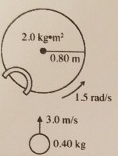
a) What is the angular velocity of the turntable just after the ball is caught?
b) What is percentage of the initial kinetic energy of the system that is lost during the capture of the ball?
Homework Answers
(a)
 (Angular momentum conservation)

(b)





percentage = 50.86%
Add Answer to:
A turntable has a radius of 0.80 m and a moment of inertia of 2.0 kg m2. The turntable is rotating with an angular velocity of 1.5 rad/s about a vertical axis though its center on frictionless bearings.
7) A turntable with moment of inertia IT = 0.042 kg m2 and radius R = 0.24 m is rotating with ω = 0.68 rad/s. A mouse of...
7) A turntable with moment of inertia IT = 0.042 kg m2 and radius R = 0.24 m is rotating with ω = 0.68 rad/s. A mouse of mass m = 0.053 kg is standing on the edge of the turntable. a) What are the total moment of inertia and the total angular momentum of this system? b) If the mouse walks towards the center of the turntable, does the angular velocity increase or decrease? Explain the answer conceptually. c)...
Consider a turntable to be a circular disk of moment of inertia 0.142 kg⋅m2 rotating at...
Consider a turntable to be a circular disk of moment of inertia 0.142 kg⋅m2 rotating at a constant angular velocity 4.80 rad/s2 around an axis through the center and perpendicular to the plane of the disk (the disk's "primary axis of symmetry"). The axis of the disk is vertical and the disk is supported by frictionless bearings. The motor of the turntable is off, so there is no external torque being applied to the axis. Another disk (a record) is...
A turntable with a rotational inertia 0.215 kg middot m^2 is rotating at 3.35 rad/s. Suddenly,...
 A turntable with a rotational inertia 0.215 kg middot m^2 is rotating at 3.35 rad/s. Suddenly, a disk with rotational inertia 0.106 kg times m^2 is dropped onto the turntable with its center on the rotation axis. Assuming no outside forces act, what's the common rotational velocity of the turntable and disk?
A disc of moment of inertia 3.00 kgm2 is rotating with angular velocity 2.00 rad/s about...
A disc of moment of inertia 3.00 kgm2 is rotating with angular velocity 2.00 rad/s about an axis perpendicular to its plane and passing through its centre. Another disk (which is not rotating) of moment of inertia 5.00 kgm2 is gently placed over it. Finally, the two discs rotate with the same angular velocity around the common rotational axis. The new angular velocity of the combined disc (in rad/s) is ?
A 55.0-kg woman stands at the rim of a horizontal turntable having a moment of inertia of 540 kg · m2 and a radius of...
A 55.0-kg woman stands at the rim of a horizontal turntable having a moment of inertia of 540 kg · m2 and a radius of 2.00 m. The turntable is initially at rest and is free to rotate about a frictionless vertical axle through its center. The woman then starts walking around the rim clockwise (as viewed from above the system) at a constant speed of 1.50 m/s relative to the Earth. (a) In what direction does the turntable rotate?...
A 3.9-m-diameter merry-go-round is rotating freely with an angular velocity of 0.80 rad/s . Its total...
A 3.9-m-diameter merry-go-round is rotating freely with an angular velocity of 0.80 rad/s . Its total moment of inertia is 1350 kg⋅m2 . Four people standing on the ground, each of mass 68 kg , suddenly step onto the edge of the merry-go-round. What is the angular velocity of the merry-go-round now?
As seen from above, a playground carousel is rotating counterclockwise about its center on frictionless bearings....
As seen from above, a playground carousel is rotating counterclockwise about its center on frictionless bearings. A person standing still on the ground grabs onto one of the bars on the carousel very close to its outer edge and climbs aboard. Thus, this person begins with an angular speed of zero and ends up with a nonzero angular speed, which means that he underwent a counterclockwise angular acceleration. The carousel has a radius of 1.56 m, an initial angular speed...
A flat horizontal disc of moment of inertia 2.2 kg m2 is rotating at 4.5 rad...
A flat horizontal disc of moment of inertia 2.2 kg m2 is rotating at 4.5 rad s-1 about a vertical axis through its centre. A 0.13 kg mass is dropped onto the disc, landing without slipping 1.4 m from the centre. Calculate the new angular velocity of the disc, in rad s-1 , to 2d.p.
A uniform disk has a mass of 3.7 kg and a radius of 0.40 m. The...
A uniform disk has a mass of 3.7 kg and a radius of 0.40 m. The disk is mounted on frictionless bearings and is used as a turntable. The turntable is initially rotating at 30 rpm. A thin - walled hollow cylinder has the same mass and radius as the disk. It is released from rest, just above the turntable, and on the same vertical axis. The hollow cylinder slips on the turntable for 0.20 s until it acquires the...
A merry-go-round with moment of inertia 400 kg-m^2 and radius 2.0m is rotating with angular speed...
A merry-go-round with moment of inertia 400 kg-m^2 and radius 2.0m is rotating with angular speed 0.50 rad/s in the clockwise direction about a fixed axis. A child of mass 40 kg runs tangentially to the merry-go-round with speed 3.0m/s and grabs onto the outside edge of the merry-go-round. a. What is the final angular velocity of the system (merry-go-round plus child)/ What is the final tangential speed of the child? b. What is the change in kinetic energy? c....
 A turntable with a rotational inertia 0.215 kg middot m^2 is rotating at 3.35 rad/s. Suddenly, a disk with rotational inertia 0.106 kg times m^2 is dropped onto the turntable with its center on the rotation axis. Assuming no outside forces act, what's the common rotational velocity of the turntable and disk?
Most questions answered within 3 hours.
-
Where is the error in this code sequence?
String s1 = "Hello";
String s2 = "ello";...
asked 11 months ago -
Financial data for Joel de Paris, Inc., for last year
follow:
Joel de Paris, Inc.
Balance...
asked 11 months ago -
Consider this reaction:
Al2(SO4)3 (aq)+ BaCl3
(aq) Al2Cl6 (aq)- +
3BaSO4(s) . What is the...
asked 11 months ago -
Suppose that Savneet is considering increasing her
recent random sample from 20 car rentals to 40...
asked 11 months ago -
Trucks arrive at an unloading terminal at an average rate of 120
per hour.
Trucks arrive...
asked 11 months ago -
Why are methanol and ethanol completely soluble in water while
octanol is not very little soluble....
asked 11 months ago -
A facilities manager at a university reads in a research report
that the mean amount of...
asked 11 months ago -
When the CuSO4 is rehydrated by adding water to the anhydrous
compound, is this an endothermic...
asked 11 months ago -
A ray of sunlight is passing from diamond into crown glass; the
angle of incidence is...
asked 11 months ago -
A block of mass 0.249 kg is placed on top of a light, vertical
spring of...
asked 11 months ago -
how do the kidneys compensate in the presences of acidosis
a) trigger hyperventilate
b) reserve acid...
asked 11 months ago -
Question 501 pts
The rental rate of capital to the firm increases. Which of the
following...
asked 11 months ago