A child applies a force F parallel to the z-axis to a 6.00 kg sled moving on the frozen surface of a small pond
A child applies a force F parallel to the z-axis to a 6.00 kg sled moving on the frozen surface of a small pond. As the child controls the speed of the sled, the 2-component of the force she applies varies with the 2-coordinate of the sled as shown in figure (Figure 1). Suppose the sled is initially at rest at x = 0. You can ignore friction between the sled and the surface of the pond.
For related problemsolving tips and strategies, you may want to view a Video Tutor Solution of Motion on a curved path.
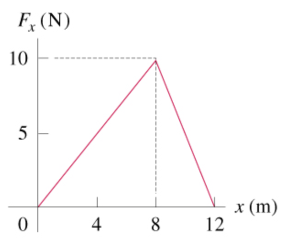
Part A
Use the work-energy theorem to find the speed of the sled at 8.0 m.
Part B
Use the work-energy theorem to find the speed of the sled at 12.0 m.
Homework Answers
a)
Workdone = area under F-x curve
here workdone staored as kE in object
0.5 m v^2 = area of triangle having base ( 8m). amd height ( 10N)
0.5* 6* v^2 = 0.5* 8* 10
v = 3.651 m/s
====
b)
similarly
0.5 m v^2 = area of triangle (base = 12 m, height = 10 N)
0.5* 6 v^2 = 0.5* 12* 10
v = 4.472 m/s
======
Comment before rate in case any doubt, will reply for sure.. goodluck
Add Answer to:
A child applies a force F parallel to the z-axis to a 6.00 kg sled moving on the frozen surface of a small pond
Three forces F1 A child applies a force parallel to the x-axis to a 6 kg...
 Three forces F1
A child applies a force parallel to the x-axis to a 6 kg sled moving along the x-axis. The force he applies varies with the x-coordinate of the sled as shown in the figure. Suppose the sled is initially at rest at x-0 You can ignore friction between the sled and the surface F, (N) Sled 6 kg F 2.5 r (m) Find the work done by the force in moving the sled from x 0 to...
Three forces F1
A child applies a force parallel to the x-axis to a 6 kg sled moving along the x-axis. The force he applies varies with the x-coordinate of the sled as shown in the figure. Suppose the sled is initially at rest at x-0 You can ignore friction between the sled and the surface F, (N) Sled 6 kg F 2.5 r (m) Find the work done by the force in moving the sled from x 0 to...
Work A child pulls a 5 kg sled along a horizontal surface The child exerts a...
Work A child pulls a 5 kg sled along a horizontal surface The child exerts a force of 15 N to 30% and the coefficient of kinetic friction is 0.1 (a) Get the work done by all the forces that feel the sled after moving 3m (b) get the speed of the sled assuming that part of the rest using the Work-Energy Theorem
A force F with arrow is applied to a 1.9-kg radio-controlled model car parallel to the...
A force F with arrow is applied to a 1.9-kg radio-controlled model car parallel to the x-axis as it moves along a straight track. The x-component of the force varies with the x-coordinate of the car as shown below. The model car is initially at rest at x = 0. Use the work-energy theorem to find the speed of the car at the following locations. (a) x = 3.0 m m/s (b) x = 4.0 m m/s (c) x =...
 Three forces F1
A child applies a force parallel to the x-axis to a 6 kg sled moving along the x-axis. The force he applies varies with the x-coordinate of the sled as shown in the figure. Suppose the sled is initially at rest at x-0 You can ignore friction between the sled and the surface F, (N) Sled 6 kg F 2.5 r (m) Find the work done by the force in moving the sled from x 0 to...
Three forces F1
A child applies a force parallel to the x-axis to a 6 kg sled moving along the x-axis. The force he applies varies with the x-coordinate of the sled as shown in the figure. Suppose the sled is initially at rest at x-0 You can ignore friction between the sled and the surface F, (N) Sled 6 kg F 2.5 r (m) Find the work done by the force in moving the sled from x 0 to...
Most questions answered within 3 hours.
-
Where is the error in this code sequence?
String s1 = "Hello";
String s2 = "ello";...
asked 10 months ago -
Financial data for Joel de Paris, Inc., for last year
follow:
Joel de Paris, Inc.
Balance...
asked 10 months ago -
Consider this reaction:
Al2(SO4)3 (aq)+ BaCl3
(aq) Al2Cl6 (aq)- +
3BaSO4(s) . What is the...
asked 10 months ago -
Suppose that Savneet is considering increasing her
recent random sample from 20 car rentals to 40...
asked 10 months ago -
Trucks arrive at an unloading terminal at an average rate of 120
per hour.
Trucks arrive...
asked 10 months ago -
Why are methanol and ethanol completely soluble in water while
octanol is not very little soluble....
asked 10 months ago -
A facilities manager at a university reads in a research report
that the mean amount of...
asked 10 months ago -
When the CuSO4 is rehydrated by adding water to the anhydrous
compound, is this an endothermic...
asked 10 months ago -
A ray of sunlight is passing from diamond into crown glass; the
angle of incidence is...
asked 10 months ago -
A block of mass 0.249 kg is placed on top of a light, vertical
spring of...
asked 10 months ago -
how do the kidneys compensate in the presences of acidosis
a) trigger hyperventilate
b) reserve acid...
asked 10 months ago -
Question 501 pts
The rental rate of capital to the firm increases. Which of the
following...
asked 10 months ago