electric potential
Rank the electric potentials at the four points shown in the figure below from largest to smallest. (Use only ">" or "=" symbols. Do not include any parentheses around the letters or symbols.)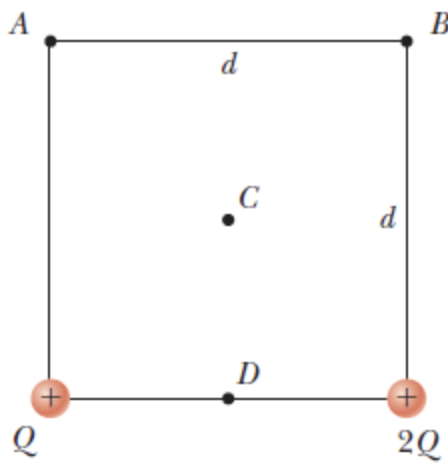
Homework Answers
The concept used to solve this question is electric potential.
First, determine the distance between corresponding charges to the corresponding points by drawing the diagram and then determine the electric potential at point A and B by using the electric potential formula.
Later, determine the electric potential at the point and by using the diagram and the electric potential formula.
Electric potential:
The electric potential is defined as the work required to move a unit charge from a reference point to a specified point.
The electric potential is defined as,
Here, is the electric potential, is the Coulomb constant, is the charge and is the distance between the charged particle to the required point of electric potential.

The total electric potential at any point is calculated as the scalar sum of all potentials due to different charges.
Therefore, the electric potential at point A and B can be expressed as,
…… (1)
Here, and are two charges which have the value of respectively, is the distance of the corresponding point from charge and is the distance of the corresponding point from charge .
The electric potential at point A is .
Substitute for , for , for and for in equation (1).
The electric potential at point B is .
Substitute for , for , for and for in equation (1).
The electric potential at point C is
Substitute for , for , for and for in equation (1).
The electric potential at point D is
Substitute for , for , for and for in equation (1).
From the above explanation, it clearly shows that the electric potential at point D is the highest and at point A is the lowest.
Ans:The order of the electric potential at the points from largest to smallest is .
Rank the electric fluxes through each gaussian surface shown in the figure below from largest to smallest.
 Rank the electric fluxes through each gaussian surface shown in the figure below from largest to smallest. Display any cases of equality in your ranking.(Use only ">" or "=" symbols. Do not include any parentheses around the letters or symbols.)
The four cases below all show a ball with a charge of -3q at the top...
 The four cases below all show a ball with a charge of -3q at the top right corner of a square. Then there is either one, two, or three additional charged balls, each ball located at a different corner of the square. For parts (b) and (c), use q = 3.10 x 10⁻⁶ C, and L = 20.0 cm, as well as k-9.00 x 10⁹ N·m2/C2. -3q -24 -24 (a) Rank the cases based on the magnitude of the net...
The four cases below all show a ball with a charge of-3q at the top right...
 The four cases below all show a ball with a charge of-3q at the top right corner of a square. Then there is either one, two, or three additional charged balls, each ball located at a different corner of the square. For parts (b) and (c), use q-4.50 × 10⁻⁶ C, and L-40.0 cm, as well as k-9.00 x 10⁹ N·m2/C2. -3q -3q -2q tq -2q tg (a) Rank the cases based on the magnitude of the net electrostatic force...
Please show work for all parts of the question. Thanks! The four cases below all show...
 Please show work for all parts of the question. Thanks!
The four cases below all show a ball with a charge of-3q at the top right corner of a square. Then there is either one, two, or three additional charged balls, each ball located at a different corner of the square. For parts (b) and (c), use q = 5.90 × 10⁻⁶ C, and L = 20.0 cm, as well as k = 9.00 x 10⁹ N·m2/C2. 2q (a) Rank...
Please show work for all parts of the question. Thanks!
The four cases below all show a ball with a charge of-3q at the top right corner of a square. Then there is either one, two, or three additional charged balls, each ball located at a different corner of the square. For parts (b) and (c), use q = 5.90 × 10⁻⁶ C, and L = 20.0 cm, as well as k = 9.00 x 10⁹ N·m2/C2. 2q (a) Rank...
Consider the two circuits shown in the figure below in which the batteries are identical. The...
 Consider the two circuits shown in the figure below in which the batteries are identical. The resistance of each lightbulb is R. Neglect the internal resistance of the batteries (a) Find expressions for the currents in each lightbulb. (Use the following as necessary: for ε and R.) IA = is Ic (b) How does the brightness of B compare with that of C? (Use only">or"symbols. Do not include any parentheses around the letters or symbols.) Explain This answer has not...
need help with all 3 parts of this question thanks! The four cases below all show...
 need help with all 3 parts of
this question
thanks!
The four cases below all show a ball with a charge of -3q at the top right corner of a square. Then there is either one, two, or three additional charged balls, each ball located at a different corner of the square. Note that the electric potential is defined to be zero an infinite distance from the charges. For parts (b) and (c), use q-3.50 x 10⁻⁶ c, and L-40.0...
need help with all 3 parts of
this question
thanks!
The four cases below all show a ball with a charge of -3q at the top right corner of a square. Then there is either one, two, or three additional charged balls, each ball located at a different corner of the square. Note that the electric potential is defined to be zero an infinite distance from the charges. For parts (b) and (c), use q-3.50 x 10⁻⁶ c, and L-40.0...
I(current), i didn't get it.
In the circuit shown in the figure below, each battery is delivering energy to the circuit by electrical transmission. All the resistors have equal resistance.(a) Rank the electric potentials at points a, b, c, d, e, f, g, and h from highest to lowest, noting any cases of equality in the ranking. Use only ">" or "="symbols. If any elements are equal, show their equality in alphabetic order (for example: a>b=c).(b) Rank the magnitudes of the currents at the same...
need help with all parts The figure below shows, at a particular instant of time, the...
 need help with all parts
The figure below shows, at a particular instant of time, the velocity vectors of four identical charged particles. The particles are in a uniform magnetic field directed to the right. We will assume that the particles are influenced only by the magnetic field. (a) Rank the four particles based on the magnitude of the magnetic force experienced by the particles at the instant shown in the picture, from largest to smallest. (Use only ">"orsymbols. Do...
need help with all parts
The figure below shows, at a particular instant of time, the velocity vectors of four identical charged particles. The particles are in a uniform magnetic field directed to the right. We will assume that the particles are influenced only by the magnetic field. (a) Rank the four particles based on the magnitude of the magnetic force experienced by the particles at the instant shown in the picture, from largest to smallest. (Use only ">"orsymbols. Do...
Three balls, with masses of 4m, 2m, and m, are equally spaced along a line. The...
 Three balls, with masses of 4m, 2m, and m, are equally spaced along a line. The spacing between neighboring balls is r. We can arrange the balls in three different ways, as shown in the figure. In each case, the balls are in an isolated region of space very far from anything else 2m 2m (a) Rank the three cases, from largest to smallest, based on the magnitude of the net gravitational force experienced by the ball with the mass...
 The four cases below all show a ball with a charge of -3q at the top right corner of a square. Then there is either one, two, or three additional charged balls, each ball located at a different corner of the square. For parts (b) and (c), use q = 3.10 x 10⁻⁶ C, and L = 20.0 cm, as well as k-9.00 x 10⁹ N·m2/C2. -3q -24 -24 (a) Rank the cases based on the magnitude of the net...
 The four cases below all show a ball with a charge of-3q at the top right corner of a square. Then there is either one, two, or three additional charged balls, each ball located at a different corner of the square. For parts (b) and (c), use q-4.50 × 10⁻⁶ C, and L-40.0 cm, as well as k-9.00 x 10⁹ N·m2/C2. -3q -3q -2q tq -2q tg (a) Rank the cases based on the magnitude of the net electrostatic force...
 Please show work for all parts of the question. Thanks!
The four cases below all show a ball with a charge of-3q at the top right corner of a square. Then there is either one, two, or three additional charged balls, each ball located at a different corner of the square. For parts (b) and (c), use q = 5.90 × 10⁻⁶ C, and L = 20.0 cm, as well as k = 9.00 x 10⁹ N·m2/C2. 2q (a) Rank...
Please show work for all parts of the question. Thanks!
The four cases below all show a ball with a charge of-3q at the top right corner of a square. Then there is either one, two, or three additional charged balls, each ball located at a different corner of the square. For parts (b) and (c), use q = 5.90 × 10⁻⁶ C, and L = 20.0 cm, as well as k = 9.00 x 10⁹ N·m2/C2. 2q (a) Rank...
 Consider the two circuits shown in the figure below in which the batteries are identical. The resistance of each lightbulb is R. Neglect the internal resistance of the batteries (a) Find expressions for the currents in each lightbulb. (Use the following as necessary: for ε and R.) IA = is Ic (b) How does the brightness of B compare with that of C? (Use only">or"symbols. Do not include any parentheses around the letters or symbols.) Explain This answer has not...
 need help with all 3 parts of
this question
thanks!
The four cases below all show a ball with a charge of -3q at the top right corner of a square. Then there is either one, two, or three additional charged balls, each ball located at a different corner of the square. Note that the electric potential is defined to be zero an infinite distance from the charges. For parts (b) and (c), use q-3.50 x 10⁻⁶ c, and L-40.0...
need help with all 3 parts of
this question
thanks!
The four cases below all show a ball with a charge of -3q at the top right corner of a square. Then there is either one, two, or three additional charged balls, each ball located at a different corner of the square. Note that the electric potential is defined to be zero an infinite distance from the charges. For parts (b) and (c), use q-3.50 x 10⁻⁶ c, and L-40.0...
 need help with all parts
The figure below shows, at a particular instant of time, the velocity vectors of four identical charged particles. The particles are in a uniform magnetic field directed to the right. We will assume that the particles are influenced only by the magnetic field. (a) Rank the four particles based on the magnitude of the magnetic force experienced by the particles at the instant shown in the picture, from largest to smallest. (Use only ">"orsymbols. Do...
need help with all parts
The figure below shows, at a particular instant of time, the velocity vectors of four identical charged particles. The particles are in a uniform magnetic field directed to the right. We will assume that the particles are influenced only by the magnetic field. (a) Rank the four particles based on the magnitude of the magnetic force experienced by the particles at the instant shown in the picture, from largest to smallest. (Use only ">"orsymbols. Do...
 Three balls, with masses of 4m, 2m, and m, are equally spaced along a line. The spacing between neighboring balls is r. We can arrange the balls in three different ways, as shown in the figure. In each case, the balls are in an isolated region of space very far from anything else 2m 2m (a) Rank the three cases, from largest to smallest, based on the magnitude of the net gravitational force experienced by the ball with the mass...
Most questions answered within 3 hours.
-
Where is the error in this code sequence?
String s1 = "Hello";
String s2 = "ello";...
asked 10 months ago -
Financial data for Joel de Paris, Inc., for last year
follow:
Joel de Paris, Inc.
Balance...
asked 10 months ago -
Consider this reaction:
Al2(SO4)3 (aq)+ BaCl3
(aq) Al2Cl6 (aq)- +
3BaSO4(s) . What is the...
asked 10 months ago -
Suppose that Savneet is considering increasing her
recent random sample from 20 car rentals to 40...
asked 10 months ago -
Trucks arrive at an unloading terminal at an average rate of 120
per hour.
Trucks arrive...
asked 10 months ago -
Why are methanol and ethanol completely soluble in water while
octanol is not very little soluble....
asked 10 months ago -
A facilities manager at a university reads in a research report
that the mean amount of...
asked 10 months ago -
When the CuSO4 is rehydrated by adding water to the anhydrous
compound, is this an endothermic...
asked 10 months ago -
A ray of sunlight is passing from diamond into crown glass; the
angle of incidence is...
asked 10 months ago -
A block of mass 0.249 kg is placed on top of a light, vertical
spring of...
asked 10 months ago -
how do the kidneys compensate in the presences of acidosis
a) trigger hyperventilate
b) reserve acid...
asked 10 months ago -
Question 501 pts
The rental rate of capital to the firm increases. Which of the
following...
asked 10 months ago