What is the angle? (two point charges on 1.0m long threads repel each other after being charged...
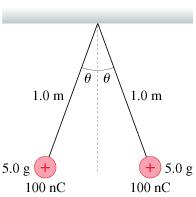
Two 5.0g point charges on 1.0m long threads repel each other after being charged to +100 nC, as shown in the figure.
What is the angle theta?You can assume that theta is a small angle.
The answer is 4.4 degree.Please give steps to getting the answer.
Homework Answers
The concepts required to solve the problem are the force equilibrium, trigonometric relations and electrostatic force.
Initially, consider the components of tension on the thread. Later, use the trigonometric relations to simplify the equation for tension. Finally, compare the force component with equivalent forces to calculate the angle.
The tension on a thread which held a mass at an angle from the vertical axis has two components. The horizontal component of the tension is,

Here,  is the tension,
  is the angle from the vertical axis.
The vertical component of the tension is,

The weight of an object is,

Here,  is the mass of the object and
  is the acceleration due to gravity.
The electrostatic force between two identical charges is,

Here,  is the Coulomb constant,
  is the charge of each charged particle and
  is the distance between the charges.
For small angle  ,
,  and
and  .
.
The opposite side of an angle in a right-angle triangle is,

Here,  is the length of hypotenuse.
The tension on the thread hanging two charged particles have two components of force on it.
The horizontal component of the tension is,

The horizontal component of the force acting on the particle is equivalent to the electrostatic force between them. The electrostatic force between the charges is,
The distance between the charges is,

Substitute  for
for  in the expression for electrostatic force . The electrostatic force between the point charges is,

The horizontal component of tension on the thread is,

Substitute  for
for  and
and  for
for  . The horizontal component of force is,
The angle the charges makes with the vertical axis is very small. Therefore,

Substitute  or
or  . The horizontal component of tension on the thread is,

The vertical component of tension is,

The vertical component of the tension on the thread is balanced by the weight of the charged particle. The weight of charged particle is,

The vertical component of tension is,

Substitute  for
for  and
and  for
for  . The vertical component of force is,

The angle the charges makes with the vertical axis is very small. Therefore,

Substitute  for
for  . The vertical component of the tension on the thread is,

The vertical component of tension on the thread due to the charges is,

The horizontal component of tension on the thread due to the charges is,
Rewrite the equation for horizontal component of the force to calculate the angle. The angle is,

Consider the vertical component of the tension. Substitute  for
for  to find the angle. The angle is,

Substitute  for
for  ,
,  for
for  ,
,  for
for  ,
,  for
for  ,and
,and  for
for and solve for
  .
.
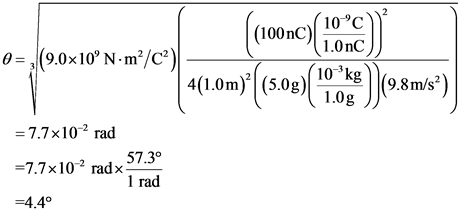
Therefore, the angle  is
is  .
.
The angle is equal to .
Add Answer to:
What is the angle? (two point charges on 1.0m long threads repel each other after being charged...
Two 5.0 g point charges on 1.0-m-long threads repel each other after being charged to +100...
 Two 5.0 g point charges on 1.0-m-long threads repel each other after being charged to +100 nC, as shown in FIGURE P25.58. What is the angle theta? You can assume that is a small angle.
Two m = 5.2 g point charges on 1.0-in-long threads repel each other after being charged...
 Two m = 5.2 g point charges on 1.0-in-long threads repel each other after being charged to q = 80 nC, as shown in the figure. (Figure 1.) What is the angle theta? You can assume that theta is a small angle. Express your answer to two significant figures and include the appropriate units.
Two m = 4.4 g point charges on 1.0 m long threads repel each other after...
 Two m = 4.4 g point charges on 1.0 m long threads repel each
other after being charged to q = 90 nC, as shown in the figure.
What is the angle θ? You can assume that θ is a small angle.
1.0 m 1.0 m
Two m = 4.4 g point charges on 1.0 m long threads repel each
other after being charged to q = 90 nC, as shown in the figure.
What is the angle θ? You can assume that θ is a small angle.
1.0 m 1.0 m
Two m-4.4 g point charges on 1.0-m-long threads repel each other after being charged toq-80 nC,...
 Two m-4.4 g point charges on 1.0-m-long threads repel each other after being charged toq-80 nC, as shown in the figure. (Figure 1) What is the angle θ? You can assume that θ is a small angle. Express your answer to tWo redo icant figures and include the appropriate units. 四? Figure く 1of1 0Value Units Submit Request Answer Provide Feedback 1.0 m 1.0 m
Two m =5.4 g point charges on 1.0-m-long threads repel each other after being charged to g = 80 nC
 Two m =5.4 g point charges on 1.0-m-long threads repel each other after being charged to g = 80 nC ,as shown in the figure. (Figure 1) Part A What is the angle θ? You can assume that θ is a small angle.
Two 3.2 g point charges on 1.0-m-long threads repel each other after being equally charged, as...
 Two 3.2 g point charges on 1.0-m-long threads repel each other
after being equally charged, as shown in the figure.(Figure 1)
Assume that θ= 28 ∘.
What is the charge q?
1.0m/θ θ\ 1.0m Im
Two 3.2 g point charges on 1.0-m-long threads repel each other
after being equally charged, as shown in the figure.(Figure 1)
Assume that θ= 28 ∘.
What is the charge q?
1.0m/θ θ\ 1.0m Im
Two 2.0 g point charges on 1.0-m-long threads repel each other after being equally charged, as...
 Two 2.0 g point charges on 1.0-m-long threads repel each other after being equally charged, as shown m the figure.(Figure 1)Assume that theta=16 degree. Part A What is the charge theta? Express your answer to two significant figures and Include the appropriate units.
Two m = 4.0 g point charges on 1.0-m-long threads repel each other after being charged...
 Two m = 4.0 g point charges on 1.0-m-long threads repel each other after being charged to q 120 nC, as shown in the figure. (Figure 1) What is the angle 0? You can assume that θ is a small angle. Express your answer to two significant figures and include Value Units igure 1 of1 > 1.0 m1.0 m In
Problem 22.62 Two m 4.8 g point charges on 1.0-m-long threads repel each other after being...
 Problem 22.62 Two m 4.8 g point charges on 1.0-m-long threads repel each other after being charged to q 90 nC, as shown in the figure Figure 1) Part A What is the angle θ? You can assume that θ is a small angle Express your answer to two significant figures and include the appropriate units. Value Units Submit ues Return to Assignment Provide Feedback Figure 1 of 1 1.0 m 1.0 m
Review Part A Two m = 5.0 g point charges on 1.0-11-long threads repel each other...
 Review Part A Two m = 5.0 g point charges on 1.0-11-long threads repel each other after being charged to q 110 nC, as shown in the figure. (Figure 1) What is the angle θ? You can assume that θ is a small angle. Express your answer to two significant figures and include the appropriate units. 5.213 Previous Answers Request Answer Figure 1 of 1 X Incorrect; Try Again; 3 attempts remaining Provide Feedback 1.0 m 1.0 m + m...
 Two 5.0 g point charges on 1.0-m-long threads repel each other after being charged to +100 nC, as shown in FIGURE P25.58. What is the angle theta? You can assume that is a small angle.
 Two m = 5.2 g point charges on 1.0-in-long threads repel each other after being charged to q = 80 nC, as shown in the figure. (Figure 1.) What is the angle theta? You can assume that theta is a small angle. Express your answer to two significant figures and include the appropriate units.
 Two m = 4.4 g point charges on 1.0 m long threads repel each
other after being charged to q = 90 nC, as shown in the figure.
What is the angle θ? You can assume that θ is a small angle.
1.0 m 1.0 m
Two m = 4.4 g point charges on 1.0 m long threads repel each
other after being charged to q = 90 nC, as shown in the figure.
What is the angle θ? You can assume that θ is a small angle.
1.0 m 1.0 m
 Two m-4.4 g point charges on 1.0-m-long threads repel each other after being charged toq-80 nC, as shown in the figure. (Figure 1) What is the angle θ? You can assume that θ is a small angle. Express your answer to tWo redo icant figures and include the appropriate units. 四? Figure く 1of1 0Value Units Submit Request Answer Provide Feedback 1.0 m 1.0 m
 Two 3.2 g point charges on 1.0-m-long threads repel each other
after being equally charged, as shown in the figure.(Figure 1)
Assume that θ= 28 ∘.
What is the charge q?
1.0m/θ θ\ 1.0m Im
Two 3.2 g point charges on 1.0-m-long threads repel each other
after being equally charged, as shown in the figure.(Figure 1)
Assume that θ= 28 ∘.
What is the charge q?
1.0m/θ θ\ 1.0m Im
 Two 2.0 g point charges on 1.0-m-long threads repel each other after being equally charged, as shown m the figure.(Figure 1)Assume that theta=16 degree. Part A What is the charge theta? Express your answer to two significant figures and Include the appropriate units.
 Two m = 4.0 g point charges on 1.0-m-long threads repel each other after being charged to q 120 nC, as shown in the figure. (Figure 1) What is the angle 0? You can assume that θ is a small angle. Express your answer to two significant figures and include Value Units igure 1 of1 > 1.0 m1.0 m In
 Problem 22.62 Two m 4.8 g point charges on 1.0-m-long threads repel each other after being charged to q 90 nC, as shown in the figure Figure 1) Part A What is the angle θ? You can assume that θ is a small angle Express your answer to two significant figures and include the appropriate units. Value Units Submit ues Return to Assignment Provide Feedback Figure 1 of 1 1.0 m 1.0 m
 Review Part A Two m = 5.0 g point charges on 1.0-11-long threads repel each other after being charged to q 110 nC, as shown in the figure. (Figure 1) What is the angle θ? You can assume that θ is a small angle. Express your answer to two significant figures and include the appropriate units. 5.213 Previous Answers Request Answer Figure 1 of 1 X Incorrect; Try Again; 3 attempts remaining Provide Feedback 1.0 m 1.0 m + m...
Most questions answered within 3 hours.
-
Where is the error in this code sequence?
String s1 = "Hello";
String s2 = "ello";...
asked 10 months ago -
Financial data for Joel de Paris, Inc., for last year
follow:
Joel de Paris, Inc.
Balance...
asked 10 months ago -
Consider this reaction:
Al2(SO4)3 (aq)+ BaCl3
(aq) Al2Cl6 (aq)- +
3BaSO4(s) . What is the...
asked 10 months ago -
Suppose that Savneet is considering increasing her
recent random sample from 20 car rentals to 40...
asked 10 months ago -
Trucks arrive at an unloading terminal at an average rate of 120
per hour.
Trucks arrive...
asked 10 months ago -
Why are methanol and ethanol completely soluble in water while
octanol is not very little soluble....
asked 10 months ago -
A facilities manager at a university reads in a research report
that the mean amount of...
asked 10 months ago -
When the CuSO4 is rehydrated by adding water to the anhydrous
compound, is this an endothermic...
asked 10 months ago -
A ray of sunlight is passing from diamond into crown glass; the
angle of incidence is...
asked 10 months ago -
A block of mass 0.249 kg is placed on top of a light, vertical
spring of...
asked 10 months ago -
how do the kidneys compensate in the presences of acidosis
a) trigger hyperventilate
b) reserve acid...
asked 10 months ago -
Question 501 pts
The rental rate of capital to the firm increases. Which of the
following...
asked 10 months ago