In an amusement park ride called The Roundup, passengers stand inside a 16.0m -diameter rotating ring. After the ring h...
In an amusement park ride called The Roundup, passengers stand inside a 16.0m -diameter rotating ring. After the ring has acquired sufficient speed, it tilts into a vertical plane, as shown in the figure.
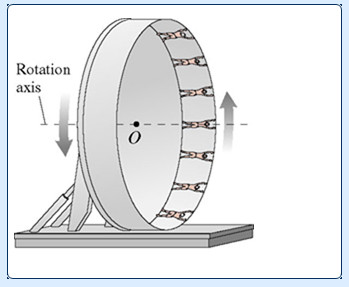
Part A) Suppose the ring rotates once every 3.60s. If a rider's mass is 55.0kg, with how much force does the ring push on her at the top of the ride?
______N
Part B) Suppose the ring rotates once every 3.60s. If a rider's mass is 55.0kg, with how much force does the ring push on her at the bottom of the ride?
_____N
Part C) What is the longest rotation period of the wheel that will prevent the riders from falling off at the top?
_____seconds
Homework Answers
The concepts required to solve the problems are the centripetal force and force equilibrium.
First use the period and the total circumference of the round up wheel to calculate the velocity of the rider. Then, use the velocity to calculate the centripetal force on the rider. Finally, use the force equilibrium to calculate the normal force.
The radius of a circle is,
Here, is the diameter of the circle.
The circumference of a circle is,
The speed is the total distance covered in a given time. The speed is,
Here, is the distance covered and is the time taken.
The centripetal force acting on a body moving in circular path is,
Here, is the mass of the body.
Weight of a body is,
Here, is the acceleration due to gravity.
Part A
The radius of the wheel is,
Here, is the diameter of the wheel.
Substitute for . The radius of the wheel is,
The circumference of the wheel is,
Substitute for and for . The circumference of the wheel is,
The speed of rider is,
Here, is the total distance covered by the rider in one revolution and is the time period.
Substitute for and for . The speed of the rider is,
The centripetal force acting on the rider is,
Here, is the mass of the rider.
Substitute for , for , and for . The centripetal force is,
The weight of the rider is,
Substitute for and for . The weight of the rider is,
The force equilibrium at the top of the wheel is,
Here, is the force that the ring pushes the rider.
Rewrite the equation in terms of the force that the ring pushes on the rider at the top. The force is,
Substitute for and for . The force is,
Part B
The force equilibrium at the bottom of the wheel is,
Rewrite the equation in terms of the force that the ring pushes on the rider at the bottom. The force is,
Substitute for and for . The force is,
Part C
The force required to keep the rider in a circular motion without falling, at the top of the wheel is,
Rewrite the equation in terms of speed of the rider. The speed is,
Substitute for and for . The speed is,
The time required for the rider to complete one revolution is,
Substitute for and for . The time is,
Ans: Part A
The force that the ring pushes the rider at the top is .
Add Answer to:
In an amusement park ride called The Roundup, passengers stand inside a 16.0m -diameter rotating ring. After the ring h...
In an amusement park ride called The Roundup, passengers stand inside a 18.0m -diameter rotating ring
 In an amusement park ride called The Roundup, passengers stand inside a 18.0m -diameter rotating ring. After the ring has acquired sufficient speed, it tilts into a vertical plane, as shown in the figure.Part A) Suppose the ring rotates once every 4.20s. If a rider's mass is 55.0kg, with how much force does the ring push on her at the top of the ride?Part B) Suppose the ring rotates once every 4.20s. If a rider's mass is 55.0kg, with how much force...
In an amusement park ride called The Roundup, passengers stand inside a 17.0 m -diameter rotating...
In an amusement park ride called The Roundup, passengers stand inside a 17.0 m -diameter rotating ring. After the ring has acquired sufficient speed, it tilts into a vertical plane. Suppose the ring rotates once every 4.50 s . If a rider's mass is 56.0 kg , with how much force does the ring push on her at the top of the ride? Suppose the ring rotates once every 4.50 s . If a rider's mass is 56.0 kg ,...
forces
In an amusement park ride called The Roundup, passengers stand inside a 18.0 m-diameter rotating ring. After the ring has acquired sufficient speed, it tilts into avertical plane, as shown in the figure .A)Suppose the ring rotates once every 4.40 s. If a rider's mass is 59.0 kg, with how much force does the ring push on her at the top of the ride?B)Suppose the ring rotates once every 4.40 s. If a rider's mass is 59.0 kg, with how...
A Ferris wheel is a vertical, circular amusement ride with radius 8.5 m. Riders sit on...
A Ferris wheel is a vertical, circular amusement ride with radius 8.5 m. Riders sit on seats that swivel to remain horizontal. The Ferris wheel rotates at a constant rate, going around once in 7.3 s. Consider a rider whose mass is 73 kg. a. At the bottom of the ride, what is the vector gravitational force exerted by the Earth on the rider? b. At the top of the ride, what is the rate of change of the rider's...
Constants | Periodic Table Part A In an old-fashioned amusement park ride, passengers stand inside a...
 Constants | Periodic Table Part A In an old-fashioned amusement park ride, passengers stand inside a 5.1-m-diameter hollow steel cylinder with their backs against the wall. The cylinder begins to rotate about a vertical axis. Then the floor on which the passengers are standing suddenly drops away! If all goes well, the passengers will "stick" to the wall and not slide. Clothing has a static coefficient of friction against steel in the range 0.64 to 1.0 and a kinetic coefficient...
An amusement park ride consists of a rotating vertical cylinder with rough canvas walls. The floor...
 An amusement park ride consists of a rotating vertical cylinder
with rough canvas walls. The floor is initially about halfway up
the cylinder wall as shown. After the rider has entered and the
cylinder is rotating sufficiently fast, the floor is dropped down,
, yet the rider does not slide down. The rider has mass of 50 kg.
The diameter of the cylinder is 6.5 meters. The coefficient of
static friction between the rider and wall of the cylinder is...
An amusement park ride consists of a rotating vertical cylinder
with rough canvas walls. The floor is initially about halfway up
the cylinder wall as shown. After the rider has entered and the
cylinder is rotating sufficiently fast, the floor is dropped down,
, yet the rider does not slide down. The rider has mass of 50 kg.
The diameter of the cylinder is 6.5 meters. The coefficient of
static friction between the rider and wall of the cylinder is...
 Constants | Periodic Table Part A In an old-fashioned amusement park ride, passengers stand inside a 5.1-m-diameter hollow steel cylinder with their backs against the wall. The cylinder begins to rotate about a vertical axis. Then the floor on which the passengers are standing suddenly drops away! If all goes well, the passengers will "stick" to the wall and not slide. Clothing has a static coefficient of friction against steel in the range 0.64 to 1.0 and a kinetic coefficient...
 An amusement park ride consists of a rotating vertical cylinder
with rough canvas walls. The floor is initially about halfway up
the cylinder wall as shown. After the rider has entered and the
cylinder is rotating sufficiently fast, the floor is dropped down,
, yet the rider does not slide down. The rider has mass of 50 kg.
The diameter of the cylinder is 6.5 meters. The coefficient of
static friction between the rider and wall of the cylinder is...
An amusement park ride consists of a rotating vertical cylinder
with rough canvas walls. The floor is initially about halfway up
the cylinder wall as shown. After the rider has entered and the
cylinder is rotating sufficiently fast, the floor is dropped down,
, yet the rider does not slide down. The rider has mass of 50 kg.
The diameter of the cylinder is 6.5 meters. The coefficient of
static friction between the rider and wall of the cylinder is...
Most questions answered within 3 hours.
-
Where is the error in this code sequence?
String s1 = "Hello";
String s2 = "ello";...
asked 10 months ago -
Financial data for Joel de Paris, Inc., for last year
follow:
Joel de Paris, Inc.
Balance...
asked 10 months ago -
Consider this reaction:
Al2(SO4)3 (aq)+ BaCl3
(aq) Al2Cl6 (aq)- +
3BaSO4(s) . What is the...
asked 10 months ago -
Suppose that Savneet is considering increasing her
recent random sample from 20 car rentals to 40...
asked 10 months ago -
Trucks arrive at an unloading terminal at an average rate of 120
per hour.
Trucks arrive...
asked 10 months ago -
Why are methanol and ethanol completely soluble in water while
octanol is not very little soluble....
asked 10 months ago -
A facilities manager at a university reads in a research report
that the mean amount of...
asked 10 months ago -
When the CuSO4 is rehydrated by adding water to the anhydrous
compound, is this an endothermic...
asked 10 months ago -
A ray of sunlight is passing from diamond into crown glass; the
angle of incidence is...
asked 10 months ago -
A block of mass 0.249 kg is placed on top of a light, vertical
spring of...
asked 10 months ago -
how do the kidneys compensate in the presences of acidosis
a) trigger hyperventilate
b) reserve acid...
asked 10 months ago -
Question 501 pts
The rental rate of capital to the firm increases. Which of the
following...
asked 10 months ago