To understand kinetic and static friction. A block of mass m lies on a horizontal table. The coefficient of static fric...
To understand kinetic and static friction. A block of mass m lies on a horizontal table. The coefficient of static friction between the block and the table is μs. The coefficient of kinetic friction is μk, with μk<μs.
a-
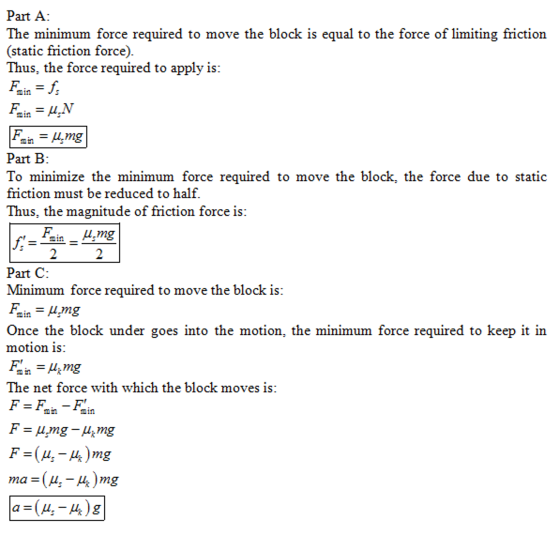
Suppose you want to move the block, but you want to push it with the least force possible to get it moving. With what force F must you be pushing the block just before the block begins to move?
Express the magnitude of F in terms of some or all the variables μs, μk, and m, as well as the acceleration due to gravity g.
b-Suppose you push horizontally with half the force needed to just make the block move. What is the magnitude of the friction force?
Express your answer in terms of some or all of the variables μs, μk, and m, as well as the acceleration due to gravity g.
c-
Suppose you push horizontally with precisely enough force to make the block start to move, and you continue to apply the same amount of force even after it starts moving. Find the acceleration a of the block after it begins to move.
Express your answer in terms of some or all of the variables μs, μk, and m, as well as the acceleration due to gravity g.
Homework Answers
Add Answer to:
To understand kinetic and static friction. A block of mass m
lies on a horizontal table. The coefficient of static fric...
To understand kinetic and static friction. A block of mass m lies on a horizontal table....
To understand kinetic and static friction. A block of mass m lies on a horizontal table. The coefficient of static friction between the block and the table is μs. The coefficient of kinetic friction isμk, with μk<μs. Part B Suppose you want to move the block, but you want to push it with the least force possible to get it moving. With what force F must you be pushing the block just before the block begins to move? Part C...
A block of mass m lies on a horizontal table. The coefficient of static friction between...
A block of mass m lies on a horizontal table. The coefficient of static friction between the block and the table is ?s. The coefficient of kinetic friction is ?k, with ?k<?s. 1)If the block is at rest (and the only forces acting on the block are the force due to gravity and the normal force from the table), what is the magnitude of the force due to friction? 2)Suppose you want to move the block, but you want to...
If the coefficients of static and kinetic friction between mass M1 and the top of the...
If the coefficients of static and kinetic friction between mass M1 and the top of the table are equal to μs=0.40 & μk=0.20 respectively, show that the masses are going to move and determine the acceleration by which they are moving. M1=5Kg & M2=10 Kg m1 m2
The block has a mass of 50 kg. The coefficient of kinetic friction between the ice...
The block has a mass of 50 kg. The coefficient of kinetic friction between the ice and the block is μk = 0.01 . How hard will you have to push on the block to keep it moving at a constant speed of 1.2 m/s? It is at an angle of 25 degrees pushing downwards. Show answer with units. Please and thank you.
A 13.0kg object is moving on a flat, horizontal surface. If the coefficient of kinetic friction...
A 13.0kg object is moving on a flat, horizontal surface. If the coefficient of kinetic friction between the mass and the surface is 0.48, find the force of friction acting on the object. Express your answer correct to 1 decimal places and consider the acceleration due to gravity, g = 9.8 m/s2. Add the appropriate unit(s).
A block with mass M = 2kg rests on a horizontal table with static and kinetic...
A block with mass M = 2kg rests on a horizontal table with static and kinetic friction coefficients µs = 0.7, µk = 0.6, respectively. A lighter block with mass m = 1kg is hanging from a string which is attached to the 1st block. (a) Find the acceleration a of the system (b) find the tension T of the string. (c) find friction f (depends if the block is moving or not!!) (d) find the maximum m when the...
A block weighing 12N rests on a table. If the coefficient of static friction is 0.8...
A block weighing 12N rests on a table. If the coefficient of static friction is 0.8 and the coefficient of kinetic friction is 0.6, then how much horizontal force is required to get the block moving?
The coefficient of static friction is 0.5 and coefficient of kinetic friction is 0.4. The mass...
 The coefficient of static friction is 0.5 and coefficient of kinetic friction is 0.4. The mass of the block is 48Kg, as shown in the figure. Draw free body diagram Calculate the acceleration.
Sam is trying to move a dresser of mass m and dimensions of length L and height H by pushing it with a horizontal force...
Sam is trying to move a dresser of mass m and dimensions of length L and height H by pushing it with a horizontal force F⃗ applied at a height h above the floor. (Figure 1) The coefficient of kinetic friction between the dresser and the floor is μk and g is the magnitude of the acceleration due to gravity. The ground exerts upward normal forces of magnitudes NP and NQ at the two ends of the dresser. Note that...
A 24-N block rests on a horizontal surface. The coefficients of static and kinetic friction between...
 A 24-N block rests on a horizontal surface.
The coefficients of static and kinetic friction between the surface
and the block are ?s=0.76 and ?k=0.34. A horizontal string is
attached to the block and a constant tension T is maintained in the
string.
blem 5-23a: A 24 N block rests on a horizontal surface. The coefficients of static and kinetic friction between the surface and the block are us=0.76 and μk=0.34. A horizontal string is attached to the block and...
A 24-N block rests on a horizontal surface.
The coefficients of static and kinetic friction between the surface
and the block are ?s=0.76 and ?k=0.34. A horizontal string is
attached to the block and a constant tension T is maintained in the
string.
blem 5-23a: A 24 N block rests on a horizontal surface. The coefficients of static and kinetic friction between the surface and the block are us=0.76 and μk=0.34. A horizontal string is attached to the block and...
 The coefficient of static friction is 0.5 and coefficient of kinetic friction is 0.4. The mass of the block is 48Kg, as shown in the figure. Draw free body diagram Calculate the acceleration.
 A 24-N block rests on a horizontal surface.
The coefficients of static and kinetic friction between the surface
and the block are ?s=0.76 and ?k=0.34. A horizontal string is
attached to the block and a constant tension T is maintained in the
string.
blem 5-23a: A 24 N block rests on a horizontal surface. The coefficients of static and kinetic friction between the surface and the block are us=0.76 and μk=0.34. A horizontal string is attached to the block and...
A 24-N block rests on a horizontal surface.
The coefficients of static and kinetic friction between the surface
and the block are ?s=0.76 and ?k=0.34. A horizontal string is
attached to the block and a constant tension T is maintained in the
string.
blem 5-23a: A 24 N block rests on a horizontal surface. The coefficients of static and kinetic friction between the surface and the block are us=0.76 and μk=0.34. A horizontal string is attached to the block and...
Most questions answered within 3 hours.
-
Where is the error in this code sequence?
String s1 = "Hello";
String s2 = "ello";...
asked 10 months ago -
Financial data for Joel de Paris, Inc., for last year
follow:
Joel de Paris, Inc.
Balance...
asked 10 months ago -
Consider this reaction:
Al2(SO4)3 (aq)+ BaCl3
(aq) Al2Cl6 (aq)- +
3BaSO4(s) . What is the...
asked 10 months ago -
Suppose that Savneet is considering increasing her
recent random sample from 20 car rentals to 40...
asked 10 months ago -
Trucks arrive at an unloading terminal at an average rate of 120
per hour.
Trucks arrive...
asked 10 months ago -
Why are methanol and ethanol completely soluble in water while
octanol is not very little soluble....
asked 10 months ago -
A facilities manager at a university reads in a research report
that the mean amount of...
asked 10 months ago -
When the CuSO4 is rehydrated by adding water to the anhydrous
compound, is this an endothermic...
asked 10 months ago -
A ray of sunlight is passing from diamond into crown glass; the
angle of incidence is...
asked 10 months ago -
A block of mass 0.249 kg is placed on top of a light, vertical
spring of...
asked 10 months ago -
how do the kidneys compensate in the presences of acidosis
a) trigger hyperventilate
b) reserve acid...
asked 10 months ago -
Question 501 pts
The rental rate of capital to the firm increases. Which of the
following...
asked 10 months ago