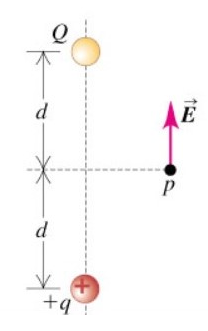
Two point charges Q and +q (where q is positive) produce the net electric field shown at point P in the figure (Figure 1...
Two point charges Q and +q (where q is positive) produce the net electric field shown at point P in the figure (Figure 1). The field points parallel to the line connecting the two charges. What can you conclude about the magnitude of Q?
Homework Answers
Since Q is negative, then the field is in the upward direction. And it adday up with the upward field due to charge q. So any finite negative value of Q will satisfy the mentioned condition.
|Q| = any finite value.
If Q is positive, the magnitude of Q must never smaller than that if q, in order to make the net field in the upward direction. So when Q is positive, then
|Q| < q
a. Q is negative
b. |Q| = q
c. no would not be possible if the lower charge were negative
Add Answer to:
Two point charges Q and +q (where q is positive) produce the net electric field shown at point P in the figure (Figure 1...
Determine magnitude of the electric field at the point P shown in the figure(Figure 1) ....
Determine magnitude of the electric field at the point P shown in the figure(Figure 1) . The two charges are separated by a distance of 2a. Point P is on the perpendicular bisector of the line joining the charges, a distance x from the midpoint between them.Determine the direction of the electric field. Assume that the positive x and y axes are directed to the right and upward respectively.
Use Coulomb's law to determine the magnitude of the electric field at points A and B in (Figure 1) due to the two positive charges (Q = 4.1 μC ) shown. Suppose that a = 4.1 cm. Determine the magnitude of the electric field at A. Determine the angle betwee
 ROBOT, do not answer. You are not helpful.Use Coulomb's law to determine the magnitude of the electric field at
points A and B in (Figure 1) due to the two positive charges (Q = 4.1
μC ) shown. Suppose that a = 4.1 cm. A) Determine the magnitude of the electric field at A. B) Determine the angle between the direction of the electric field at point A and the positive x-direction. C) Determine the magnitude of the electric field...
ROBOT, do not answer. You are not helpful.Use Coulomb's law to determine the magnitude of the electric field at
points A and B in (Figure 1) due to the two positive charges (Q = 4.1
μC ) shown. Suppose that a = 4.1 cm. A) Determine the magnitude of the electric field at A. B) Determine the angle between the direction of the electric field at point A and the positive x-direction. C) Determine the magnitude of the electric field...
Use Coulomb's law to determine the magnitude of the electric field at points A and B in (Figure 1) due to the two positive charges (Q = 4.5 μC ) shown. Suppose that a = 4.3 cm
 Use Coulomb's law to determine the magnitude of the electric
field at points A and B in (Figure 1) due to the two positive
charges (Q = 4.5 μC ) shown. Suppose that a = 4.3 cm .A) Determine the magnitude of the electric field at A. B) Determine the angle between the direction of the electric field
at point A and the positive x-direction. C) Determine the magnitude
of the electric field at point B. D) Determine the angle between the
direction...
Use Coulomb's law to determine the magnitude of the electric
field at points A and B in (Figure 1) due to the two positive
charges (Q = 4.5 μC ) shown. Suppose that a = 4.3 cm .A) Determine the magnitude of the electric field at A. B) Determine the angle between the direction of the electric field
at point A and the positive x-direction. C) Determine the magnitude
of the electric field at point B. D) Determine the angle between the
direction...
Use Coulomb's law to determine the magnitude of the electric field at points A and B in (Figure 1) due to the two positive charges (Q = 4.1 μC ) shown. Suppose that a = 4.1 cm. Determine the magnitude of the electric field at A. Determine the angle betwee
 Use Coulomb's law to determine the magnitude of the electric field at points A and B in (Figure 1) due to the two positive charges (Q = 4.1 μC ) shown. Suppose that a = 4.1 cm. A) Determine the magnitude of the electric field at A. B) Determine the angle between the direction of the electric field at point A and the positive x-direction. C) Determine the magnitude of the electric field at point B.D) Determine the angle between...
Part A Constants Find the magnitude of the net electric field these charges produce at point...
 Part A Constants Find the magnitude of the net electric field these charges produce at point A Two point charges are separated by 25.0 cm (see the figure(Figure 1)) 6.54. 10 N/C Figure 1 of 1 Submit Previous Answers Request Answer X Incorrect: Try Again; 5 attempts remaining -6.25 nC -12.5 nC Part B 10.0 cm 100 cm Find the direction of the net electric field these charges produce at point A 25.0cm Ploaso Please Choose The field is directed...
Speed of an Electron in an Electric Field Two stationary positive point charges, change 1 of...
 Speed of an Electron in an Electric Field Two stationary positive point charges, change 1 of magnitude 3.30nC and charge 2 of magnitude 1.75nC, are separated by a distance of 3.7.0 cm. An electron is released from rest at point midway between the two charges, and it moves along the line connecting the two charges. Part A What is the speed Vfinal of the electron when it is 10.0 cm from charge 1 ? Express your answer in meters per...
Three negative point charges lie along a line as shown in the figure (Figure 1)
 Three negative point charges lie along a line as shown in the figure (Figure 1) You may want to review (Pages 699-704)Part A Find the magnitude of the electric field this combination of charges produces at point P, which lies 6.00 cm from the -2.00 μC charge measured perpendicular to the line connecting the three charges. Part B Find the direction of the electric field this combination of charges produces at point P, which lies 6.00 cm from the -2.00 μC charge measured perpendicular...
Shown below are arrangements of fixed electric charges. In each figure a point labeled P is...
 Shown below are arrangements of fixed electric charges. In each figure a point labeled P is identified. All charges are of the same size q but can be either + or -, as indicated. The scale of the grid in each arrangement is the same, with the grid unit of length d. (a) Calculate the magnitude of the electric field at the point marked fay X due to the other two charges and rank than from lowest magnitude to highest...
Please answer both questions. Determine magnitude of the electric field at the point P shown in...
 Please answer both questions.
Determine magnitude of the electric field at the point P shown in the figure(Figure 1). The two charges are separated by a distance of 2a. Point P is on the perpendicular bisector of the line joining the charges, a distance from the midpoint between them. Express your answer in terms of Q, z, a, and k. E= Submit Request Answer Part B Determine the direction of the electric field. Assume that the positive x and y...
Please answer both questions.
Determine magnitude of the electric field at the point P shown in the figure(Figure 1). The two charges are separated by a distance of 2a. Point P is on the perpendicular bisector of the line joining the charges, a distance from the midpoint between them. Express your answer in terms of Q, z, a, and k. E= Submit Request Answer Part B Determine the direction of the electric field. Assume that the positive x and y...
Two positive point charges +q and two negative point charges-q are fixed at the corners of...
 Two positive point charges +q and two negative point charges-q are fixed at the corners of a square of side a, as shown in the figure. The square is centered on the origin, and a positive test charge Q is placed at the origin. -q 1) Calculate the components E, and Ey of the electric field at the origin due to the 4 charges at the corners of the square. [8] AwA 2) Let F be the force experienced by...
 Part A Constants Find the magnitude of the net electric field these charges produce at point A Two point charges are separated by 25.0 cm (see the figure(Figure 1)) 6.54. 10 N/C Figure 1 of 1 Submit Previous Answers Request Answer X Incorrect: Try Again; 5 attempts remaining -6.25 nC -12.5 nC Part B 10.0 cm 100 cm Find the direction of the net electric field these charges produce at point A 25.0cm Ploaso Please Choose The field is directed...
 Speed of an Electron in an Electric Field Two stationary positive point charges, change 1 of magnitude 3.30nC and charge 2 of magnitude 1.75nC, are separated by a distance of 3.7.0 cm. An electron is released from rest at point midway between the two charges, and it moves along the line connecting the two charges. Part A What is the speed Vfinal of the electron when it is 10.0 cm from charge 1 ? Express your answer in meters per...
 Shown below are arrangements of fixed electric charges. In each figure a point labeled P is identified. All charges are of the same size q but can be either + or -, as indicated. The scale of the grid in each arrangement is the same, with the grid unit of length d. (a) Calculate the magnitude of the electric field at the point marked fay X due to the other two charges and rank than from lowest magnitude to highest...
 Please answer both questions.
Determine magnitude of the electric field at the point P shown in the figure(Figure 1). The two charges are separated by a distance of 2a. Point P is on the perpendicular bisector of the line joining the charges, a distance from the midpoint between them. Express your answer in terms of Q, z, a, and k. E= Submit Request Answer Part B Determine the direction of the electric field. Assume that the positive x and y...
Please answer both questions.
Determine magnitude of the electric field at the point P shown in the figure(Figure 1). The two charges are separated by a distance of 2a. Point P is on the perpendicular bisector of the line joining the charges, a distance from the midpoint between them. Express your answer in terms of Q, z, a, and k. E= Submit Request Answer Part B Determine the direction of the electric field. Assume that the positive x and y...
 Two positive point charges +q and two negative point charges-q are fixed at the corners of a square of side a, as shown in the figure. The square is centered on the origin, and a positive test charge Q is placed at the origin. -q 1) Calculate the components E, and Ey of the electric field at the origin due to the 4 charges at the corners of the square. [8] AwA 2) Let F be the force experienced by...
Most questions answered within 3 hours.
-
Where is the error in this code sequence?
String s1 = "Hello";
String s2 = "ello";...
asked 10 months ago -
Financial data for Joel de Paris, Inc., for last year
follow:
Joel de Paris, Inc.
Balance...
asked 10 months ago -
Consider this reaction:
Al2(SO4)3 (aq)+ BaCl3
(aq) Al2Cl6 (aq)- +
3BaSO4(s) . What is the...
asked 10 months ago -
Suppose that Savneet is considering increasing her
recent random sample from 20 car rentals to 40...
asked 10 months ago -
Trucks arrive at an unloading terminal at an average rate of 120
per hour.
Trucks arrive...
asked 10 months ago -
Why are methanol and ethanol completely soluble in water while
octanol is not very little soluble....
asked 10 months ago -
A facilities manager at a university reads in a research report
that the mean amount of...
asked 10 months ago -
When the CuSO4 is rehydrated by adding water to the anhydrous
compound, is this an endothermic...
asked 10 months ago -
A ray of sunlight is passing from diamond into crown glass; the
angle of incidence is...
asked 10 months ago -
A block of mass 0.249 kg is placed on top of a light, vertical
spring of...
asked 10 months ago -
how do the kidneys compensate in the presences of acidosis
a) trigger hyperventilate
b) reserve acid...
asked 10 months ago -
Question 501 pts
The rental rate of capital to the firm increases. Which of the
following...
asked 10 months ago