Two ice skaters, Daniel (mass 65 kg) and Rebecca (mass 45 kg), are practicing.
Two ice skaters, Daniel (mass 65 kg) and Rebecca (mass 45 kg), are practicing. Daniel is initially at rest when struck by Rebecca moving at 13 m/s. After the collision, Rebecca has a velocity of 8 m/s at an angle of 53.10 from her initial direction.
a) What are the magnitude and direction of Daniel's velocity after the collision?
b) What is the change in kinetic energy of the two skaters as a result of the collision?
Homework Answers
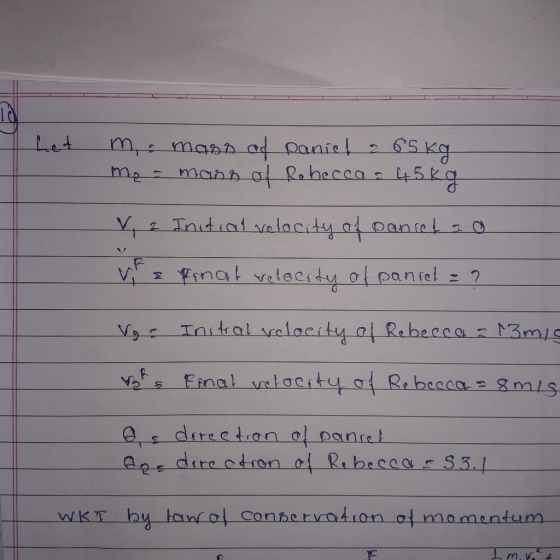
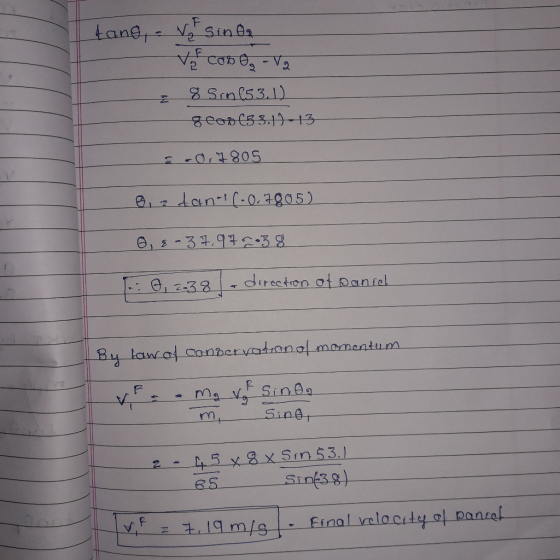

The question 10 is solved in the attached image.
(Note-change in kinetic energy is the energy lost after collision,energy loss can be represented by negative symbol i.e -682.38 j is the change in kinetic energy)
Add Answer to:
Two ice skaters, Daniel (mass 65 kg) and Rebecca (mass 45 kg), are practicing.
Two ice skaters, Daniel (mass 70.0 kg ) and Rebecca (mass 45.0 kg ), are practicing....
Two ice skaters, Daniel (mass 70.0 kg ) and Rebecca (mass 45.0 kg ), are practicing. Daniel stops to tie his shoelace and, while at rest, is struck by Rebecca, who is moving at 14.0 m/s before she collides with him. After the collision, Rebecca has a velocity of magnitude 7.00 m/s at an angle of 55.1 ∘ from her initial direction. Both skaters move on the frictionless, horizontal surface of the rink. Part A What is the magnitude of...
need help with this two questions, please !! Two ice skaters, Daniel (mass 60.0 kg) and...
 need help with this two questions, please !!
Two ice skaters, Daniel (mass 60.0 kg) and Rebecca (mass 45.0 kg), are practicing. Daniel stops to tie his shoelace and, while at rest, is struck by Rebecca, who is moving at 13.0 m/s before she collides with him. After the collision, Rebecca has a velocity of magnitude 7.00 m/s at an angle of 54.1" from her initial direction. Both skaters move on the frictionless, horizontal surface of the rink. What is...
need help with this two questions, please !!
Two ice skaters, Daniel (mass 60.0 kg) and Rebecca (mass 45.0 kg), are practicing. Daniel stops to tie his shoelace and, while at rest, is struck by Rebecca, who is moving at 13.0 m/s before she collides with him. After the collision, Rebecca has a velocity of magnitude 7.00 m/s at an angle of 54.1" from her initial direction. Both skaters move on the frictionless, horizontal surface of the rink. What is...
. Two ice skaters collide on the ice. A 39.6-kg skater moving South at 6.21 m/s...
. Two ice skaters collide on the ice. A 39.6-kg skater moving South at 6.21 m/s collides with a 52.1-kg skater moving East at 4.33 m/s. The two skaters entangle and move together across the ice. Determine the magnitude and direction of their post-collision velocity
A ball with a mass of 0.615 kg is initially at rest. It is struck by...
A ball with a mass of 0.615 kg is initially at rest. It is struck by a second ball having a mass of 0.410 kg , initially moving with a velocity of 0.235 m/s toward the right along the x axis. After the collision, the 0.410 kg ball has a velocity of 0.200 m/s at an angle of 36.8 ∘ above the x axis in the first quadrant. Both balls move on a frictionless, horizontal surface. What is the magnitude...
Two ice skaters are gliding together along the ice, both moving at the same, constant velocity...
Two ice skaters are gliding together along the ice, both moving at the same, constant velocity (sliding without exerting a force). The first skater (the one in the back), with mass M1 = 62.3 kg, pushes the second skater (the one in front), with mass M2 = 70.4 kg, directly forward in the direction they are initially moving. After the push the first skater is not moving (velocity = 0) and the second skater is moving with a velocity of...
Two skaters gliding on ice run into each other head-on. If the two skaters hold onto each other and continue to move as a unit after the collision
Part III: Solve the following problems Two skaters gliding on ice run into each other head-on. If the two skaters hold onto each other and continue to move as a unit after the collision, what will be their resultant velocity? Skater A has a velocity of 5 m/s and a mass of 65 kg. Skater B has a velocity of 6 m/s and a mass of 60 kg.
QUESTION 1 Two skaters, one of mass 80 kg, the other of mass 40 kg, are...
 QUESTION 1 Two skaters, one of mass 80 kg, the other of mass 40 kg, are standing next to each other on frictionless ice rink. The 40 kg skater pushes the 80 kg skater. After the push, the 80 kg skater is going at 1 m/s. How fast and in what direction is the 40 kg skater going after the push? (HINT: use the fact that since there are no external forces, the velocity of the center of mass of...
Sphere A, of mass 0.600 kg, is initially moving to the right at 4.00 m/s. Sphere B, of mass 1.80 kg, is initially to the...
Sphere A, of mass 0.600 kg, is initially moving to the right at 4.00 m/s. Sphere B, of mass 1.80 kg, is initially to the right of sphere A and moving to the right at 2.00 m/s. After the two spheres collide, sphere B is moving at 3.00 m/s in the same direction as before. (a) What is the velocity (magnitude and direction) of sphere A after this collision? (b) Is this collision elastic or inelastic? (c) Sphere B then...
Two ice skaters are gliding together along the ice, both moving at a constant velocity vi...
Two ice skaters are gliding together along the ice, both moving at a constant velocity vi = 4.39 m/s (sliding without exerting a force). The first skater, the one in the back, with mass M1 = 79.6 kg, pushes the second skater, the one in front, with mass M2 = 57.3 kg, directly forward in the direction they are initially moving. After the push the first skater is not moving (velocity = 0) and the second skater is moving with...
Two ice skaters are gliding together along the ice, both moving at a constant velocity vi...
Two ice skaters are gliding together along the ice, both moving at a constant velocity vi = 1.73 m/s (sliding without exerting a force). The first skater, the one in the back, with mass M1 = 75.2 kg, pushes the second skater, the one in front, with mass M2 = 55.2 kg, directly forward in the direction they are initially moving. After the push the first skater is not moving (velocity = 0) and the second skater is moving with...
 need help with this two questions, please !!
Two ice skaters, Daniel (mass 60.0 kg) and Rebecca (mass 45.0 kg), are practicing. Daniel stops to tie his shoelace and, while at rest, is struck by Rebecca, who is moving at 13.0 m/s before she collides with him. After the collision, Rebecca has a velocity of magnitude 7.00 m/s at an angle of 54.1" from her initial direction. Both skaters move on the frictionless, horizontal surface of the rink. What is...
need help with this two questions, please !!
Two ice skaters, Daniel (mass 60.0 kg) and Rebecca (mass 45.0 kg), are practicing. Daniel stops to tie his shoelace and, while at rest, is struck by Rebecca, who is moving at 13.0 m/s before she collides with him. After the collision, Rebecca has a velocity of magnitude 7.00 m/s at an angle of 54.1" from her initial direction. Both skaters move on the frictionless, horizontal surface of the rink. What is...
 QUESTION 1 Two skaters, one of mass 80 kg, the other of mass 40 kg, are standing next to each other on frictionless ice rink. The 40 kg skater pushes the 80 kg skater. After the push, the 80 kg skater is going at 1 m/s. How fast and in what direction is the 40 kg skater going after the push? (HINT: use the fact that since there are no external forces, the velocity of the center of mass of...
Most questions answered within 3 hours.
-
Where is the error in this code sequence?
String s1 = "Hello";
String s2 = "ello";...
asked 10 months ago -
Financial data for Joel de Paris, Inc., for last year
follow:
Joel de Paris, Inc.
Balance...
asked 10 months ago -
Consider this reaction:
Al2(SO4)3 (aq)+ BaCl3
(aq) Al2Cl6 (aq)- +
3BaSO4(s) . What is the...
asked 10 months ago -
Suppose that Savneet is considering increasing her
recent random sample from 20 car rentals to 40...
asked 10 months ago -
Trucks arrive at an unloading terminal at an average rate of 120
per hour.
Trucks arrive...
asked 10 months ago -
Why are methanol and ethanol completely soluble in water while
octanol is not very little soluble....
asked 10 months ago -
A facilities manager at a university reads in a research report
that the mean amount of...
asked 10 months ago -
When the CuSO4 is rehydrated by adding water to the anhydrous
compound, is this an endothermic...
asked 10 months ago -
A ray of sunlight is passing from diamond into crown glass; the
angle of incidence is...
asked 10 months ago -
A block of mass 0.249 kg is placed on top of a light, vertical
spring of...
asked 10 months ago -
how do the kidneys compensate in the presences of acidosis
a) trigger hyperventilate
b) reserve acid...
asked 10 months ago -
Question 501 pts
The rental rate of capital to the firm increases. Which of the
following...
asked 10 months ago