A ball of mass m moving with velocity v⃗ i strikes a vertical wall as shown...
|
A ball of mass m moving with velocity v⃗ i strikes a vertical wall as shown in (Figure 1) . The angle between the ball's initial velocity vector and the wall is θi as shown on the diagram, which depicts the situation as seen from above. The duration of the collision between the ball and the wall is Δt, and this collision is completely elastic. Friction is negligible, so the ball does not start spinning. In this idealized collision, the force exerted on the ball by the wall is parallel to the x axis. |
Part A What is the final angle θf that the ball's velocity vector makes with the negative y axis? Express your answer in terms of quantities given in the problem introduction. Hints
SubmitMy AnswersGive Up Correct Part B What is the magnitude F of the average force exerted on the ball by the wall? Express your answer in terms of variables given in the problem introduction and/or vix. Hints
SubmitMy AnswersGive Up Incorrect; Try Again |
Homework Answers
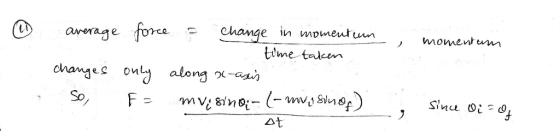
 ***************************************************************************************************
This concludes the answers. Check the answer and let me know if
it's correct. If you need any more clarification, modification or
correction, feel free to ask.....
Add Answer to:
A ball of mass m moving with velocity v⃗ i
strikes a vertical wall as shown...
A ball of mass m moving with velocity v_i_vec strikes a vertical wall. The angle between the ball's initial velocity ve...
 A ball of mass m moving with velocity v_i_vec strikes a vertical
wall. The angle between the ball's initial velocity vector and the
wall is theta_i as shown on the diagram, which depicts the
situation as seen from above. The duration of the collision between
the ball and the wall is Deltat, and this collision is completely
elastic. Friction is negligible, so the ball does not start
spinning. In this idealized collision, the force exerted on the
ball by the...
A ball of mass m moving with velocity v_i_vec strikes a vertical
wall. The angle between the ball's initial velocity vector and the
wall is theta_i as shown on the diagram, which depicts the
situation as seen from above. The duration of the collision between
the ball and the wall is Deltat, and this collision is completely
elastic. Friction is negligible, so the ball does not start
spinning. In this idealized collision, the force exerted on the
ball by the...
A Ball Hits a Wall Elastically Part A A ball of mass m moving with velocity...
 A Ball Hits a Wall Elastically Part A A ball of mass m moving with velocity strikes a vertical wall as shown in (Figure 1). The angle between the ball's initial velocity vector and the wall is 0, as shown on the diagram, which depicts the situation as seen from above. The duration of the collision between the ball and the wall is Δ, and this collision is completely elastic. Friction is negligible, so the ball does not start spinning...
A racquet ball with mass m = 0.244 kg is moving toward the wall at v...
A racquet ball with mass m = 0.244 kg is moving toward the wall at v = 15 m/s and at an angle of θ = 27° with respect to the horizontal. The ball makes a perfectly elastic collision with the solid, frictionless wall and rebounds at the same angle with respect to the horizontal. The ball is in contact with the wall for t = 0.067 s. 1)What is the magnitude of the change in momentum of the racquet...
A billiard ball moving at 6.00 m/s strikes a stationary ball of the same mass. After...
A billiard ball moving at 6.00 m/s strikes a stationary ball of the same mass. After the collision, the first ball moves at 4.94 m/s at an angle of 34.5° with respect to the original line of motion. Assuming an elastic collision (and ignoring friction and rotational motion), find the struck ball's velocity after the collision. What is the magnitude of the velocity and the direction o counter-clockwise from the original direction of motion?
A racquet ball with mass m = 0.252 kg is moving toward the wall at v...
 A racquet ball with mass m = 0.252 kg is moving toward the wall
at v = 18.2 m/s and at an angle of θ = 25° with respect to the
horizontal. The ball makes a perfectly elastic collision with the
solid, frictionless wall and rebounds at the same angle with
respect to the horizontal. The ball is in contact with the wall for
t = 0.06 s.
1)
What is the magnitude of the initial momentum of the racquet...
A racquet ball with mass m = 0.252 kg is moving toward the wall
at v = 18.2 m/s and at an angle of θ = 25° with respect to the
horizontal. The ball makes a perfectly elastic collision with the
solid, frictionless wall and rebounds at the same angle with
respect to the horizontal. The ball is in contact with the wall for
t = 0.06 s.
1)
What is the magnitude of the initial momentum of the racquet...
A billiard ball moving at 5.60 m/s strikes a stationary ball of the same mass. After...
A billiard ball moving at 5.60 m/s strikes a stationary ball of the same mass. After the collision, the first ball moves at 5.03 m/s at an angle of 26.0° with respect to the original line of motion. Assuming an elastic collision (and ignoring friction and rotational motion), find the struck ball's velocity after the collision. magnitude m/s direction ° (with respect to the original line of motion)
A billiard ball moving at 5.20 m/s strikes a stationary ball of the same mass. After...
A billiard ball moving at 5.20 m/s strikes a stationary ball of the same mass. After the collision, the first ball moves at 4.75 m/s at an angle of 24.0° with respect to the original line of motion. Assuming an elastic collision (and ignoring friction and rotational motion), find the struck ball's velocity after the collision. magnitude m/s direction ° (with respect to the original line of motion)
A billiard ball moving at 5.20 m/s strikes a stationary ball of the same mass. After...
A billiard ball moving at 5.20 m/s strikes a stationary ball of the same mass. After the collision, the first ball moves at 4.41 m/s at an angle of 32.0° with respect to the original line of motion. Assuming an elastic collision (and ignoring friction and rotational motion), find the struck ball's velocity after the collision. magnitude ______________m/s direction__________________ ° (with respect to the original line of motion
30° Vi 1) A 150-g ball is moving with a velocity of 23.0 m/s directed 30....
 30° Vi 1) A 150-g ball is moving with a velocity of 23.0 m/s directed 30. below the horizontal just before it strikes vertical wall. The ball leaves the wall 50 ms later with a velocity of 15.2 m/s directed 40. below the horizontal. (a) What are momenta of the ball before and after collision? Express your answer in Cartesian unit vectors. (b) What is the magnitude and direction of average force exerted on the ball by the wall? (The...
 A ball of mass m moving with velocity v_i_vec strikes a vertical
wall. The angle between the ball's initial velocity vector and the
wall is theta_i as shown on the diagram, which depicts the
situation as seen from above. The duration of the collision between
the ball and the wall is Deltat, and this collision is completely
elastic. Friction is negligible, so the ball does not start
spinning. In this idealized collision, the force exerted on the
ball by the...
A ball of mass m moving with velocity v_i_vec strikes a vertical
wall. The angle between the ball's initial velocity vector and the
wall is theta_i as shown on the diagram, which depicts the
situation as seen from above. The duration of the collision between
the ball and the wall is Deltat, and this collision is completely
elastic. Friction is negligible, so the ball does not start
spinning. In this idealized collision, the force exerted on the
ball by the...
 A Ball Hits a Wall Elastically Part A A ball of mass m moving with velocity strikes a vertical wall as shown in (Figure 1). The angle between the ball's initial velocity vector and the wall is 0, as shown on the diagram, which depicts the situation as seen from above. The duration of the collision between the ball and the wall is Δ, and this collision is completely elastic. Friction is negligible, so the ball does not start spinning...
 A racquet ball with mass m = 0.252 kg is moving toward the wall
at v = 18.2 m/s and at an angle of θ = 25° with respect to the
horizontal. The ball makes a perfectly elastic collision with the
solid, frictionless wall and rebounds at the same angle with
respect to the horizontal. The ball is in contact with the wall for
t = 0.06 s.
1)
What is the magnitude of the initial momentum of the racquet...
A racquet ball with mass m = 0.252 kg is moving toward the wall
at v = 18.2 m/s and at an angle of θ = 25° with respect to the
horizontal. The ball makes a perfectly elastic collision with the
solid, frictionless wall and rebounds at the same angle with
respect to the horizontal. The ball is in contact with the wall for
t = 0.06 s.
1)
What is the magnitude of the initial momentum of the racquet...
 30° Vi 1) A 150-g ball is moving with a velocity of 23.0 m/s directed 30. below the horizontal just before it strikes vertical wall. The ball leaves the wall 50 ms later with a velocity of 15.2 m/s directed 40. below the horizontal. (a) What are momenta of the ball before and after collision? Express your answer in Cartesian unit vectors. (b) What is the magnitude and direction of average force exerted on the ball by the wall? (The...
Most questions answered within 3 hours.
-
Where is the error in this code sequence?
String s1 = "Hello";
String s2 = "ello";...
asked 11 months ago -
Financial data for Joel de Paris, Inc., for last year
follow:
Joel de Paris, Inc.
Balance...
asked 11 months ago -
Consider this reaction:
Al2(SO4)3 (aq)+ BaCl3
(aq) Al2Cl6 (aq)- +
3BaSO4(s) . What is the...
asked 11 months ago -
Suppose that Savneet is considering increasing her
recent random sample from 20 car rentals to 40...
asked 11 months ago -
Trucks arrive at an unloading terminal at an average rate of 120
per hour.
Trucks arrive...
asked 11 months ago -
Why are methanol and ethanol completely soluble in water while
octanol is not very little soluble....
asked 11 months ago -
A facilities manager at a university reads in a research report
that the mean amount of...
asked 11 months ago -
When the CuSO4 is rehydrated by adding water to the anhydrous
compound, is this an endothermic...
asked 11 months ago -
A ray of sunlight is passing from diamond into crown glass; the
angle of incidence is...
asked 11 months ago -
A block of mass 0.249 kg is placed on top of a light, vertical
spring of...
asked 11 months ago -
how do the kidneys compensate in the presences of acidosis
a) trigger hyperventilate
b) reserve acid...
asked 11 months ago -
Question 501 pts
The rental rate of capital to the firm increases. Which of the
following...
asked 11 months ago