Initially, the switch in the figure (Figure 1) is in position A and capacitors C2 and...
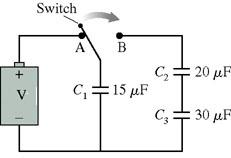
Initially, the switch in the figure (Figure 1) is in position A and capacitors C2 and C3 are uncharged. Then the switch is flipped to position B. Afterward, what are the charge on and the potential difference across EACH capacitor if V=100 Volts?
Homework Answers
Initially, charge on C1 is q = CV = 100 * 15 = 1500 uC
Also, the combined capacitance of C2 and C3 in series is 20*30/(20+30) = 12 uF
When the switch is flipped, we know two things:
potential across the 2-3 combo is the same as the final potential of C1 (because they are in parallel), and the total charge is still 1500 uC
So...
total charge = 15 * V + 12 * V = 1500
V = 55.556 Volts
Charge remaining on C1 = CV = 15 * 55.556 = 833.33 uC
C2 and C3 each have charge = 12 * 55.556 = 666.67 uC
and potential of C2 = q/C = 666.67 / 20 = 33.33 Volts
potential of C3 = 666.67 / 30 = 22.22 V
in summary
C1: final charge 833.33 uC, final potential 55.56 V
C2: final charge 666.67 uC, final potential 33.33 V
C3: final charge 666.67 uC, final potential 22.22 V
Add Answer to:
Initially, the switch in the figure (Figure 1) is in position A
and capacitors C2 and...
Initially, the switch in the figure is in position A and capacitors C2 and C3 are...
 Initially, the switch in the figure is in position A and
capacitors C2 and C3 are uncharged. Then the switch is flipped to
position B. (Figure 1)
Afterward, what is the charge on C1 capacitor?
Express your answer in microcoulombs.
Afterward, what is the potential difference across C1
capacitor?
Express your answer in volts.
Afterward, what is the charge on C2 capacitor?
Express your answer in microcoulombs.
Afterward, what is the potential difference across C2
capacitor?
Express your answer in...
Initially, the switch in the figure is in position A and
capacitors C2 and C3 are uncharged. Then the switch is flipped to
position B. (Figure 1)
Afterward, what is the charge on C1 capacitor?
Express your answer in microcoulombs.
Afterward, what is the potential difference across C1
capacitor?
Express your answer in volts.
Afterward, what is the charge on C2 capacitor?
Express your answer in microcoulombs.
Afterward, what is the potential difference across C2
capacitor?
Express your answer in...
The capacitor in (Figure 1) is initially uncharged and the switch, in position c, is not...
The capacitor in (Figure 1) is initially uncharged and the switch, in position c, is not connected to either side of the circuit. The switch is now flipped to position a for 11 ms , then to position b for 11 ms , and then brought back to position c. Suppose that E = 15 V . Part A What is the final potential difference across the capacitor?
The capacitor in the figure shown is initially uncharged and the switch, in position c, is not connected to either side of the circuit.
 The capacitor in the figure shown is initially uncharged and the switch, in position c, is not connected to either side of the circuit. The switch is now flipped to position a for 10 ms, (a) What is voltage difference across the capacitor? (b) then the switch flipped to position b for 10 ms and then brought back to position c. What the final voltage difference across the capacitor?
Problem 4 The four capacitors in figure (18.44) are initially uncharged when the switch, S, is open, C1 = 2μF and C2 = 4μF.
 Problem 4 The four capacitors in figure (18.44) are initially uncharged when the switch, S, is open, C1 = 2μF and C2 = 4μF. A potential difference of VA - VB = 240V is applied between points A and B. (i) Determine the potential difference between points C and D, VC -VD. (ii) Determine the charge on each capacitor after the switch is closed if the potential difference between points A and B remains 240V. iii) Determine how much charge flows through the...
In Figure 4, all of the capacitors have identical capacitance C, and the battery provides 60V....
 In Figure 4, all of the capacitors have identical capacitance C, and the battery provides 60V. C1 60V C2 C4 C3 Figure 4 Consider the following scenarios, in each case starting with uncharged capacitors. Explain your answers. Case I (a) While switch B is kept open, switch A is closed and then opened after C1, C2 and Cs are fully charged. What is the potential difference across each capacitor? (b) Subsequently switch B is closed. What is now the electric...
Switch When the switch is in position A, Capacitors 2 and 3 are uncharged. The switch is subsequently set to b, what is the A В charge on and potential difference across each capacitor?
 Switch When the switch is in position A, Capacitors 2 and 3 are uncharged. The switch is subsequently set to b, what is the A В charge on and potential difference across each capacitor?
The figure shows capacitors C1, C2, and C3 connected to a battery with potential difference V...
The figure shows capacitors C1, C2, and C3 connected to a battery with potential difference V . When switch S is closed so as to connect uncharged capacitor 4 (C4), (a) how much charge passes through point P from the battery and (b) how much charge shows up on capacitor 4? State your answers in terms of the given variables.
The figure shows a network of three capacitors, C1 = 3.0μF, C2 = 4.0μF, and C3...
 The figure shows a network of three capacitors,
C1 = 3.0μF, C2 = 4.0μF, and
C3 = 8.0μF, connected to a constant applied
potential Vacacross terminals a and
c. The capacitors in the network are fully charged, and
the charge on C2
is60.0μC.
a. What is the charge (in units of
μC) on
capacitor C3?
b. What is the value (in units of μF) of the equivalent
capacitance Cacof the three-capacitor network
between points a andc?
c. What is the...
The figure shows a network of three capacitors,
C1 = 3.0μF, C2 = 4.0μF, and
C3 = 8.0μF, connected to a constant applied
potential Vacacross terminals a and
c. The capacitors in the network are fully charged, and
the charge on C2
is60.0μC.
a. What is the charge (in units of
μC) on
capacitor C3?
b. What is the value (in units of μF) of the equivalent
capacitance Cacof the three-capacitor network
between points a andc?
c. What is the...
The circuit in the figure below shows four capacitors connected to a battery. The switch s...
 The circuit in the figure below shows four capacitors connected to a battery. The switch s is initially open, and all capacitors have reached their final charge. The capacitances are C1 = 5.90 μF, C3 = 8.20 μF, and C4 = 3.90 μF C2 = 14.00 μF 10.0 V (a) Find the potential difference across each capacitor and the charge stored in each. 4.13 Your response is off by a multiple of ten. HC 4.2 Your response differs from the...
In the diagram below, the four capacitors have the same capacitance; the battery provides 120V. Consider...
 In
the diagram below, the four capacitors have the same capacitance;
the battery provides 120V. Consider two cases, starting in both
cases with uncharged capacitors.
Case 1(a) While switch B is kept open, switch A is closed and
then opened after C1,C2 and C3 are fully charged. What is now the
electric potential difference across each capacitor? (b)
Subsequently switch B is closed. What is now the electric potential
difference across each capacitor?
Case 2(c) Switch A is open. Switch...
In
the diagram below, the four capacitors have the same capacitance;
the battery provides 120V. Consider two cases, starting in both
cases with uncharged capacitors.
Case 1(a) While switch B is kept open, switch A is closed and
then opened after C1,C2 and C3 are fully charged. What is now the
electric potential difference across each capacitor? (b)
Subsequently switch B is closed. What is now the electric potential
difference across each capacitor?
Case 2(c) Switch A is open. Switch...
 Initially, the switch in the figure is in position A and
capacitors C2 and C3 are uncharged. Then the switch is flipped to
position B. (Figure 1)
Afterward, what is the charge on C1 capacitor?
Express your answer in microcoulombs.
Afterward, what is the potential difference across C1
capacitor?
Express your answer in volts.
Afterward, what is the charge on C2 capacitor?
Express your answer in microcoulombs.
Afterward, what is the potential difference across C2
capacitor?
Express your answer in...
Initially, the switch in the figure is in position A and
capacitors C2 and C3 are uncharged. Then the switch is flipped to
position B. (Figure 1)
Afterward, what is the charge on C1 capacitor?
Express your answer in microcoulombs.
Afterward, what is the potential difference across C1
capacitor?
Express your answer in volts.
Afterward, what is the charge on C2 capacitor?
Express your answer in microcoulombs.
Afterward, what is the potential difference across C2
capacitor?
Express your answer in...
 In Figure 4, all of the capacitors have identical capacitance C, and the battery provides 60V. C1 60V C2 C4 C3 Figure 4 Consider the following scenarios, in each case starting with uncharged capacitors. Explain your answers. Case I (a) While switch B is kept open, switch A is closed and then opened after C1, C2 and Cs are fully charged. What is the potential difference across each capacitor? (b) Subsequently switch B is closed. What is now the electric...
 The figure shows a network of three capacitors,
C1 = 3.0μF, C2 = 4.0μF, and
C3 = 8.0μF, connected to a constant applied
potential Vacacross terminals a and
c. The capacitors in the network are fully charged, and
the charge on C2
is60.0μC.
a. What is the charge (in units of
μC) on
capacitor C3?
b. What is the value (in units of μF) of the equivalent
capacitance Cacof the three-capacitor network
between points a andc?
c. What is the...
The figure shows a network of three capacitors,
C1 = 3.0μF, C2 = 4.0μF, and
C3 = 8.0μF, connected to a constant applied
potential Vacacross terminals a and
c. The capacitors in the network are fully charged, and
the charge on C2
is60.0μC.
a. What is the charge (in units of
μC) on
capacitor C3?
b. What is the value (in units of μF) of the equivalent
capacitance Cacof the three-capacitor network
between points a andc?
c. What is the...
 The circuit in the figure below shows four capacitors connected to a battery. The switch s is initially open, and all capacitors have reached their final charge. The capacitances are C1 = 5.90 μF, C3 = 8.20 μF, and C4 = 3.90 μF C2 = 14.00 μF 10.0 V (a) Find the potential difference across each capacitor and the charge stored in each. 4.13 Your response is off by a multiple of ten. HC 4.2 Your response differs from the...
 In
the diagram below, the four capacitors have the same capacitance;
the battery provides 120V. Consider two cases, starting in both
cases with uncharged capacitors.
Case 1(a) While switch B is kept open, switch A is closed and
then opened after C1,C2 and C3 are fully charged. What is now the
electric potential difference across each capacitor? (b)
Subsequently switch B is closed. What is now the electric potential
difference across each capacitor?
Case 2(c) Switch A is open. Switch...
In
the diagram below, the four capacitors have the same capacitance;
the battery provides 120V. Consider two cases, starting in both
cases with uncharged capacitors.
Case 1(a) While switch B is kept open, switch A is closed and
then opened after C1,C2 and C3 are fully charged. What is now the
electric potential difference across each capacitor? (b)
Subsequently switch B is closed. What is now the electric potential
difference across each capacitor?
Case 2(c) Switch A is open. Switch...
Most questions answered within 3 hours.
-
Where is the error in this code sequence?
String s1 = "Hello";
String s2 = "ello";...
asked 10 months ago -
Financial data for Joel de Paris, Inc., for last year
follow:
Joel de Paris, Inc.
Balance...
asked 10 months ago -
Consider this reaction:
Al2(SO4)3 (aq)+ BaCl3
(aq) Al2Cl6 (aq)- +
3BaSO4(s) . What is the...
asked 10 months ago -
Suppose that Savneet is considering increasing her
recent random sample from 20 car rentals to 40...
asked 10 months ago -
Trucks arrive at an unloading terminal at an average rate of 120
per hour.
Trucks arrive...
asked 10 months ago -
Why are methanol and ethanol completely soluble in water while
octanol is not very little soluble....
asked 10 months ago -
A facilities manager at a university reads in a research report
that the mean amount of...
asked 10 months ago -
When the CuSO4 is rehydrated by adding water to the anhydrous
compound, is this an endothermic...
asked 10 months ago -
A ray of sunlight is passing from diamond into crown glass; the
angle of incidence is...
asked 10 months ago -
A block of mass 0.249 kg is placed on top of a light, vertical
spring of...
asked 10 months ago -
how do the kidneys compensate in the presences of acidosis
a) trigger hyperventilate
b) reserve acid...
asked 10 months ago -
Question 501 pts
The rental rate of capital to the firm increases. Which of the
following...
asked 10 months ago