An object at rest explodes into three fragments. The figure shows the momentum vectors of two...
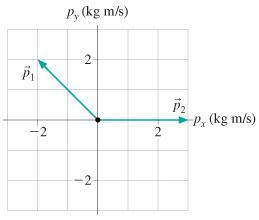
An object at rest explodes into three fragments. The figure shows
the momentum vectors of two of the fragments.
What is p_x of the third fragment?
What is p_y of the third fragment?
answer in "kg m/s" please!
"HINT" the answer IS NOT p3_x=0 & p3_y=-2
Homework Answers
The concepts required for this problem are Linear momentum conservation, vector addition and equality of vectors.
First find the x and y- component of the velocities of two fragment and then use the conservation of linear momentum to find the horizontal and vertical component of velocity.
Momentum: momentum is a vector quantity which is equal to the product of mass and velocity of the body. This can be written as follows;
Here,is the momentum,is the velocity of the mass and is the mass of the body.
Law of conservation of momentum states that total momentum of the system remains conserved if there is no external force acting on the system.
It is represented by the expression as follows;
Here, is initial momentum and is final momentum.
(a)
Calculate the x and y- components of the momentum of two fragments as follows:
From the graph, the horizontal component of momentum of first fragment is as follows:
The y- component of momentum of first fragment is as follows:
The horizontal component of momentum of second fragment is as follows:
The y- component of momentum of first fragment is as follows:
Calculate the horizontal component of momentum for the third particle as follows:
Since the object was initially at rest therefore the initial horizontal component of the system is zero. This can be written as follows:
The final horizontal component of the momentum of the system is as follows:
Substitute for and forin the equationto calculate final horizontal component of the momentum of the system.
According to the law of conservation of momentum,
Substitute forandforin the equation and solve for.
Hence, of the third fragment is.
(b)
Calculate the y-component of third fragment as follows:
Since the object was initially at rest therefore the initial horizontal component of the system is as zero. This can be written as follows;
The final y-component of the momentum of the system is as follows:
Substitute for and forin the equationto calculate the final horizontal component of the momentum of the system.
According to the law of conservation of momentum,
Substitute for and forin the equation and solve for.
Hence, of the third fragment is.
Ans: Part aThe of the third fragment is.
Part bThe of the third fragment is.
Add Answer to:
An object at rest explodes into three fragments. The figure shows
the momentum vectors of two...
An object at rest on a flat, horizontal surface explodes into two fragments, one seven times...
An object at rest on a flat, horizontal surface explodes into two fragments, one seven times as massive as the other. The heavier fragment slides 5.40 m before stopping. How far does the lighter fragment slide? Part A: Assume that both fragments have the same coefficient of kinetic friction.
An object explodes into two fragments such that the larger fragment has twice the mass as...
An object explodes into two fragments such that the larger fragment has twice the mass as the smaller fragment. If 15,000 J is given to the fragments in the explosion, what is the kinetic energy of the larger mass?
A(n) 22 kg object, initially at rest in free space, “explodes” into three segments. The masses...
A(n) 22 kg object, initially at rest in free space, “explodes” into three segments. The masses of two of these segments are both 7 kg and their velocities are 2.8 m/s. The angle between the direction of motion of these segments is 62 ◦ . What is the speed of the third segment? Answer in units of m/s.
025 10.0 points A(n) 14 kg object, initially at rest in free space, "explodes" into three...
 025 10.0 points A(n) 14 kg object, initially at rest in free space, "explodes" into three segments. The and their velocities are 5.8 m/s. The an- gle between the direction of motion of these segments is 67 What is the speed of the third segment? Answer in units of m/s
An object with total mass mtotal = 16.2 kg is sitting at rest when it explodes...
An object with total mass mtotal = 16.2 kg is sitting at rest when it explodes into three pieces. One piece with mass m1 = 4.7 kg moves up and to the left at an angle of θ1 = 23° above the –x axis with a speed of v1 = 25.3 m/s. A second piece with mass m2 = 5.1 kg moves down and to the right, an angle of θ2 = 28° to the right of the -y axis...
A 7.50kg shell at rest explodes into two fragments, one with a mass of 1.00kg and...
A 7.50kg shell at rest explodes into two fragments, one with a mass of 1.00kg and the other with a mass of 6.50kg . If the heavier fragment gains 120J of kinetic energy from the explosion, how much kinetic energy does the lighter one gain? K=?J
See the "BEFORE picture below. It shows a 6-kilogram firecracker initially at rest. Then the firecracker...
 See the "BEFORE picture below. It shows a 6-kilogram firecracker initially at rest. Then the firecracker explodes into three pieces. In the picture labeled "AFTER, two of the pieces are shown; the third piece has not been drawn yet 3 a) BEFORE the explosion, how much is the total momentum? b) AFTER the explosion... .how much is the mass of the third piece? ...how much is the speed and direction of the third piece? (Hint: Break down all momentum vectors...
a bomb explodes in two fragments which move horizontally. One fragment woth a mass of 3...
a bomb explodes in two fragments which move horizontally. One fragment woth a mass of 3 kg travels at the speed of 50 m/s. Find the apeed of the other fragment which has a mass of 5kg.
1 object initially at rest explodes into three picces. Piece A has a mass of 5...
 1
object initially at rest explodes into three picces. Piece A has a mass of 5 kg, B has a mass of 3.0 kg, and C has a mass of 2.5 kg. After the explosion, A's velocity is (3.0 m/s)i + (2.0 m/s) j and B's velocity is (2.0 m/s)i - (3.0 m/s) j y at rest explodes into three pieces. Piece A has a mass of 5.0 a. What is C's velocity after the explosion? b. Calculate the change...
1
object initially at rest explodes into three picces. Piece A has a mass of 5 kg, B has a mass of 3.0 kg, and C has a mass of 2.5 kg. After the explosion, A's velocity is (3.0 m/s)i + (2.0 m/s) j and B's velocity is (2.0 m/s)i - (3.0 m/s) j y at rest explodes into three pieces. Piece A has a mass of 5.0 a. What is C's velocity after the explosion? b. Calculate the change...
A bomb at rest at the origin of an xy-coordinate system explodes into three pieces. Just...
A bomb at rest at the origin of an xy-coordinate system explodes into three pieces. Just after the explosion, one piece, of mass 2 kg, moves with a velocity of 43 m/s in the negative x-direction, and a second piece, also of mass 2 kg, moves with a velocity of 30 m/s in the negative y-direction. The third piece has a mass of 7 kg. What is the initial momentum of the bomb before the explosion? What is the x-component...
 025 10.0 points A(n) 14 kg object, initially at rest in free space, "explodes" into three segments. The and their velocities are 5.8 m/s. The an- gle between the direction of motion of these segments is 67 What is the speed of the third segment? Answer in units of m/s
 See the "BEFORE picture below. It shows a 6-kilogram firecracker initially at rest. Then the firecracker explodes into three pieces. In the picture labeled "AFTER, two of the pieces are shown; the third piece has not been drawn yet 3 a) BEFORE the explosion, how much is the total momentum? b) AFTER the explosion... .how much is the mass of the third piece? ...how much is the speed and direction of the third piece? (Hint: Break down all momentum vectors...
 1
object initially at rest explodes into three picces. Piece A has a mass of 5 kg, B has a mass of 3.0 kg, and C has a mass of 2.5 kg. After the explosion, A's velocity is (3.0 m/s)i + (2.0 m/s) j and B's velocity is (2.0 m/s)i - (3.0 m/s) j y at rest explodes into three pieces. Piece A has a mass of 5.0 a. What is C's velocity after the explosion? b. Calculate the change...
1
object initially at rest explodes into three picces. Piece A has a mass of 5 kg, B has a mass of 3.0 kg, and C has a mass of 2.5 kg. After the explosion, A's velocity is (3.0 m/s)i + (2.0 m/s) j and B's velocity is (2.0 m/s)i - (3.0 m/s) j y at rest explodes into three pieces. Piece A has a mass of 5.0 a. What is C's velocity after the explosion? b. Calculate the change...
Most questions answered within 3 hours.
-
Where is the error in this code sequence?
String s1 = "Hello";
String s2 = "ello";...
asked 10 months ago -
Financial data for Joel de Paris, Inc., for last year
follow:
Joel de Paris, Inc.
Balance...
asked 10 months ago -
Consider this reaction:
Al2(SO4)3 (aq)+ BaCl3
(aq) Al2Cl6 (aq)- +
3BaSO4(s) . What is the...
asked 10 months ago -
Suppose that Savneet is considering increasing her
recent random sample from 20 car rentals to 40...
asked 10 months ago -
Trucks arrive at an unloading terminal at an average rate of 120
per hour.
Trucks arrive...
asked 10 months ago -
Why are methanol and ethanol completely soluble in water while
octanol is not very little soluble....
asked 10 months ago -
A facilities manager at a university reads in a research report
that the mean amount of...
asked 10 months ago -
When the CuSO4 is rehydrated by adding water to the anhydrous
compound, is this an endothermic...
asked 10 months ago -
A ray of sunlight is passing from diamond into crown glass; the
angle of incidence is...
asked 10 months ago -
A block of mass 0.249 kg is placed on top of a light, vertical
spring of...
asked 10 months ago -
how do the kidneys compensate in the presences of acidosis
a) trigger hyperventilate
b) reserve acid...
asked 10 months ago -
Question 501 pts
The rental rate of capital to the firm increases. Which of the
following...
asked 10 months ago