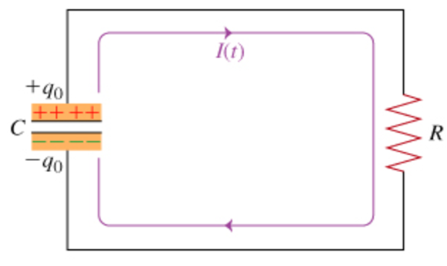
A capacitor with capacitance C is initially charged with charge q0. At time t = 0 a resistor with resistance R is connected across the capacitor. (Figure 1)
To understand the behavior of the current and voltage in a simple R-C circuit.
A capacitor with capacitance C is initially charged with charge q0. At time t = 0 a resistor with resistance R is connected across the capacitor. (Figure 1)
Part C
Now solve the differential equation V(t) = -CR dV(t)/dt for the initial conditions given in the problem introduction to find the voltage as a function of time for any time t.
Homework Answers

Add Answer to:
A capacitor with capacitance C is initially charged with charge q0. At time t = 0 a resistor with resistance R is connected across the capacitor. (Figure 1)
Learning Goal: To understand the behavior of the current andvoltage in a simple R-C circuit...
 Learning Goal: To understand the behavior of the current and
voltage in a simple R-C circuit A capacitor with capacitance C is
initially charged with charge q0. At time t=0 a resistor with
resistance R is connected across the capacitor. (Figure 1)Part AUse the Kirchhoff loop rule and Ohm's law to express the voltage
across the capacitor V(t) in terms of the currentI(t) flowing through the circuit.Express your answer in terms of I(t) andR.V(t) =
Learning Goal: To understand the behavior of the current and
voltage in a simple R-C circuit A capacitor with capacitance C is
initially charged with charge q0. At time t=0 a resistor with
resistance R is connected across the capacitor. (Figure 1)Part AUse the Kirchhoff loop rule and Ohm's law to express the voltage
across the capacitor V(t) in terms of the currentI(t) flowing through the circuit.Express your answer in terms of I(t) andR.V(t) =
A battery, a resistor of resistance R, and an initially uncharged capacitor of capacitance C are...
A battery, a resistor of resistance R, and an initially uncharged capacitor of capacitance C are connected in series. At what time does the capacitor voltage reach 90% of the battery voltage? Assume that the battery has no internal resistance.
Problem 7 A resistor with resistance R, battery with voltage AV, capacitor with capacitance C, and...
 Problem 7 A resistor with resistance R, battery with voltage AV, capacitor with capacitance C, and switch are connected in series. The switch is closed at t = 0. The time constant of the circuit is T. What is the initial voltage across the resistor immediately after the student is closed? Select One of the Following: (a) o (b) AV (c) TAV (d) AV/T (e) AV/(R+C) Problem 8 A capacitor is charged to potential difference V and then allowed to...
7 A circuit consists of a resistor of resistance R, and a capacitor of capacitance C,...
 7 A circuit consists of a resistor of resistance R, and a capacitor of capacitance C, connected in series, and is described by the first order differential equation - + y = E where E is the constant e.m.f. and v is the voltage across the capacitor. Given that v(O) = 0, show by using the integrating factor method that v = E(1 - e-t/(RC))
Consider a series circuit containing a resistor of resistance R and a capacitor of capacitance C connected to a source of EMF ε with negligible internal resistance.
 Consider a series circuit containing a resistor of resistance R and a capacitor of capacitance C connected to a source of EMF ε with negligible internal resistance. The wires are also assumed to have zero resistance. Initially, the switch is open and the capacitor discharged. (Figure 1)Immediately after the switch is closed, what is the voltage
across the resistor?Immediately after the switch is closed, what is the direction of
the current in the circuit?
Consider a series circuit containing a resistor of resistance R and a capacitor of capacitance C connected to a source of EMF ε with negligible internal resistance. The wires are also assumed to have zero resistance. Initially, the switch is open and the capacitor discharged. (Figure 1)Immediately after the switch is closed, what is the voltage
across the resistor?Immediately after the switch is closed, what is the direction of
the current in the circuit?
Switch S in in the figure is closed at time t = 0, to begin charging an initially uncharged capacitor of capacitance C = 17.9 μF through a resistor of resistance R = 23.0 Ω
 Chapter 27, Problem 057 Switch S in in the figure is closed at time t = 0, to begin charging an initially uncharged capacitor of capacitance C = 17.9 μF through a resistor of resistance R = 23.0 Ω. At what time is the potential across the capacitor equal to that across the resistor?
Consider a series circuit containing a resistor of resistance R and a capacitor of capacitance C connected to a source of EMF E with negligible internal resistance.
 Consider a series circuit containing a resistor of resistance R and a capacitor of capacitance C connected to a source of EMF E with negligible internal resistance. The wires are also assumed to have zero resistance. Initially, the switch is open and the capacitor discharged. (Figure 1)A Immediately after the switch is closed, what is the voltage across the capacitor?B Complete previous part(s) C Immediately after the switch is closed, what is the direction of the current in the circuit? E Eventually,...
Q1. An uncharged capacitor is connected across a resistor of resistance 75 k 2. R.75000 2...
 Q1. An uncharged capacitor is connected across a resistor of resistance 75 k 2. R.75000 2 Tono The graph below shows the variation of potential difference. V across the capacitor with time while in discharging process. (3marks) Veltage Versus Time 10315 PHY 2011 Saicena See 51A Use the graph to determine: a) The total current in the circuit. Total b) The time constant of the circuit (T). (time taken to discharge your capacitor 37% of total voltage) c) The capacitance...
A capacitor with capacitance C is charged to a voltage V and connected (with caution) across...
A capacitor with capacitance C is charged to a voltage V and connected (with caution) across a resistor R. After some time elapses, the voltage is less than half the original value. What determines how long it takes for this to happen. a.) the voltage V, and C but not R b.) the product of R and C c.) the fraction 1/RC d.) the ratio C/R
A simply RC circuit made up of a capacitor with capacitance C and resistor with resistance...
A simply RC circuit made up of a capacitor with capacitance C and resistor with resistance R = 15 kΩ is attached to a battery with emf E = 24 V. If time constant is 25 µs, what is the capacitance C and the time it takes for the voltage across the capacitor to reach 16 V after the switch is closed at t = 0?
 Learning Goal: To understand the behavior of the current and
voltage in a simple R-C circuit A capacitor with capacitance C is
initially charged with charge q0. At time t=0 a resistor with
resistance R is connected across the capacitor. (Figure 1)Part AUse the Kirchhoff loop rule and Ohm's law to express the voltage
across the capacitor V(t) in terms of the currentI(t) flowing through the circuit.Express your answer in terms of I(t) andR.V(t) =
Learning Goal: To understand the behavior of the current and
voltage in a simple R-C circuit A capacitor with capacitance C is
initially charged with charge q0. At time t=0 a resistor with
resistance R is connected across the capacitor. (Figure 1)Part AUse the Kirchhoff loop rule and Ohm's law to express the voltage
across the capacitor V(t) in terms of the currentI(t) flowing through the circuit.Express your answer in terms of I(t) andR.V(t) =
 Problem 7 A resistor with resistance R, battery with voltage AV, capacitor with capacitance C, and switch are connected in series. The switch is closed at t = 0. The time constant of the circuit is T. What is the initial voltage across the resistor immediately after the student is closed? Select One of the Following: (a) o (b) AV (c) TAV (d) AV/T (e) AV/(R+C) Problem 8 A capacitor is charged to potential difference V and then allowed to...
 7 A circuit consists of a resistor of resistance R, and a capacitor of capacitance C, connected in series, and is described by the first order differential equation - + y = E where E is the constant e.m.f. and v is the voltage across the capacitor. Given that v(O) = 0, show by using the integrating factor method that v = E(1 - e-t/(RC))
 Q1. An uncharged capacitor is connected across a resistor of resistance 75 k 2. R.75000 2 Tono The graph below shows the variation of potential difference. V across the capacitor with time while in discharging process. (3marks) Veltage Versus Time 10315 PHY 2011 Saicena See 51A Use the graph to determine: a) The total current in the circuit. Total b) The time constant of the circuit (T). (time taken to discharge your capacitor 37% of total voltage) c) The capacitance...
Most questions answered within 3 hours.
-
Where is the error in this code sequence?
String s1 = "Hello";
String s2 = "ello";...
asked 11 months ago -
Financial data for Joel de Paris, Inc., for last year
follow:
Joel de Paris, Inc.
Balance...
asked 11 months ago -
Consider this reaction:
Al2(SO4)3 (aq)+ BaCl3
(aq) Al2Cl6 (aq)- +
3BaSO4(s) . What is the...
asked 11 months ago -
Suppose that Savneet is considering increasing her
recent random sample from 20 car rentals to 40...
asked 11 months ago -
Trucks arrive at an unloading terminal at an average rate of 120
per hour.
Trucks arrive...
asked 11 months ago -
Why are methanol and ethanol completely soluble in water while
octanol is not very little soluble....
asked 11 months ago -
A facilities manager at a university reads in a research report
that the mean amount of...
asked 11 months ago -
When the CuSO4 is rehydrated by adding water to the anhydrous
compound, is this an endothermic...
asked 11 months ago -
A ray of sunlight is passing from diamond into crown glass; the
angle of incidence is...
asked 11 months ago -
A block of mass 0.249 kg is placed on top of a light, vertical
spring of...
asked 11 months ago -
how do the kidneys compensate in the presences of acidosis
a) trigger hyperventilate
b) reserve acid...
asked 11 months ago -
Question 501 pts
The rental rate of capital to the firm increases. Which of the
following...
asked 11 months ago