To understand the dynamics of a seriesR-C circuit.Consider a series circuitcontaining a resistor...
To understand the dynamics of a series R-C circuit.
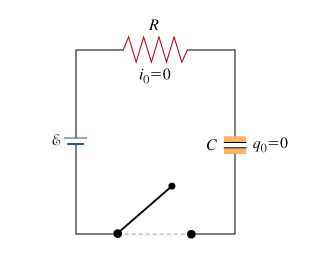
Consider a series circuit containing a resistor of resistance R and a capacitor of capacitance Cconnected to a source of EMF E with negligible internal resistance. The wires are also assumed to have zero resistance. Initially, the switch is open and the capacitor discharged. (Figure 1)
Let us try to understand the processes that take place after the switch is closed. The charge of the capacitor, the current in the circuit, and, correspondingly, the voltages across the resistor and the capacitor will be changing. Note that at any moment in time during the life of our circuit, Kirchhoff's loop rule holds and, indeed, it is helpful: E?VR?VC=0, whereVR is the voltage across the resistor and VC is the voltage across the capacitor.
a. In the steady state, what is the charge
q of the capacitor?
Express your answer in terms of any or all of E, R, and C.
b. How much work
W is done by the voltage source by the time the steady state is reached?
Express your answer in terms of any or all of E, R, and C.
Homework Answers
Add Answer to:
To understand the dynamics of a seriesR-C circuit.Consider a series circuitcontaining a resistor...
Learning Goal: To understand the dynamics of a series R-C circuit. Consider a series circuit containing...
 Learning Goal: To understand the dynamics of a series R-C circuit. Consider a series circuit containing a resistor of resistance R and a capacitor of capacitance C connected to a source of EMF ε with negligible internal resistance. The wires are also assumed to have zero resistance. Initially, the switch is open and the capacitor discharged. (Figure 1)Let us try to understand the processes that take place after the switch is closed. The charge of the capacitor, the current in...
Learning Goal: To understand the dynamics ofaseries R-C circuit.Consider a series circuit containing a...
Learning Goal: To understand the dynamics of aseries R-C circuit.Consider a series circuit containing a resistor of resistance R anda capacitor of capacitance C connected to a source ofEMF ε with negligible internal resistance. The wiresare also assumed to have zero resistance. Initially, the switch isopen and the capacitor discharged.Let us try to understand the processes that take place afterthe switch is closed. The charge of the capacitor, the current inthe circuit, and, correspondingly, the voltages across the resistorand the...
Part A Learning Goal To understand the dynamics of a series R-C circuit. Immediately after the...
 Part A Learning Goal To understand the dynamics of a series R-C circuit. Immediately after the switch is closed, what is the voltage across the capacitor? Consider a series circuit containing a resistor of resistance R and a capacitor of capacitance C connected to a source of EMF with negligible internal resistance. The wires are also assumed to have zero resistance. Initially, the switch is open and the capacitor discharged. (Figure 1) zero Let us try to understand the processes...
Consider a series circuit containing a resistor of resistance R and a capacitor of capacitance C connected to a source of EMF E with negligible internal resistance.
 Consider a series circuit containing a resistor of resistance R and a capacitor of capacitance C connected to a source of EMF E with negligible internal resistance. The wires are also assumed to have zero resistance. Initially, the switch is open and the capacitor discharged. (Figure 1)A Immediately after the switch is closed, what is the voltage across the capacitor?B Complete previous part(s) C Immediately after the switch is closed, what is the direction of the current in the circuit? E Eventually,...
Consider a series circuit containing a resistor of resistance R and a capacitor of capacitance C connected to a source of EMF ε with negligible internal resistance.
 Consider a series circuit containing a resistor of resistance R and a capacitor of capacitance C connected to a source of EMF ε with negligible internal resistance. The wires are also assumed to have zero resistance. Initially, the switch is open and the capacitor discharged. (Figure 1)Immediately after the switch is closed, what is the voltage
across the resistor?Immediately after the switch is closed, what is the direction of
the current in the circuit?
Consider a series circuit containing a resistor of resistance R and a capacitor of capacitance C connected to a source of EMF ε with negligible internal resistance. The wires are also assumed to have zero resistance. Initially, the switch is open and the capacitor discharged. (Figure 1)Immediately after the switch is closed, what is the voltage
across the resistor?Immediately after the switch is closed, what is the direction of
the current in the circuit?
Exercise 31.13 - Enhanced - with Feedback You have a resistor of resistance 1902, an inductor...
 Exercise 31.13 - Enhanced - with Feedback You have a resistor of resistance 1902, an inductor of inductance 0.450 H, a capacitor of capacitance 6.40 pF and a voltage source that has a voltage amplitude of 26.0 V and an angular frequency of 300 rad/s. The resistor, inductor, capacitor, and voltage source are connected to form an L-R-C series circuit. Part A What is the impedance of the circuit? Express your answer in ohms. VOI ΑΣΦ FR ? Z= 12...
A capacitor of capacitance C= 2.5 μF is initially uncharged. It is connected in series with a switch of negligible resistance
 A capacitor of capacitance C= 2.5 μF is initially uncharged. It is connected in series with a switch of negligible resistance, a resistor of resistance R= 14.5 kΩ, and a battery which provides a potential difference of VB = 160 V.Part (a) Immediately after the switch is closed, what is the voltage drop Vc, in volt across the capacitor?Part (b) Immediately after the switch is closed, what is the voltage drop VR, in volt: across the resistor?Part (c) Immediately after...
A resistance R = 10Ω, a capacitor C = 15μF, an inductor of L = 38mH,...
A resistance R = 10Ω, a capacitor C = 15μF, an inductor of L = 38mH, and an alternating current source with a voltage amplitude of 50V to 160Hz are connected in series. A- Calculate the angular frequency of the source B- Calculate the XL, XC, and Z impedance reactances C- Calculate the lag between the circuit current and the source voltage D- Calculate the amplitude of the circuit current and express the circuit current as a function of time...
1. A resistor R and capacitor care connected in series with an AC voltage source with...
 1. A resistor R and capacitor care connected in series with an AC voltage source with frequency f and maximum voltage Vo. a. Find the complex impedance (in the form Z = R + jX). If the impedance is written in polar form (Z = Zejº), find expressions for Z and Ⓡ. Write your answers in terms of the variables R, C, and o(= 21f). b. If the voltage source is described by the phasor V = V, ejwt, and...
In a series R-L-C circuit, L = 0.190 H , C = 84.5 μF and the...
In a series R-L-C circuit, L = 0.190 H , C = 84.5 μF and the voltage amplitude of the source is 290 V . Part A What is the resonance angular frequency of the circuit? ω0 = rad/s SubmitMy AnswersGive Up Part B When the source operates at the resonance angular frequency, the current amplitude in the circuit is 0.610 A . What is the resistance R of the resistor? R = Ω SubmitMy AnswersGive Up Part C At...
 Part A Learning Goal To understand the dynamics of a series R-C circuit. Immediately after the switch is closed, what is the voltage across the capacitor? Consider a series circuit containing a resistor of resistance R and a capacitor of capacitance C connected to a source of EMF with negligible internal resistance. The wires are also assumed to have zero resistance. Initially, the switch is open and the capacitor discharged. (Figure 1) zero Let us try to understand the processes...
 Exercise 31.13 - Enhanced - with Feedback You have a resistor of resistance 1902, an inductor of inductance 0.450 H, a capacitor of capacitance 6.40 pF and a voltage source that has a voltage amplitude of 26.0 V and an angular frequency of 300 rad/s. The resistor, inductor, capacitor, and voltage source are connected to form an L-R-C series circuit. Part A What is the impedance of the circuit? Express your answer in ohms. VOI ΑΣΦ FR ? Z= 12...
 1. A resistor R and capacitor care connected in series with an AC voltage source with frequency f and maximum voltage Vo. a. Find the complex impedance (in the form Z = R + jX). If the impedance is written in polar form (Z = Zejº), find expressions for Z and Ⓡ. Write your answers in terms of the variables R, C, and o(= 21f). b. If the voltage source is described by the phasor V = V, ejwt, and...
Most questions answered within 3 hours.
-
Where is the error in this code sequence?
String s1 = "Hello";
String s2 = "ello";...
asked 11 months ago -
Financial data for Joel de Paris, Inc., for last year
follow:
Joel de Paris, Inc.
Balance...
asked 11 months ago -
Consider this reaction:
Al2(SO4)3 (aq)+ BaCl3
(aq) Al2Cl6 (aq)- +
3BaSO4(s) . What is the...
asked 11 months ago -
Suppose that Savneet is considering increasing her
recent random sample from 20 car rentals to 40...
asked 11 months ago -
Trucks arrive at an unloading terminal at an average rate of 120
per hour.
Trucks arrive...
asked 11 months ago -
Why are methanol and ethanol completely soluble in water while
octanol is not very little soluble....
asked 11 months ago -
A facilities manager at a university reads in a research report
that the mean amount of...
asked 11 months ago -
When the CuSO4 is rehydrated by adding water to the anhydrous
compound, is this an endothermic...
asked 11 months ago -
A ray of sunlight is passing from diamond into crown glass; the
angle of incidence is...
asked 11 months ago -
A block of mass 0.249 kg is placed on top of a light, vertical
spring of...
asked 11 months ago -
how do the kidneys compensate in the presences of acidosis
a) trigger hyperventilate
b) reserve acid...
asked 11 months ago -
Question 501 pts
The rental rate of capital to the firm increases. Which of the
following...
asked 11 months ago