 Please help me with this
problem
Please help me with this
problem
Homework Answers
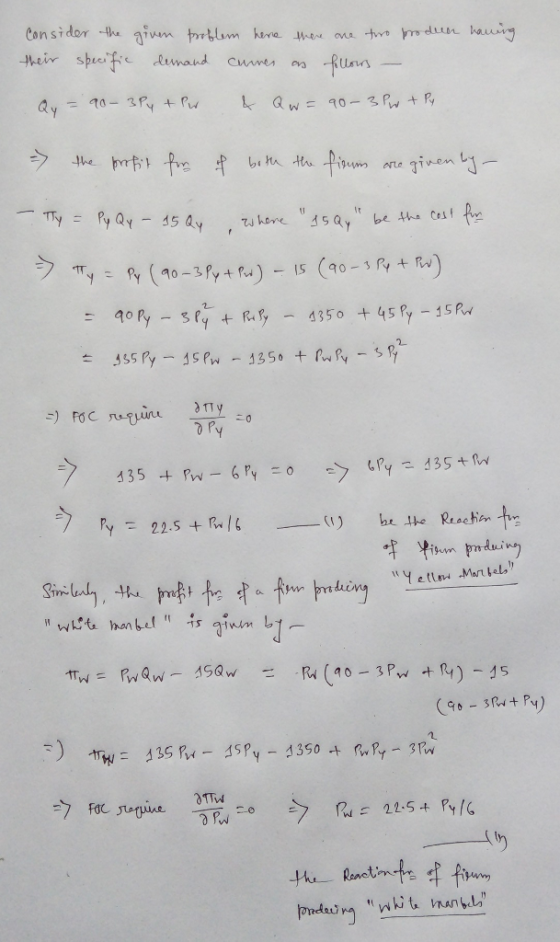
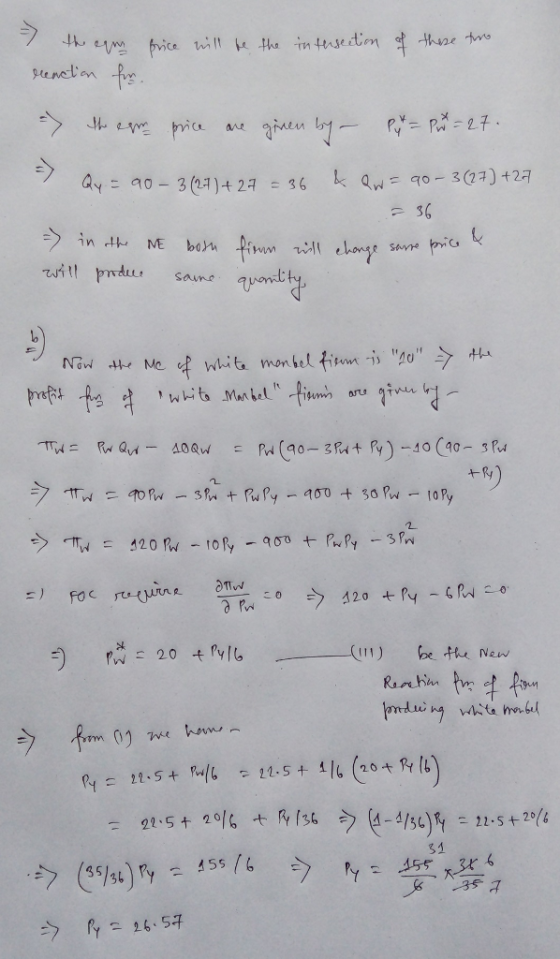
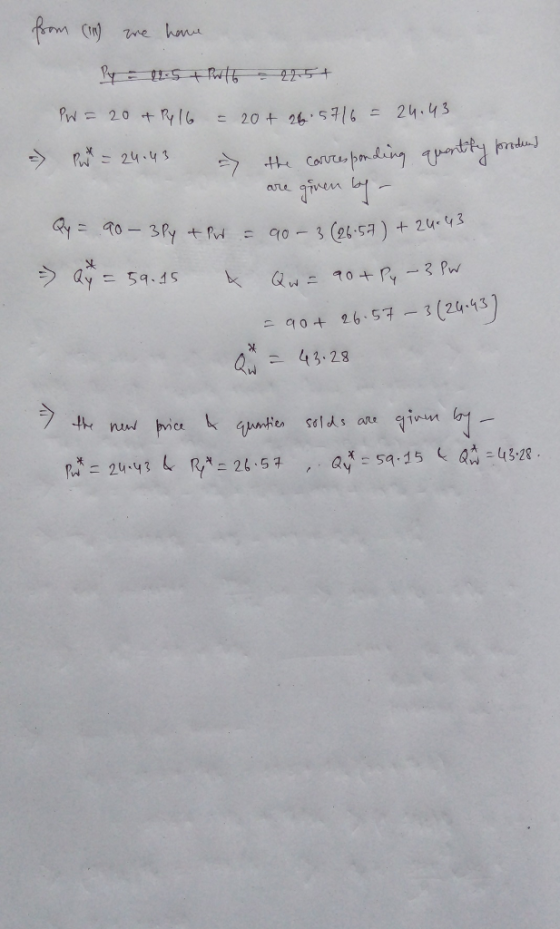
c).
In the “Bertrand Model” with the differentiated good a firm having cost disadvantaged will stray into the industry . Since, there are new customer will still purchase a particular good at the higher price compare the available substitute good. But in the case of the homogeneous good it’s not possible that the two firms will change different price. If a firm will have cost disadvantage will not able to service in to the industry.
Add Answer to:
Please help me with this
problem
6. Differentiated product Bertrand. Suppose that firm Y produces yellow...
4. Homogenous product Bertrand. Suppose that the demand for marbles is given by Q- 80 -...
 4. Homogenous product Bertrand. Suppose that the demand for marbles is given by Q- 80 - 5P, where Q is measured in bags of marbles. There are two firms that supply the market, and the firms produce identical marbles (i.e., they are homogenous products). Firm 1 has a constant marginal cost of $10.00/bag, while firm 2 has a constant marginal cost of S5.00/bag. The two firms compete in price. In Nash Equilibrium, what prices will the two firms set? How...
There are two firms. Firm 1 (or, a small firm) produces a single product, product A,...
There are two firms. Firm 1 (or, a small firm) produces a single product, product A, at zero cost. Firm 2 (or, a big firm) is a multi-product firm that sells both products A and B. Firm 2 is less efficient in producing A. It incurs a constant marginal cost c > 0 for producing A. However, firm 2 is a monopolist of the market of product B and its cost of producing product B is zero. A unit mass...
Suppose there are two firms in a market producing differentiated products. Both firms have MC=0. The...
Suppose there are two firms in a market producing differentiated products. Both firms have MC=0. The demand for firm 1 and 2’s products are given by: q1(p1,p2) = 5 - 2p1 + p2 q2(p1,p2) = 5 - 2p2 + p1 a. First, suppose that the two firms compete in prices (i.e. Bertrand). Compute and graph each firm’s best response functions. What is the sign of the slope of the firms’ best-response functions? Are prices strategic substitutes or complements? b. Solve...
Differentiated Bertrand competition versus price leadership. The demand for two brands of laundry detergent, Wave (W)...
Differentiated Bertrand competition versus price leadership. The demand for two brands of laundry detergent, Wave (W) and Rah (R), are given by the following demands: Qw =80–2pW +pR QR =80–2pR +pWThe firms have identical cost functions, with a constant marginal cost of 10. The firms compete in prices. (a) What is the best response function for each firm? (that is, what is firm W's optimal price as a function of firm R’s price, and vice-versa?) What is the equilibrium to...
4. Suppose that firm 1 and firm 2 each produce the same product and face a...
 4. Suppose that firm 1 and firm 2 each produce the same product and face a market demand curve given by Q = 5000 – 200P. Firm 1 has a unit (marginal) cost of production ci = 6 while firm 2 has a unit cost of c2 = 10. Firms compete by setting prices and consumers in this market will always purchase from the firm with the lower price. In addition, suppose that firms must choose an integer price. This...
I only need answers for the Bertrand Nash Equilibrium section. please provide answers with as much...
 I only need answers for the Bertrand Nash Equilibrium
section.
please provide answers with as much details as possible. Thank
you
Oligopoly There are two firms competing in the market for Airplanes - Boeing and Airbus. The market demand is given by Q = 120 - P. Boeing has lower Marginal Costs of production than Airbus. Thus MCB = $20, MCA = $40. Assume that TFC = $0 for both firms. (Think of price being in thousands.) Boeing a) Derive...
I only need answers for the Bertrand Nash Equilibrium
section.
please provide answers with as much details as possible. Thank
you
Oligopoly There are two firms competing in the market for Airplanes - Boeing and Airbus. The market demand is given by Q = 120 - P. Boeing has lower Marginal Costs of production than Airbus. Thus MCB = $20, MCA = $40. Assume that TFC = $0 for both firms. (Think of price being in thousands.) Boeing a) Derive...
Problem 5: Product Differentiation in a Bertrand Setting. Firms 1 and 2 face the same AC...
 Problem 5: Product Differentiation in a Bertrand Setting. Firms 1 and 2 face the same AC = MC = 30 but sell differentiated products. The demands for firms 1 and 2 are given by D.(P1, P2) = 70 – P1 + P2 D2(P1, P2) = 70 – P2 +5 P1 The firms choose prices Pı and P2 simultaneously. a) For each firm, represent profits as a function of both prices p and p2. b) Find the best response function for...
EC202-5-FY 10 9Answer both parts of this question. (a) Firm A and Firm B produce a homogenous good and are Cournot duopolists. The firms face an inverse market demand curve given by P 10-Q. where...
 EC202-5-FY 10 9Answer both parts of this question. (a) Firm A and Firm B produce a homogenous good and are Cournot duopolists. The firms face an inverse market demand curve given by P 10-Q. where P is the market price and Q is the market quantity demanded. The marginal and average cost of each firm is 4 i. 10 marks] Show that if the firms compete as Cournot duopolists that the total in- dustry output is 4 and that if...
Problem 1. There are two suppliers of distilled water, labeled firm A and firm B. Distilled...
Problem 1. There are two suppliers of distilled water, labeled firm A and firm B. Distilled water is considered to be a homogenous good. Let p denote the price per gallon, qA quantity sold by firm A, and qB the quantity sold by firm B. Firm A and firm B bear a production cost of cA = cB = 2 per one gallon of water. The inverse demand function for distilled water is given by p = 12 − 1Q,...
Two airlines compete for passengers on a one-way flight Philadelphia Orlando, FL. They differentiate their products primarily on product quality, with Firm A providing more upscale service, while Fir...
 Two airlines compete for passengers on a one-way flight Philadelphia Orlando, FL. They differentiate their products primarily on product quality, with Firm A providing more upscale service, while Firm B operates more as an economy airline. The demand curve for Firm A's product (upscale service) is: Qa- 720-2Pa PB, Firm B has a product (economy service) demand curve equal to: QB-528-3Ps + 2PA The marginal cost for firm A is $70 per passenger, for firm B it is $40 per...
 4. Homogenous product Bertrand. Suppose that the demand for marbles is given by Q- 80 - 5P, where Q is measured in bags of marbles. There are two firms that supply the market, and the firms produce identical marbles (i.e., they are homogenous products). Firm 1 has a constant marginal cost of $10.00/bag, while firm 2 has a constant marginal cost of S5.00/bag. The two firms compete in price. In Nash Equilibrium, what prices will the two firms set? How...
 4. Suppose that firm 1 and firm 2 each produce the same product and face a market demand curve given by Q = 5000 – 200P. Firm 1 has a unit (marginal) cost of production ci = 6 while firm 2 has a unit cost of c2 = 10. Firms compete by setting prices and consumers in this market will always purchase from the firm with the lower price. In addition, suppose that firms must choose an integer price. This...
 I only need answers for the Bertrand Nash Equilibrium
section.
please provide answers with as much details as possible. Thank
you
Oligopoly There are two firms competing in the market for Airplanes - Boeing and Airbus. The market demand is given by Q = 120 - P. Boeing has lower Marginal Costs of production than Airbus. Thus MCB = $20, MCA = $40. Assume that TFC = $0 for both firms. (Think of price being in thousands.) Boeing a) Derive...
I only need answers for the Bertrand Nash Equilibrium
section.
please provide answers with as much details as possible. Thank
you
Oligopoly There are two firms competing in the market for Airplanes - Boeing and Airbus. The market demand is given by Q = 120 - P. Boeing has lower Marginal Costs of production than Airbus. Thus MCB = $20, MCA = $40. Assume that TFC = $0 for both firms. (Think of price being in thousands.) Boeing a) Derive...
 Problem 5: Product Differentiation in a Bertrand Setting. Firms 1 and 2 face the same AC = MC = 30 but sell differentiated products. The demands for firms 1 and 2 are given by D.(P1, P2) = 70 – P1 + P2 D2(P1, P2) = 70 – P2 +5 P1 The firms choose prices Pı and P2 simultaneously. a) For each firm, represent profits as a function of both prices p and p2. b) Find the best response function for...
 EC202-5-FY 10 9Answer both parts of this question. (a) Firm A and Firm B produce a homogenous good and are Cournot duopolists. The firms face an inverse market demand curve given by P 10-Q. where P is the market price and Q is the market quantity demanded. The marginal and average cost of each firm is 4 i. 10 marks] Show that if the firms compete as Cournot duopolists that the total in- dustry output is 4 and that if...
 Two airlines compete for passengers on a one-way flight Philadelphia Orlando, FL. They differentiate their products primarily on product quality, with Firm A providing more upscale service, while Firm B operates more as an economy airline. The demand curve for Firm A's product (upscale service) is: Qa- 720-2Pa PB, Firm B has a product (economy service) demand curve equal to: QB-528-3Ps + 2PA The marginal cost for firm A is $70 per passenger, for firm B it is $40 per...
Most questions answered within 3 hours.
-
Where is the error in this code sequence?
String s1 = "Hello";
String s2 = "ello";...
asked 10 months ago -
Financial data for Joel de Paris, Inc., for last year
follow:
Joel de Paris, Inc.
Balance...
asked 10 months ago -
Consider this reaction:
Al2(SO4)3 (aq)+ BaCl3
(aq) Al2Cl6 (aq)- +
3BaSO4(s) . What is the...
asked 10 months ago -
Suppose that Savneet is considering increasing her
recent random sample from 20 car rentals to 40...
asked 10 months ago -
Trucks arrive at an unloading terminal at an average rate of 120
per hour.
Trucks arrive...
asked 10 months ago -
Why are methanol and ethanol completely soluble in water while
octanol is not very little soluble....
asked 10 months ago -
A facilities manager at a university reads in a research report
that the mean amount of...
asked 10 months ago -
When the CuSO4 is rehydrated by adding water to the anhydrous
compound, is this an endothermic...
asked 10 months ago -
A ray of sunlight is passing from diamond into crown glass; the
angle of incidence is...
asked 10 months ago -
A block of mass 0.249 kg is placed on top of a light, vertical
spring of...
asked 10 months ago -
how do the kidneys compensate in the presences of acidosis
a) trigger hyperventilate
b) reserve acid...
asked 10 months ago -
Question 501 pts
The rental rate of capital to the firm increases. Which of the
following...
asked 10 months ago