
Homework Answers
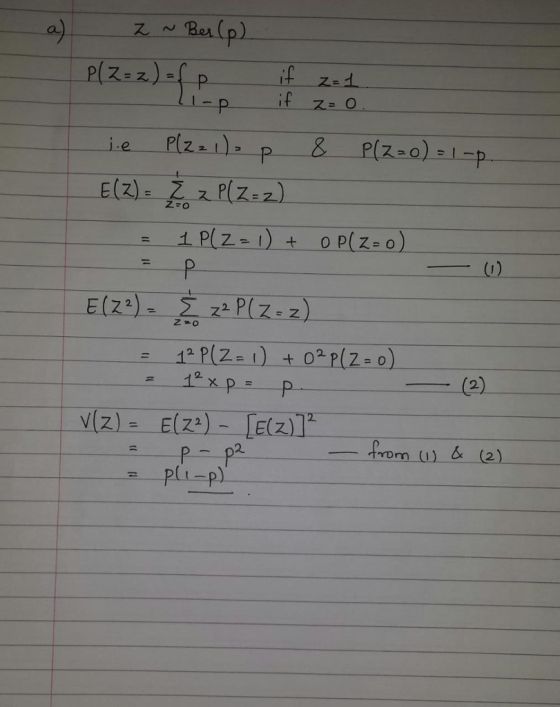
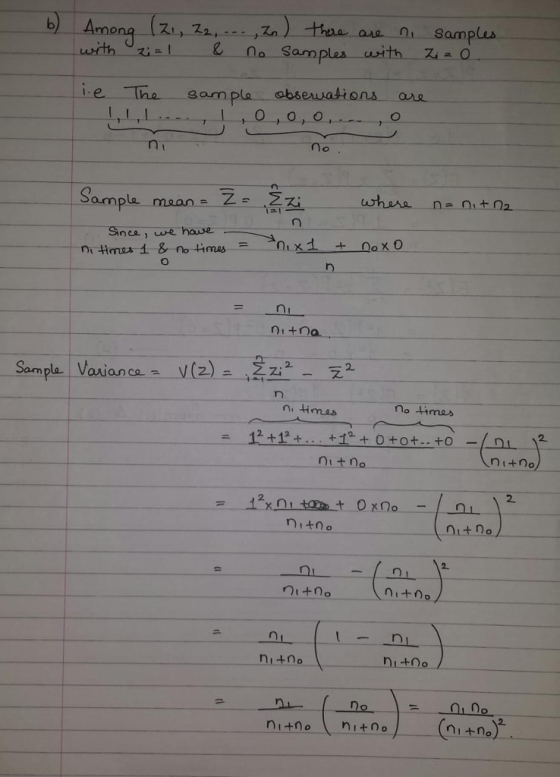
c) The law of large numbers states that, as the number of I.I.D. random variables increases, their sample mean (average) approaches their theoretical mean.
Central limit theorem states that, for sufficiently large samples from a population with finite variance, the mean of all samples from the same population will be approximately equal to the mean of the population.
Add Answer to:
Let : be a random variable that follows a distribution to be specified later Suppose that...
3) Suppose X,,X,,X, (n > 1) is a random sample from Bernoulli distribution with Circle out...
 3) Suppose X,,X,,X, (n > 1) is a random sample from Bernoulli distribution with Circle out your Class: Mon&Wed or Mon.Evening p.mf. p(x)=p"(I-p)'-x , x = 0,1, , thenyi follows ( ). Binomial distribution B(a.p) eNormal distribution N(p,mp(- O Poisson distribution P(np) Dcan not be determined. 4) Suppose X-N(0,1) and Y~N(24), they are independent, then )is incorrect. X+Y N(2, 5) C X-Y-NC-2,5) BP(Y <2)>0.5 D Var(X) < Var(Y) x,X,, ,X, (n>1) is a random sample from N(μσ2), let-1ΣΧί 5) Suppose...
A discrete random variable A takes values {1, 2, 4} with probabilities specified as follows: P[A...
 A discrete random variable A takes values {1, 2, 4} with probabilities specified as follows: P[A = 1] = 0.5, P[A = 2] = 0.3 and P [A = 4] = 0.2 Given A= ), a discrete random variable N is Poisson distributed with rate equal to 1, that is: 9 P[N = n|A = 1] = in n! el Hint If N is Poisson distributed with rate 1, its expectation and variance are as follows: E[N] = Var [N]...
Let Xi and X2 independent random variables, with distribution functions F1, and F2, respectively Let Y a Bernoulli random variable with parameter p. Suppose that Y, X1 and X2 are independent. Proof u...
Let Xi and X2 independent random variables, with distribution functions F1, and F2, respectively Let Y a Bernoulli random variable with parameter p. Suppose that Y, X1 and X2 are independent. Proof using the de finition of distribution function that the the distribution function of Z =Y Xit(1-Y)X2 is F = pF14(1-p)F2 Don't use generatinq moment functions, characteristic functions) Xi and X2 independent random variables, with distribution functions F1, and F2, respectively Let Y a Bernoulli random variable with parameter...
Suppose X, Y and Z are three different random variables. Let X obey Bernoulli Distribution. The...
Suppose X, Y and Z are three different random variables. Let X obey Bernoulli Distribution. The probability distribution function is p(x) = Let Y obeys the standard Normal (Gaussian) distribution, which can be written as Y ∼ N(0, 1). X and Y are independent. Meanwhile, let Z = XY . (a) What is the Expectation (mean value) of X? (b) Are Y and Z independent? (Just clarify, do not need to prove) (c) Show that Z is also a standard...
Central Limit Theorem: let x1,x2,...,xn be I.I.D. random variables with E(xi)= U Var(xi)= (sigma)^2 defind Z=...
Central Limit Theorem: let x1,x2,...,xn be I.I.D. random variables with E(xi)= U Var(xi)= (sigma)^2 defind Z= x1+x2+...+xn the distribution of Z converges to a gaussian distribution P(Z<=z)=1-Q((z-Uz)/(sigma)^2) Use MATLAB to prove the central limit theorem. To achieve this, you will need to generate N random variables (I.I.D. with the distribution of your choice) and show that the distribution of the sum approaches a Guassian distribution. Plot the distribution and matlab code. Hint: you may find the hist() function helpful
Multiple Choice Question Let random variable X follows an exponential distribution with probability density function fx(x)...
 Multiple Choice Question Let random variable X follows an exponential distribution with probability density function fx(x) = 0.5 exp(-x/2), x > 0. Suppose that {X1, ..., X81} is i.i.d random sample from distribution of X. Approximate the probability of P(X1 +...+X31 > 170). A. 0.67 B. 0.16 C. 0.33 D. 0.95 E. none of the preceding
Q2 Suppose X1, X2, ..., Xn are i.i.d. Bernoulli random variables with probability of success p....
 Q2 Suppose X1, X2, ..., Xn are i.i.d. Bernoulli random variables with probability of success p. It is known that p = ΣΧ; is an unbiased estimator for p. n 1. Find E(@2) and show that p2 is a biased estimator for p. (Hint: make use of the distribution of X, and the fact that Var(Y) = E(Y2) – E(Y)2) 2. Suggest an unbiased estimator for p2. (Hint: use the fact that the sample variance is unbiased for variance.) Xi+2...
Let random variable X follows an exponential distribution with probability density function fx (2) = 0.5...
 Let random variable X follows an exponential distribution with probability density function fx (2) = 0.5 exp(-x/2), x > 0. Suppose that {X1, ..., X81} is i.i.d random sample from distribution of X. Approximate the probability of P(X1+...+X81 > 170). A. 0.67 B. 0.16 C. 0.33 D. 0.95 E. none of the preceding
6. Basic Computation: Central Limit Theorem Suppose x has a distribution with a mean of 20...
 6. Basic Computation: Central Limit Theorem Suppose x has a distribution with a mean of 20 and a standard deviation of 3. Random samples of size n 36 are drawn. (a) Describe the x distribution and compute the mean and standard deviation of the distribution. (b) Find the z value corresponding to x = 19. (c) Find P(x < 19). (d) Interpretation Would it be unusual for a random sample of size 36 from the x distribution to have a...
7. Let X1,....Xn random sample from a Bernoulli distribution with parameter p. A random variable X...
 7. Let X1,....Xn random sample from a Bernoulli distribution with parameter p. A random variable X with Bernoulli distribution has a probability mass function (pmf) of with E(X) = p and Var(X) = p(1-p). (a) Find the method of moments (MOM) estimator of p. (b) Find a sufficient statistic for p. (Hint: Be careful when you write the joint pmf. Don't forget to sum the whole power of each term, that is, for the second term you will have (1...
 3) Suppose X,,X,,X, (n > 1) is a random sample from Bernoulli distribution with Circle out your Class: Mon&Wed or Mon.Evening p.mf. p(x)=p"(I-p)'-x , x = 0,1, , thenyi follows ( ). Binomial distribution B(a.p) eNormal distribution N(p,mp(- O Poisson distribution P(np) Dcan not be determined. 4) Suppose X-N(0,1) and Y~N(24), they are independent, then )is incorrect. X+Y N(2, 5) C X-Y-NC-2,5) BP(Y <2)>0.5 D Var(X) < Var(Y) x,X,, ,X, (n>1) is a random sample from N(μσ2), let-1ΣΧί 5) Suppose...
 A discrete random variable A takes values {1, 2, 4} with probabilities specified as follows: P[A = 1] = 0.5, P[A = 2] = 0.3 and P [A = 4] = 0.2 Given A= ), a discrete random variable N is Poisson distributed with rate equal to 1, that is: 9 P[N = n|A = 1] = in n! el Hint If N is Poisson distributed with rate 1, its expectation and variance are as follows: E[N] = Var [N]...
 Multiple Choice Question Let random variable X follows an exponential distribution with probability density function fx(x) = 0.5 exp(-x/2), x > 0. Suppose that {X1, ..., X81} is i.i.d random sample from distribution of X. Approximate the probability of P(X1 +...+X31 > 170). A. 0.67 B. 0.16 C. 0.33 D. 0.95 E. none of the preceding
 Q2 Suppose X1, X2, ..., Xn are i.i.d. Bernoulli random variables with probability of success p. It is known that p = ΣΧ; is an unbiased estimator for p. n 1. Find E(@2) and show that p2 is a biased estimator for p. (Hint: make use of the distribution of X, and the fact that Var(Y) = E(Y2) – E(Y)2) 2. Suggest an unbiased estimator for p2. (Hint: use the fact that the sample variance is unbiased for variance.) Xi+2...
 Let random variable X follows an exponential distribution with probability density function fx (2) = 0.5 exp(-x/2), x > 0. Suppose that {X1, ..., X81} is i.i.d random sample from distribution of X. Approximate the probability of P(X1+...+X81 > 170). A. 0.67 B. 0.16 C. 0.33 D. 0.95 E. none of the preceding
 6. Basic Computation: Central Limit Theorem Suppose x has a distribution with a mean of 20 and a standard deviation of 3. Random samples of size n 36 are drawn. (a) Describe the x distribution and compute the mean and standard deviation of the distribution. (b) Find the z value corresponding to x = 19. (c) Find P(x < 19). (d) Interpretation Would it be unusual for a random sample of size 36 from the x distribution to have a...
 7. Let X1,....Xn random sample from a Bernoulli distribution with parameter p. A random variable X with Bernoulli distribution has a probability mass function (pmf) of with E(X) = p and Var(X) = p(1-p). (a) Find the method of moments (MOM) estimator of p. (b) Find a sufficient statistic for p. (Hint: Be careful when you write the joint pmf. Don't forget to sum the whole power of each term, that is, for the second term you will have (1...
Most questions answered within 3 hours.
-
Where is the error in this code sequence?
String s1 = "Hello";
String s2 = "ello";...
asked 11 months ago -
Financial data for Joel de Paris, Inc., for last year
follow:
Joel de Paris, Inc.
Balance...
asked 11 months ago -
Consider this reaction:
Al2(SO4)3 (aq)+ BaCl3
(aq) Al2Cl6 (aq)- +
3BaSO4(s) . What is the...
asked 11 months ago -
Suppose that Savneet is considering increasing her
recent random sample from 20 car rentals to 40...
asked 11 months ago -
Trucks arrive at an unloading terminal at an average rate of 120
per hour.
Trucks arrive...
asked 11 months ago -
Why are methanol and ethanol completely soluble in water while
octanol is not very little soluble....
asked 11 months ago -
A facilities manager at a university reads in a research report
that the mean amount of...
asked 11 months ago -
When the CuSO4 is rehydrated by adding water to the anhydrous
compound, is this an endothermic...
asked 11 months ago -
A ray of sunlight is passing from diamond into crown glass; the
angle of incidence is...
asked 11 months ago -
A block of mass 0.249 kg is placed on top of a light, vertical
spring of...
asked 11 months ago -
how do the kidneys compensate in the presences of acidosis
a) trigger hyperventilate
b) reserve acid...
asked 11 months ago -
Question 501 pts
The rental rate of capital to the firm increases. Which of the
following...
asked 11 months ago