
Homework Answers
Add Answer to:
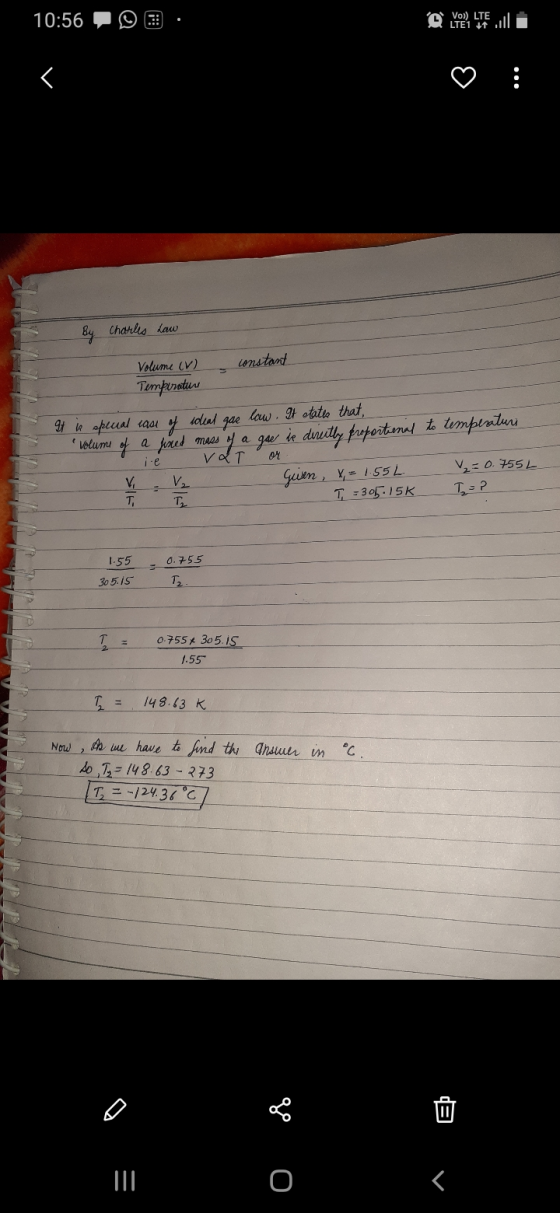
Thave a cylinder sitting in my lab that contains 1.55L of gas, and it's temperature is...
A rigid cylinder contains 2.00 liters of gas at a temperature of 25°C. If the pressure...
A rigid cylinder contains 2.00 liters of gas at a temperature of 25°C. If the pressure of this gas is changed from 0.750 atmospheres to 1.50 atmospheres, what will be the new temperature (in Kelvin, reported to three significant figures) of the gas? (The volume is constant.) 12.5 K 596 K 149 K 50.0 K none of the above
23) What temperature scale is used in gas law calculations? A) Fahrenheit B) Celsius C) Kelvin...
 23) What temperature scale is used in gas law calculations? A) Fahrenheit B) Celsius C) Kelvin D) either Celsius or Fahrenheit E) either Celsius or Kelvin 24) At STP, temperature and pressure have the values of A) O K and I atm B) 273 K and I mmHg C) 273 K and 760 mmHg D) O K and 760 mmHg E) 760 K and 25) At STP, how many moles of helium would occupy 1.00 L? A) 2.24 moles B)...
a gas cylinder in the lab contains 12.0 ft3 of some gas at 70ºF and 100psia....
a gas cylinder in the lab contains 12.0 ft3 of some gas at 70ºF and 100psia. The gas is then compressed to 2.0 ft 3 in an experiment. Assuming isothermal conditions, and using the ideal gas law, what is the pressure of the new volume?
A cylinder with 25.0 L chlorine gas initially had a pressure of 625 mmHg at 125...
A cylinder with 25.0 L chlorine gas initially had a pressure of 625 mmHg at 125 degree celsius. Changes in temperature caused volume of the gas to decrease 15,000 mL with new pressure of 1.5 atm. What was the change in temperature in degree celsius, that caused this change?
An industrial cylinder with a volume of 50 L contains Ar gas at room temperature (20...
An industrial cylinder with a volume of 50 L contains Ar gas at room temperature (20 degrees C) and at a pressure of 1.724 × 10^7 Pa. How many kilograms of Ar gas is there in the cylinder? What is the rms speed these gas molecules?
A cylinder witha movable piston contains an ideal gas. Both the amount of gas and the volume of the container can be ad...
 A cylinder witha movable piston contains an ideal gas. Both the amount of gas and the volume of the container can be adjusted, but the temperature remains constant at 300.0 K. Use the ideal gas law and the individual gas law relationships to answer the questi ons below. L x atm nRT where R = 0.08206 PV mol xK 1st attempt See Periodic Table See Hint Part 1 (1 point) Calculate the number of moles of the gas in the...
A cylinder contains 3.5 L of oxygen at 320 K and 2.7 atm . The gas...
A cylinder contains 3.5 L of oxygen at 320 K and 2.7 atm . The gas is heated, causing a piston in the cylinder to move outward. The heating causes the temperature to rise to 610 K and the volume of the cylinder to increase to 9.4 L . What is the final gas pressure?
A cylinder contains 3.5 L of oxygen at 350 K and 2.6 atm . The gas...
A cylinder contains 3.5 L of oxygen at 350 K and 2.6 atm . The gas is heated, causing a piston in the cylinder to move outward. The heating causes the temperature to rise to 650 K and the volume of the cylinder to increase to 9.5 L . a.What is the final gas pressure?
A cylinder of volume 0.290 m3 contains 10.6 mol of neon gas at 20.6°C. Assume neon...
A cylinder of volume 0.290 m3 contains 10.6 mol of neon gas at 20.6°C. Assume neon behaves as an ideal gas. (a) What is the pressure of the gas? Pa (b) Find the internal energy of the gas. J (c) Suppose the gas expands at constant pressure to a volume of 1.000 m3. How much work is done on the gas? J (d) What is the temperature of the gas at the new volume? K (e) Find the internal energy...
a cylinder contains 10 moles of an ideal gas at a temperature of 300 K. The...
a cylinder contains 10 moles of an ideal gas at a temperature of 300 K. The gas is compressed at constant pressure until the final volume equals 0.77 times the initial volume. The molar heat capacity at constant volume of the gas is 24.0 j/mol. What is the heat absorbed by the gas in kJ
 23) What temperature scale is used in gas law calculations? A) Fahrenheit B) Celsius C) Kelvin D) either Celsius or Fahrenheit E) either Celsius or Kelvin 24) At STP, temperature and pressure have the values of A) O K and I atm B) 273 K and I mmHg C) 273 K and 760 mmHg D) O K and 760 mmHg E) 760 K and 25) At STP, how many moles of helium would occupy 1.00 L? A) 2.24 moles B)...
 A cylinder witha movable piston contains an ideal gas. Both the amount of gas and the volume of the container can be adjusted, but the temperature remains constant at 300.0 K. Use the ideal gas law and the individual gas law relationships to answer the questi ons below. L x atm nRT where R = 0.08206 PV mol xK 1st attempt See Periodic Table See Hint Part 1 (1 point) Calculate the number of moles of the gas in the...
Most questions answered within 3 hours.
-
Where is the error in this code sequence?
String s1 = "Hello";
String s2 = "ello";...
asked 11 months ago -
Financial data for Joel de Paris, Inc., for last year
follow:
Joel de Paris, Inc.
Balance...
asked 11 months ago -
Consider this reaction:
Al2(SO4)3 (aq)+ BaCl3
(aq) Al2Cl6 (aq)- +
3BaSO4(s) . What is the...
asked 11 months ago -
Suppose that Savneet is considering increasing her
recent random sample from 20 car rentals to 40...
asked 11 months ago -
Trucks arrive at an unloading terminal at an average rate of 120
per hour.
Trucks arrive...
asked 11 months ago -
Why are methanol and ethanol completely soluble in water while
octanol is not very little soluble....
asked 11 months ago -
A facilities manager at a university reads in a research report
that the mean amount of...
asked 11 months ago -
When the CuSO4 is rehydrated by adding water to the anhydrous
compound, is this an endothermic...
asked 11 months ago -
A ray of sunlight is passing from diamond into crown glass; the
angle of incidence is...
asked 11 months ago -
A block of mass 0.249 kg is placed on top of a light, vertical
spring of...
asked 11 months ago -
how do the kidneys compensate in the presences of acidosis
a) trigger hyperventilate
b) reserve acid...
asked 11 months ago -
Question 501 pts
The rental rate of capital to the firm increases. Which of the
following...
asked 11 months ago