Lowell Co. acquired 100% of Boston, Inc. on January 1, 2017. On that date, Boston had...
Lowell Co. acquired 100% of Boston, Inc. on January 1, 2017. On that date, Boston had land with a book value of $42,000 and a fair value of $52,000. Also, on the date of acquisition, Boston had a building with a book value of $200,000 and a fair value of $390,000. Boston had equipment with a book value of $350,000 and a fair value of $280,000. Both companies use the same depreciation policy, that the building had a 10-year remaining useful life and the equipment had a 5-year remaining useful life.
On December 31, 2020, the two companies have the following assets:
|
Lowell |
Boston |
|||
|
BV |
FV |
BV |
FV |
|
|
Land |
50,000 |
60,000 |
32,000 |
45,000 |
|
Building |
300,000 |
500,000 |
120,000 |
234,000 |
|
Equipment |
600,000 |
390,000 |
70,000 |
56,000 |
When preparing the consolidation [A] entry to adjust the Buildings on December 31, 2020, Lowell should debit the building for what?
Homework Answers

Add Answer to:
Lowell Co. acquired 100% of Boston, Inc. on January 1, 2017. On
that date, Boston had...
Lowell Co. acquired 100% of Boston, Inc. on January 1, 2017. On that date, Boston had...
Lowell Co. acquired 100% of Boston, Inc. on January 1, 2017. On that date, Boston had land with a book value of $42,000 and a fair value of $52,000. Also, on the date of acquisition, Boston had a building with a book value of $200,000 and a fair value of $390,000. Boston had equipment with a book value of $350,000 and a fair value of $280,000. Both companies use the same depreciation policy, that the building had a 10-year remaining...
Chapter 3 Red Co. acquired 100% of Green, Inc. on January 1, 2017. On that date,...
Chapter 3 Red Co. acquired 100% of Green, Inc. on January 1, 2017. On that date, Green had land with a book value of $42,000 and a fair value of $52,000. Also, on the date of acquisition, Green had a building with a book value of $200,000 and a fair value of $390,000. Green had equipment with a book value of $350,000 and a fair value of $280,000. The building had a 10-year remaining useful life and the equipment had...
Lowell Company acquired 90 percent of Boston Company’s 100,000 outstanding shares on January 1, 2019, for...
Lowell Company acquired 90 percent of Boston Company’s 100,000 outstanding shares on January 1, 2019, for $234,000 cash. Boston’s share was actively traded at $2.50 per share on the market, which is deemed as the NCI’s fair value per share. Boston's stockholders' equity consisted of common stock of $120,000 and retained earnings of $80,000. An analysis of Boston's net assets revealed the following: Book Value Fair Value Buildings (10-year life) $ 10,000 $ 8,000 Equipment (4-year life) 14,000 18,000 Land...
Davis acquires 100% of Ramos on January 1st, 2009. Ramos will be operated as a separate...
Davis acquires 100% of Ramos on January 1st, 2009. Ramos will be operated as a separate subsidiary. Davis will use the equity method to account for its investment in Ramos. In 2013, Davis has net income of $400,000 and pays dividends of $100,000. Ramos has NI of $200,000 and pays dividends of $75,000. At acquisition date, Davis has a building with a. BV of $800,000 and FV of $900,000. Both buildings have a remaining useful life of 10 years (assume...
Red Co. acquired 100% of Brown, Inc. on January 1, Yeart. On that date. Brown had:...
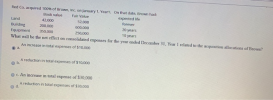 Red Co. acquired 100% of Brown, Inc. on January 1, Yeart. On that date. Brown had: Book value Fair Value expected life Land 42.000 52.000 forever Building 200,000 600.000 20 years Equipment 350,000 250,000 10 years What will be the net effect on consolidated expenses for the year ended December 31, Year 1 related to the acquisition allocations of Brown? An increase in total expenses of $10,000 A reduction in total expenses of $10,000 b. c. An increase in total...
Pepper Company acquired 90 percent of Salt Company's stock at underlying book value on January 1,...
Pepper Company acquired 90 percent of Salt Company's stock at underlying book value on January 1, 2008. At that date, the fair value of the non-controlling interest was equal to 10 percent of the book value of Salt Company. Salt Co. sold equipment to Pepper Co. for a $360,000 on December 31, 2008. Salt Co. had originally purchased the equipment for $400,000 on January 1, 2005, with a useful life of 10 years and no salvage value. At the time...
Pepper Company acquired 90 percent of Salt Company's stock at underlying book value on January 1,...
Pepper Company acquired 90 percent of Salt Company's stock at underlying book value on January 1, 2008. At that date, the fair value of the non-controlling interest was equal to 10 percent of the book value of Salt Company. Salt Co. sold equipment to Pepper Co. for a $360,000 on December 31, 2008. Salt Co. had originally purchased the equipment for $400,000 on January 1, 2005, with a useful life of 10 years and no salvage value. At the time...
Pepper Company acquired 90 percent of Salt Company's stock at underlying book value on January 1,...
Pepper Company acquired 90 percent of Salt Company's stock at underlying book value on January 1, 2008. At that date, the fair value of the non-controlling interest was equal to 10 percent of the book value of Salt Company. Salt Co. sold equipment to Pepper Co. for a $360,000 on December 31, 2008. Salt Co. had originally purchased the equipment for $400,000 on January 1, 2005, with a useful life of 10 years and no salvage value. At the time...
On January 1, 2017 Preibus acquired 100 % of Spicer. This acquisition was not a bargain...
On January 1, 2017 Preibus acquired 100 % of Spicer. This acquisition was not a bargain purchase. On the date of acquisition, Spicer's Equipment had a net book value of 1,600,000 and a fair value of 1,435,082. Preibus determined that Spicer's equipment had a remaining life of 5 years at the date of acquisition. What is the consolidation adjustment (in addition to adding the two trial balance amounts together) that must be made to the Equipment account when preparing consolidated...
1: On January 1, 2009, Vacker Co. acquired 70% of Carper Inc. by paying $650,000. This...
1: On January 1, 2009, Vacker Co. acquired 70% of Carper Inc. by paying $650,000. This included a $20,000 control premium. Carper reported common stock on that date of $420,000 with retained earnings of $252,000. A building was undervalued in the company's financial records by $28,000. This building had a ten-year remaining life. Copyrights of $80,000 were to be recognized and amortized over 20 years. Carper earned income and paid cash dividends as follows: NI Div Paid 2009 $105,000 $54,600...
 Red Co. acquired 100% of Brown, Inc. on January 1, Yeart. On that date. Brown had: Book value Fair Value expected life Land 42.000 52.000 forever Building 200,000 600.000 20 years Equipment 350,000 250,000 10 years What will be the net effect on consolidated expenses for the year ended December 31, Year 1 related to the acquisition allocations of Brown? An increase in total expenses of $10,000 A reduction in total expenses of $10,000 b. c. An increase in total...
Most questions answered within 3 hours.
-
Where is the error in this code sequence?
String s1 = "Hello";
String s2 = "ello";...
asked 11 months ago -
Financial data for Joel de Paris, Inc., for last year
follow:
Joel de Paris, Inc.
Balance...
asked 11 months ago -
Consider this reaction:
Al2(SO4)3 (aq)+ BaCl3
(aq) Al2Cl6 (aq)- +
3BaSO4(s) . What is the...
asked 11 months ago -
Suppose that Savneet is considering increasing her
recent random sample from 20 car rentals to 40...
asked 11 months ago -
Trucks arrive at an unloading terminal at an average rate of 120
per hour.
Trucks arrive...
asked 11 months ago -
Why are methanol and ethanol completely soluble in water while
octanol is not very little soluble....
asked 11 months ago -
A facilities manager at a university reads in a research report
that the mean amount of...
asked 11 months ago -
When the CuSO4 is rehydrated by adding water to the anhydrous
compound, is this an endothermic...
asked 11 months ago -
A ray of sunlight is passing from diamond into crown glass; the
angle of incidence is...
asked 11 months ago -
A block of mass 0.249 kg is placed on top of a light, vertical
spring of...
asked 11 months ago -
how do the kidneys compensate in the presences of acidosis
a) trigger hyperventilate
b) reserve acid...
asked 11 months ago -
Question 501 pts
The rental rate of capital to the firm increases. Which of the
following...
asked 11 months ago