
Homework Answers
here,
let the velocity at the bottom of the track is v
Using conservation of energy
0.50 * m * v^2 = m * g * H
0.50 * v^2 = 9.8 * 24
v = 21.7 m/s
for the maximum height h
maximum height h = (v * sin(theta))^2/(2 * g)
maximum height h = (21.7 * sin(28))^2/(2 * 9.8)
maximum height h = 5.29 m
the maximum height is 5.29 m
part (b)
as the speed is independent of mass
the height remains the same
A 64.0-kg skier starts from rest at the top of a ski slope of height 64.0...
A 64.0-kg skier starts from rest at the top of a ski slope of height 64.0 m . a) If frictional forces do −1.01×10⁴ J of work on her as she descends, how fast is she going at the bottom of the slope? Take free fall acceleration to be g = 9.80 m/s2 b) Now moving horizontally, the skier crosses a patch of soft snow, where the coefficient of friction is 0.25. If the patch is of width 62.0 m...
A skier (m=59.0 kg) starts sliding down from the top of a ski jump with negligible...
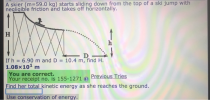 A skier (m=59.0 kg) starts sliding down from the top of a ski jump with negligible friction and takes off horizontally If h 6.90 m and D 10.4 m, find H. 1.08x101 m You arecprmec i 155-1271 Previous Tries Your receipt no. is 155-1271 o inetic energy as she reaches the ground. Use conservation of energy
please explain the answer 2) A ball is dropped from rest at a height H. At...
 please explain the answer
2) A ball is dropped from rest at a height H. At height h (below H) the ball bounces off a surface with no loss in speed. The surface is tilted at 45°, so the ball bounces off horizon- tally. Derive an expression for the distance the ball travels in the horizontal direction. Plot the distance traveled in the horizontal direction as a function of h where h varies between O and H. 3) Imagine an...
please explain the answer
2) A ball is dropped from rest at a height H. At height h (below H) the ball bounces off a surface with no loss in speed. The surface is tilted at 45°, so the ball bounces off horizon- tally. Derive an expression for the distance the ball travels in the horizontal direction. Plot the distance traveled in the horizontal direction as a function of h where h varies between O and H. 3) Imagine an...
An 90 kg skier starts from rest at the top of a ski run. She quickly...
 An 90 kg skier starts from rest at the top of a ski run. She quickly finds herself going fast down the icy (essentially frictionless) hill. At the base of the hill she is unable to stop. She skis across an icy deck, through the open doors of the ski lodge; across the concrete floor of the rental shop before coming to rest against the back wall of the shop. The height of the hill is 150m, the deck and...
A skier with mass 64.0 kg starts at rest at the top of an 842 m...
A skier with mass 64.0 kg starts at rest at the top of an 842 m long ski slope, which makes an angle 13.0 ∘ with the horizontal. A typical coefficient of friction between skis and snow is 5.20×10⁻². skiers don't go straight down the hill- they zigzag back and forth. Even though they still end up at the bottom of the hill, they've lost more energy to friction because friction is a non-conservative force. Let's say due to zigzagging,...
A mass m is dropped from rest from a height h above the left hand side...
A mass m is dropped from rest from a height h above the left hand side of a frictionless bowl where it meets the side of the bowl exactly after falling h and starts to slide down the side of the bowl with some initial velocity where it then collides with a 4m mass sitting at the bottom. The 4m mass makes it exactly up to the rim of the bowl on the right hand side and the m mass...
E.1. [14 points) A soccer ball starts from rest when it is at a vertical height...
 E.1. [14 points) A soccer ball starts from rest when it is at a vertical height yo = 3.00 m above the ground and rolls without slipping down a curved ramp, as shown in the diagram. The ball rolls off the ramp when it is at a vertical height yı = 1.25 m above the ground. Assume the soccer ball is a hollow sphere (spherical shell) of radius 12 cm and mass 450 g. Ignore all frictional losses What is...
a 1200 kg Frictionless roller coaster starts from rest at a height 24 m. what is...
a 1200 kg Frictionless roller coaster starts from rest at a height 24 m. what is the kinetic energy when it goes over a hill that is 12 m high
a 1200 kg frictionless roller coaster starts from rest at a height of 24 m. what...
a 1200 kg frictionless roller coaster starts from rest at a height of 24 m. what is its kinetic energy when it goes over a hill that is 12 m high
On a slide, a child starts sliding from rest from a height of 30 m. If...
 On a slide, a child starts sliding from rest from a height of 30 m. If the slide is frictionless then what is the speed of the child when it reaches the ground (instant before 'impact) Select one: a. We need the mass to determine the velocity o b. 24 m/s O C. 36 m/s O d. 29 m/s On a slide, a child starts sliding from rest from a height of 30 m. If the slide is frictionless then...
 A skier (m=59.0 kg) starts sliding down from the top of a ski jump with negligible friction and takes off horizontally If h 6.90 m and D 10.4 m, find H. 1.08x101 m You arecprmec i 155-1271 Previous Tries Your receipt no. is 155-1271 o inetic energy as she reaches the ground. Use conservation of energy
 please explain the answer
2) A ball is dropped from rest at a height H. At height h (below H) the ball bounces off a surface with no loss in speed. The surface is tilted at 45°, so the ball bounces off horizon- tally. Derive an expression for the distance the ball travels in the horizontal direction. Plot the distance traveled in the horizontal direction as a function of h where h varies between O and H. 3) Imagine an...
please explain the answer
2) A ball is dropped from rest at a height H. At height h (below H) the ball bounces off a surface with no loss in speed. The surface is tilted at 45°, so the ball bounces off horizon- tally. Derive an expression for the distance the ball travels in the horizontal direction. Plot the distance traveled in the horizontal direction as a function of h where h varies between O and H. 3) Imagine an...
 An 90 kg skier starts from rest at the top of a ski run. She quickly finds herself going fast down the icy (essentially frictionless) hill. At the base of the hill she is unable to stop. She skis across an icy deck, through the open doors of the ski lodge; across the concrete floor of the rental shop before coming to rest against the back wall of the shop. The height of the hill is 150m, the deck and...
 E.1. [14 points) A soccer ball starts from rest when it is at a vertical height yo = 3.00 m above the ground and rolls without slipping down a curved ramp, as shown in the diagram. The ball rolls off the ramp when it is at a vertical height yı = 1.25 m above the ground. Assume the soccer ball is a hollow sphere (spherical shell) of radius 12 cm and mass 450 g. Ignore all frictional losses What is...
 On a slide, a child starts sliding from rest from a height of 30 m. If the slide is frictionless then what is the speed of the child when it reaches the ground (instant before 'impact) Select one: a. We need the mass to determine the velocity o b. 24 m/s O C. 36 m/s O d. 29 m/s On a slide, a child starts sliding from rest from a height of 30 m. If the slide is frictionless then...
Most questions answered within 3 hours.
-
Where is the error in this code sequence?
String s1 = "Hello";
String s2 = "ello";...
asked 11 months ago -
Financial data for Joel de Paris, Inc., for last year
follow:
Joel de Paris, Inc.
Balance...
asked 11 months ago -
Consider this reaction:
Al2(SO4)3 (aq)+ BaCl3
(aq) Al2Cl6 (aq)- +
3BaSO4(s) . What is the...
asked 11 months ago -
Suppose that Savneet is considering increasing her
recent random sample from 20 car rentals to 40...
asked 11 months ago -
Trucks arrive at an unloading terminal at an average rate of 120
per hour.
Trucks arrive...
asked 11 months ago -
Why are methanol and ethanol completely soluble in water while
octanol is not very little soluble....
asked 11 months ago -
A facilities manager at a university reads in a research report
that the mean amount of...
asked 11 months ago -
When the CuSO4 is rehydrated by adding water to the anhydrous
compound, is this an endothermic...
asked 11 months ago -
A ray of sunlight is passing from diamond into crown glass; the
angle of incidence is...
asked 11 months ago -
A block of mass 0.249 kg is placed on top of a light, vertical
spring of...
asked 11 months ago -
how do the kidneys compensate in the presences of acidosis
a) trigger hyperventilate
b) reserve acid...
asked 11 months ago -
Question 501 pts
The rental rate of capital to the firm increases. Which of the
following...
asked 11 months ago