
Homework Answers
Add Answer to:
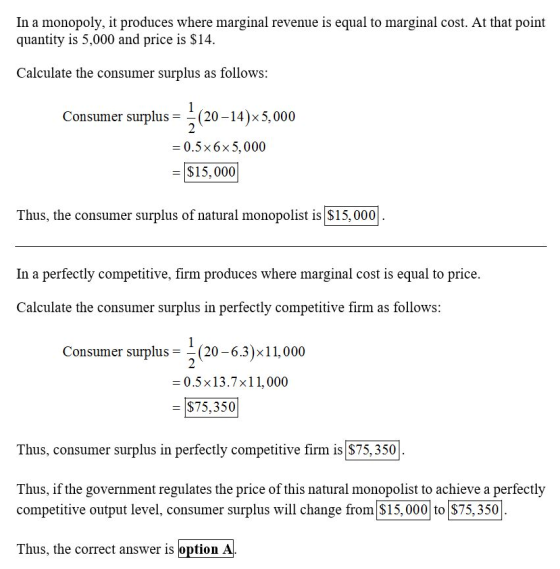
If the government regulates the price of this natural monopolist to achieve a perfectly competitive output...
The perfect price-discriminating monopolist in this diagram will produce ____ units of output, and a single-price...
 The perfect price-discriminating monopolist in this diagram will
produce ____ units of output, and a single-price monopolist would
produce _____ units of output. Consumer surplus under a perfectly
price discriminating monopolist is _____ dollars than under a
single-price monopolist. While, perfect price discrimination
results in reduced consumer surplus, it (increases/decreases)
producer surplus and ultimately results in deadweight loss that is
(less than/greater than/equal to) the amount of deadweight loss
found in a perfectly competitive market.
3 5 points Price $10...
The perfect price-discriminating monopolist in this diagram will
produce ____ units of output, and a single-price monopolist would
produce _____ units of output. Consumer surplus under a perfectly
price discriminating monopolist is _____ dollars than under a
single-price monopolist. While, perfect price discrimination
results in reduced consumer surplus, it (increases/decreases)
producer surplus and ultimately results in deadweight loss that is
(less than/greater than/equal to) the amount of deadweight loss
found in a perfectly competitive market.
3 5 points Price $10...
3. (Figure: Price-Discriminating Monopolist 2) The perfectly price-discriminating monopolist in this diagram will produce units of...
 3. (Figure: Price-Discriminating Monopolist 2) The perfectly price-discriminating monopolist in this diagram will produce units of output, and a single price monopolist would produce units of output. Consumer surplus under a perfectly price discriminating monopolist is dollars less than under a single-price monopolist. While, perfect price discrimination results in reduced consumer surplus, it (increases/decreases) producer surplus and ultimately results in deadweight loss that is (less than/equal to greater than the amount of deadweight loss found in a perfectly competitive market....
Price Discriminating Monopolist vs. Single Price Monopolist I have 4/5 answers to the question correct, but I do not kno...
 Price Discriminating Monopolist vs. Single Price Monopolist
I have 4/5 answers to the question correct, but I do not know
which ones, and I cannot seem to figure out which one I have
incorrect. My answers are:
8
4
8
increases
Less Than
3. (Figure: Price-Discriminating Monopolist 2) The perfectly price-discriminating monopolist in this diagram will produce units of output, and a single-price monopolist would produce units of output. Consumer surplus under a perfectly price discriminating monopolist is_ dollars less...
Price Discriminating Monopolist vs. Single Price Monopolist
I have 4/5 answers to the question correct, but I do not know
which ones, and I cannot seem to figure out which one I have
incorrect. My answers are:
8
4
8
increases
Less Than
3. (Figure: Price-Discriminating Monopolist 2) The perfectly price-discriminating monopolist in this diagram will produce units of output, and a single-price monopolist would produce units of output. Consumer surplus under a perfectly price discriminating monopolist is_ dollars less...
15. Use the following figure for a firm in a perfectly competitive market. a What is the output that maximizes...
 15. Use the following figure for a firm in a perfectly competitive market. a What is the output that maximizes the firm's profit? b. At the profit-maximizing output, calculate total revenue and total cost. C. If the firm maximizes profit, how much profit does it earn? d. What will likely happen to market demand or market supply in the long run? e. What will likely happen to the market price in the long run? Price (s) d = P =...
Assume that a market was initially perfectly competitive. In response to equity concerns, the government allowed...
Assume that a market was initially perfectly competitive. In response to equity concerns, the government allowed all of the sellers to form a cartel, effectively monopolizing the market. The resulting monopoly does not price discriminate. Using a carefully labelled graph: i. Compare the price and output before and after the creation of the cartel. ii. Identify the impact on consumer surplus resulting from the cartel. iii. In general, would consumer expenditure on this good increase or decrease as the result...
1) Compared with a purely competitive industry, a monopolist produces a. more output at a lower...
1) Compared with a purely competitive industry, a monopolist produces a. more output at a lower price. b. less output at a higher price. c. more output at a higher price. d. less output at a lower price. 2) Which one of the following statements about monopoly firms and firms in a purely competitive industry is true? a. In the long run, monopoly firms and firms in a purely competitive industry operate at the minimum point of their average total...
3.Assume that a market was initially perfectly competitive. In response to equity concerns, the government allowed...
3.Assume that a market was initially perfectly competitive. In response to equity concerns, the government allowed all of the sellers to form a cartel, effectively monopolizing the market. The resulting monopoly does not price discriminate. Using a carefully labelled graph: i. Compare the price and output before and after the creation of the cartel. ii. Identify the impact on consumer surplus resulting from the cartel. iii. In general, would consumer expenditure on this good increase or decrease as the result...
1.) What is the main difference between a competitive firm and a monopoly? a. A competitive...
1.) What is the main difference between a competitive firm and a monopoly? a. A competitive firm owns a key resource, but a monopoly firm does not. b. A competitive firm is a price taker, and a monopoly is a price maker. c. A competitive firm produces output at a lower cost than a monopoly firm. d. A competitive firm is subject to government regulations, but a monopoly firm is not. 2.) What is the main social problem caused by...
Market perfectly competitive Current market equilibrium price = $15 Short run total cost of TC= 0.5q^2...
Market perfectly competitive Current market equilibrium price = $15 Short run total cost of TC= 0.5q^2 Profit maximization? Total revenue? TC= aQ^2-bQ+c where, a,b,c are positive constants. For this cost function AC is minimum at the output level where, AC=MC Monopolist seller faces an inverse demand curve P=40-0.5Q and the monopolist can produce at a constant marginal cost of $5 How many units will an unregulated profit maximization monopolist sell? If the government imposes a price ceiling of $6, how...
Microeconomics- AP FRQ Practice
Assume that electricity production has been done by several regional firms in the U.S. each operating as a pure monopoly.Explain and graphically illustrate how the electrical monopolist would determine its profit maximizing price and output level. (Label Pm and Qm)Identify any area of consumer and/or producer surplus for the profit maximizing monopoly.Identify the deadweight loss for the monopolist.Now assume the federal government imposes a regulation on the monopoly. Draw a new monopoly graph for part 2.Show and explain how the...
 The perfect price-discriminating monopolist in this diagram will
produce ____ units of output, and a single-price monopolist would
produce _____ units of output. Consumer surplus under a perfectly
price discriminating monopolist is _____ dollars than under a
single-price monopolist. While, perfect price discrimination
results in reduced consumer surplus, it (increases/decreases)
producer surplus and ultimately results in deadweight loss that is
(less than/greater than/equal to) the amount of deadweight loss
found in a perfectly competitive market.
3 5 points Price $10...
The perfect price-discriminating monopolist in this diagram will
produce ____ units of output, and a single-price monopolist would
produce _____ units of output. Consumer surplus under a perfectly
price discriminating monopolist is _____ dollars than under a
single-price monopolist. While, perfect price discrimination
results in reduced consumer surplus, it (increases/decreases)
producer surplus and ultimately results in deadweight loss that is
(less than/greater than/equal to) the amount of deadweight loss
found in a perfectly competitive market.
3 5 points Price $10...
 3. (Figure: Price-Discriminating Monopolist 2) The perfectly price-discriminating monopolist in this diagram will produce units of output, and a single price monopolist would produce units of output. Consumer surplus under a perfectly price discriminating monopolist is dollars less than under a single-price monopolist. While, perfect price discrimination results in reduced consumer surplus, it (increases/decreases) producer surplus and ultimately results in deadweight loss that is (less than/equal to greater than the amount of deadweight loss found in a perfectly competitive market....
 Price Discriminating Monopolist vs. Single Price Monopolist
I have 4/5 answers to the question correct, but I do not know
which ones, and I cannot seem to figure out which one I have
incorrect. My answers are:
8
4
8
increases
Less Than
3. (Figure: Price-Discriminating Monopolist 2) The perfectly price-discriminating monopolist in this diagram will produce units of output, and a single-price monopolist would produce units of output. Consumer surplus under a perfectly price discriminating monopolist is_ dollars less...
Price Discriminating Monopolist vs. Single Price Monopolist
I have 4/5 answers to the question correct, but I do not know
which ones, and I cannot seem to figure out which one I have
incorrect. My answers are:
8
4
8
increases
Less Than
3. (Figure: Price-Discriminating Monopolist 2) The perfectly price-discriminating monopolist in this diagram will produce units of output, and a single-price monopolist would produce units of output. Consumer surplus under a perfectly price discriminating monopolist is_ dollars less...
 15. Use the following figure for a firm in a perfectly competitive market. a What is the output that maximizes the firm's profit? b. At the profit-maximizing output, calculate total revenue and total cost. C. If the firm maximizes profit, how much profit does it earn? d. What will likely happen to market demand or market supply in the long run? e. What will likely happen to the market price in the long run? Price (s) d = P =...
Most questions answered within 3 hours.
-
Where is the error in this code sequence?
String s1 = "Hello";
String s2 = "ello";...
asked 11 months ago -
Financial data for Joel de Paris, Inc., for last year
follow:
Joel de Paris, Inc.
Balance...
asked 11 months ago -
Consider this reaction:
Al2(SO4)3 (aq)+ BaCl3
(aq) Al2Cl6 (aq)- +
3BaSO4(s) . What is the...
asked 11 months ago -
Suppose that Savneet is considering increasing her
recent random sample from 20 car rentals to 40...
asked 11 months ago -
Trucks arrive at an unloading terminal at an average rate of 120
per hour.
Trucks arrive...
asked 11 months ago -
Why are methanol and ethanol completely soluble in water while
octanol is not very little soluble....
asked 11 months ago -
A facilities manager at a university reads in a research report
that the mean amount of...
asked 11 months ago -
When the CuSO4 is rehydrated by adding water to the anhydrous
compound, is this an endothermic...
asked 11 months ago -
A ray of sunlight is passing from diamond into crown glass; the
angle of incidence is...
asked 11 months ago -
A block of mass 0.249 kg is placed on top of a light, vertical
spring of...
asked 11 months ago -
how do the kidneys compensate in the presences of acidosis
a) trigger hyperventilate
b) reserve acid...
asked 11 months ago -
Question 501 pts
The rental rate of capital to the firm increases. Which of the
following...
asked 11 months ago