
Homework Answers
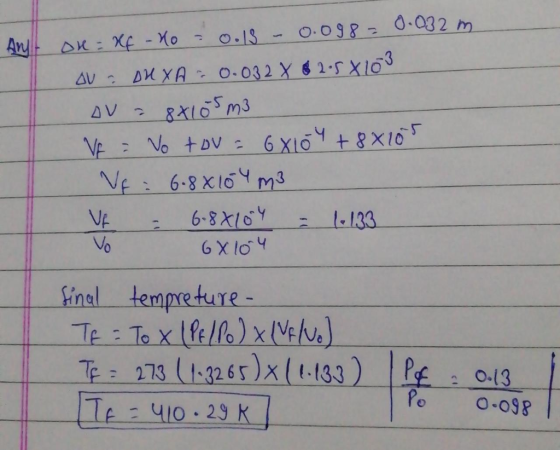
Add Answer to:
The drawing shows an ideal gas confined to a cylinder by a massless piston that is...
Chapter 14, Problem 26 GO The drawing shows an ideal gas confined to a cylinder by...
 Chapter 14, Problem 26 GO The drawing shows an ideal gas confined to a cylinder by a massless piston that is attached to an ideal spring. Outside the cylinder is a vacuum. The cross-sectional area of the piston is A = 2.50 x 10³ m². The initial pressure, volume, and temperature of the gas are, respectively, Po, Vo = 6.00 x 10⁻⁴ m and To = 273 K, and the spring is initially stretched by an amount Xo = 0.097...
1. The drawing shows an ideal gas confined to a cylinder by a massless piston that...
 1. The drawing shows an ideal gas confined to a cylinder by a
massless piston that is attached to an ideal spring. Outside the
cylinder is a vacuum. The cross-sectional area of the piston is A =
2.50 × 10⁻³ m2. The initial pressure, volume, and temperature of
the gas are, respectively, P0, V0 = 6.00 × 10⁻⁴ m3 and T0 = 273 K,
and the spring is initially stretched by an amount x0 = 0.092 m
with respect to...
1. The drawing shows an ideal gas confined to a cylinder by a
massless piston that is attached to an ideal spring. Outside the
cylinder is a vacuum. The cross-sectional area of the piston is A =
2.50 × 10⁻³ m2. The initial pressure, volume, and temperature of
the gas are, respectively, P0, V0 = 6.00 × 10⁻⁴ m3 and T0 = 273 K,
and the spring is initially stretched by an amount x0 = 0.092 m
with respect to...
1. Manufacturers of headache remedies routinely claim that their own brands are more potent pain relievers...
 1. Manufacturers of headache remedies routinely claim that their
own brands are more potent pain relievers than the competing
brands. Their way of making the comparison is to compare the number
of molecules in the standard dosage. Tylenol uses 325 mg of
acetaminophen (C8H9NO2) as the
standard dose, while Advil uses 2.00 x 10² mg of
ibuprofen (C13H18O2). Find the
number of molecules of pain reliever in the standard doses of (a)
Tylenol and (b) Advil.
2. The drawing shows...
1. Manufacturers of headache remedies routinely claim that their
own brands are more potent pain relievers than the competing
brands. Their way of making the comparison is to compare the number
of molecules in the standard dosage. Tylenol uses 325 mg of
acetaminophen (C8H9NO2) as the
standard dose, while Advil uses 2.00 x 10² mg of
ibuprofen (C13H18O2). Find the
number of molecules of pain reliever in the standard doses of (a)
Tylenol and (b) Advil.
2. The drawing shows...
A cylinder of monatomic ideal gas is sealed in a cylinder by a piston. Initially, the...
A cylinder of monatomic ideal gas is sealed in a cylinder by a piston. Initially, the gas occupies a volume of 2.50 L and the pressure is initially 125 kPa. The cylinder is placed in an oven that maintains the temperature at a constant value. 80.0 J of work is then done on the piston, compressing the gas (in other words, the gas does -80 J of work). The work is done very slowly so that the gas maintains a...
He gas is confined to a piston and cylinder with a mechanical stop that prevents the...
He gas is confined to a piston and cylinder with a mechanical stop that prevents the cylinder from expanding. The temperature of the gas is 298 K, the volume of gas in the cylinder is 1.20 L and its pressure is 2.15 bar. The ideal gas EOS is very accurate for He under these conditions. Starting from the final state of the He gas in part (b), the gas (and apparatus) was cooled from 298 K to 263 K. The...
One mole of ideal gas is confined in a cylinder by a piston and is in...
One mole of ideal gas is confined in a cylinder by a piston and is in the thermal contact with a heat reservoir with T=To. As a result, gas slowly expands from V1 to V2 while at the same temperature To. The internal energy of the gas does not change. Calculate work done by the gas and the heat flow into the gas.
He gas is confined to a piston and cylinder with a mechanical stop that prevents the...
He gas is confined to a piston and cylinder with a mechanical stop that prevents the cylinder from expanding. The temperature of the gas is 298 K, the volume of gas in the cylinder is 1.20 L and its pressure is 2.15 bar. The ideal gas EOS is very accurate for He under these conditions. The mechanical stop is a nut on a threaded rod that can be turned, slowly allowing the gas in the cylinder to expand. This process...
1. A gas fills the right portion of a horizontal cylinder whose radius is 5.50 cm....
 1. A gas fills the right portion of a horizontal cylinder whose radius is 5.50 cm. The initial pressure of the gas is 1.01 x 10' Pa. A frictionless movable piston separates the gas from the left portion of the cylinder, which is evacuated and contains an ideal spring, as the figure shows. The piston is initially held in place by a pin. The spring is initially unstrained, and the length of the gas-filled portion is 23.0 cm. When the...
1. A gas fills the right portion of a horizontal cylinder whose radius is 4.60 cm....
 1. A gas fills the right portion of a horizontal cylinder whose radius is 4.60 cm. The initial pressure of the gas is 1.01 X 10Pa. A frictionless movable piston separates the gas from the left portion of the cylinder, which is evacuated and contains an ideal spring, as the figure shows. The piston is initially held in place by a pin. The spring is initially unstrained, and the length of the gas-filled portion is 23.0 cm. When the pin...
A movable piston traps 0.205 moles of an ideal gas in a vertical cylinder. As the...
A movable piston traps 0.205 moles of an ideal gas in a vertical cylinder. As the temperature of the gas is decreased from 511 ◦C to 24.0◦C, the piston slides without friction, reducing the volume of the gas so that its pressure remains constant. Find the work (J) done on the gas in the piston. Hint: Use the ideal gas law to change W = −P∆V to an expression using n and T. Be sure to include the sign of...
 Chapter 14, Problem 26 GO The drawing shows an ideal gas confined to a cylinder by a massless piston that is attached to an ideal spring. Outside the cylinder is a vacuum. The cross-sectional area of the piston is A = 2.50 x 10³ m². The initial pressure, volume, and temperature of the gas are, respectively, Po, Vo = 6.00 x 10⁻⁴ m and To = 273 K, and the spring is initially stretched by an amount Xo = 0.097...
 1. The drawing shows an ideal gas confined to a cylinder by a
massless piston that is attached to an ideal spring. Outside the
cylinder is a vacuum. The cross-sectional area of the piston is A =
2.50 × 10⁻³ m2. The initial pressure, volume, and temperature of
the gas are, respectively, P0, V0 = 6.00 × 10⁻⁴ m3 and T0 = 273 K,
and the spring is initially stretched by an amount x0 = 0.092 m
with respect to...
1. The drawing shows an ideal gas confined to a cylinder by a
massless piston that is attached to an ideal spring. Outside the
cylinder is a vacuum. The cross-sectional area of the piston is A =
2.50 × 10⁻³ m2. The initial pressure, volume, and temperature of
the gas are, respectively, P0, V0 = 6.00 × 10⁻⁴ m3 and T0 = 273 K,
and the spring is initially stretched by an amount x0 = 0.092 m
with respect to...
 1. Manufacturers of headache remedies routinely claim that their
own brands are more potent pain relievers than the competing
brands. Their way of making the comparison is to compare the number
of molecules in the standard dosage. Tylenol uses 325 mg of
acetaminophen (C8H9NO2) as the
standard dose, while Advil uses 2.00 x 10² mg of
ibuprofen (C13H18O2). Find the
number of molecules of pain reliever in the standard doses of (a)
Tylenol and (b) Advil.
2. The drawing shows...
1. Manufacturers of headache remedies routinely claim that their
own brands are more potent pain relievers than the competing
brands. Their way of making the comparison is to compare the number
of molecules in the standard dosage. Tylenol uses 325 mg of
acetaminophen (C8H9NO2) as the
standard dose, while Advil uses 2.00 x 10² mg of
ibuprofen (C13H18O2). Find the
number of molecules of pain reliever in the standard doses of (a)
Tylenol and (b) Advil.
2. The drawing shows...
 1. A gas fills the right portion of a horizontal cylinder whose radius is 5.50 cm. The initial pressure of the gas is 1.01 x 10' Pa. A frictionless movable piston separates the gas from the left portion of the cylinder, which is evacuated and contains an ideal spring, as the figure shows. The piston is initially held in place by a pin. The spring is initially unstrained, and the length of the gas-filled portion is 23.0 cm. When the...
 1. A gas fills the right portion of a horizontal cylinder whose radius is 4.60 cm. The initial pressure of the gas is 1.01 X 10Pa. A frictionless movable piston separates the gas from the left portion of the cylinder, which is evacuated and contains an ideal spring, as the figure shows. The piston is initially held in place by a pin. The spring is initially unstrained, and the length of the gas-filled portion is 23.0 cm. When the pin...
Most questions answered within 3 hours.
-
Where is the error in this code sequence?
String s1 = "Hello";
String s2 = "ello";...
asked 11 months ago -
Financial data for Joel de Paris, Inc., for last year
follow:
Joel de Paris, Inc.
Balance...
asked 11 months ago -
Consider this reaction:
Al2(SO4)3 (aq)+ BaCl3
(aq) Al2Cl6 (aq)- +
3BaSO4(s) . What is the...
asked 11 months ago -
Suppose that Savneet is considering increasing her
recent random sample from 20 car rentals to 40...
asked 11 months ago -
Trucks arrive at an unloading terminal at an average rate of 120
per hour.
Trucks arrive...
asked 11 months ago -
Why are methanol and ethanol completely soluble in water while
octanol is not very little soluble....
asked 11 months ago -
A facilities manager at a university reads in a research report
that the mean amount of...
asked 11 months ago -
When the CuSO4 is rehydrated by adding water to the anhydrous
compound, is this an endothermic...
asked 11 months ago -
A ray of sunlight is passing from diamond into crown glass; the
angle of incidence is...
asked 11 months ago -
A block of mass 0.249 kg is placed on top of a light, vertical
spring of...
asked 11 months ago -
how do the kidneys compensate in the presences of acidosis
a) trigger hyperventilate
b) reserve acid...
asked 11 months ago -
Question 501 pts
The rental rate of capital to the firm increases. Which of the
following...
asked 11 months ago