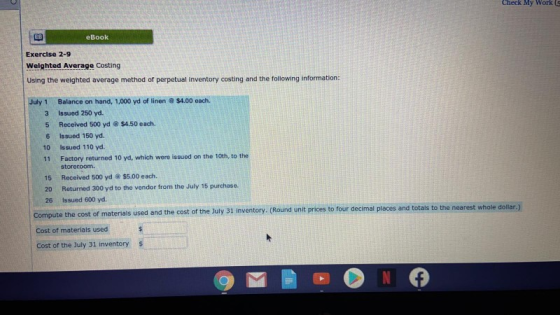
Using the weighted average method of perpetual
inventory costing and the following information:
Compute the cost materials used and the cost of the July 31
inventory. (Round unit prices to four decimals places and totals to
the nearest whole dollar)
Cost of the materials used
Cost of the July 31 inventory
Homework Answers
| RECEIPTS | ISSUES | INVENTORY BALANCE | ||||||||||||||||
| Date | Transaction | Quantity | Rate | Amount | Quantity | Rate | Amount | Quantity | Rate | Amount | ||||||||
| July,1 | Balance on hand | 1000 | $4.00 | $4,000 | ||||||||||||||
| July,3 | Issue | 250 | $4.00 | $1,000 | 750 | $4.00 | $3,000 | |||||||||||
| July,5 | Receipt | 500 | $4.50 | $2,250 | 1250 | $4.20 | $5,250 | Weighted Average Rate=(3000+2250)/1250 | ||||||||||
| July,6 | Issue | 150 | $4.20 | $630 | 1100 | $4.20 | $4,620 | |||||||||||
| July,10 | Issue | 110 | $4.20 | $462 | 990 | $4.20 | $4,158 | |||||||||||
| July,11 | Returned to Stores | 10 | $4.20 | $42 | 1000 | $4.20 | $4,200 | |||||||||||
| July,15 | Receipt | 800 | $5.00 | $4,000 | 1800 | $4.56 | $8,200 | Weighted Average Rate=(4200+4000)/1800 | ||||||||||
| July,20 | Returned to Vendor | 300 | $5.00 | $1,500 | 1500 | $4.47 | $6,700 | Weighted Average Rate=(8200-1500)/1500 | ||||||||||
| July,26 | Issue | 600 | $4.47 | $2,680 | 900 | $4.47 | $4,020 | |||||||||||
| TOTAL | 1310 | $6,292 | 1410 | $6,272 | ||||||||||||||
| COST OF MATERIALS ISSUED | $4,730 | (6272- Returns)=(6272-42-1500) | ||||||||||||||||
| COST OF THE JULY 31, INVENTORY | $4,020 | |||||||||||||||||
Add Answer to:
Using the weighted average method of perpetual
inventory costing and the following information:
Compute the cost...
Check My Work eBook Exercise 2-9 Welghted Average Costing Using the weighted average method of perpetual...
 Check My Work eBook Exercise 2-9 Welghted Average Costing Using the weighted average method of perpetual inventory costing and the following information: July 1 Balance on hand, 1,000 yd of linen @ $4.00 each. 3 Issued 250 yd. 5 Received 500 yd @ $4.50 each. 6 Issued 150 yd. 10 Issued 110 yd. 11 Factory returned 10 yd, which were issued on the 10th, to the storeroom. 15 Received 500 yd @ $5.00 each. 20 Returned 300 yd to the...
le cost of materials issued into production and the cost of the August 31 inventory under...
 le cost of materials issued into production and the cost of the August 31 inventory under each of the following costing methods (Round per unit amounts to three decimal places and total amounts to the nearest dollar.): 1. FIFO 2. LIFO 3. Weighted average E2-7 FIFO costing Using first-in, first-out perpetual inventory costing and the follow- ing information, determine the cost of materials used and the cost of the July 31 inventory: LO3 July 1 3 la 5 6 10...
Need help finding the right answer H UDUMA 20 URL X 2 Cell X Cenx tto...
 Need help finding the right answer
H UDUMA 20 URL X 2 Cell X Cenx tto X east.cengagenow.com/ilm/takeAssignment/takeAssignment Main.do?invoker assignments&takeAssignmentSession Locator assignment take Check My Work (3 remaining) eBook Exercise 2-8 LIFO Costing Using last-in, first-out perpetual inventory costing and the following information: July 1 3 5 6 10 11 Balance on hand, 1,000 yd of linen $4.00 each Issued 250 yd. Received 500 yd $4.50 each. Issued 150 yd. Issued 110 yd. Factory returned 10 yd, which were issued...
Need help finding the right answer
H UDUMA 20 URL X 2 Cell X Cenx tto X east.cengagenow.com/ilm/takeAssignment/takeAssignment Main.do?invoker assignments&takeAssignmentSession Locator assignment take Check My Work (3 remaining) eBook Exercise 2-8 LIFO Costing Using last-in, first-out perpetual inventory costing and the following information: July 1 3 5 6 10 11 Balance on hand, 1,000 yd of linen $4.00 each Issued 250 yd. Received 500 yd $4.50 each. Issued 150 yd. Issued 110 yd. Factory returned 10 yd, which were issued...
Requirement 3. Compute cost of goods sold and gross profit using the weighted-average inventory costing method....
 Requirement 3. Compute cost of goods sold and gross profit using the weighted-average inventory costing method. (Round weighted average cost per unit to the nearest cent and all other amounts to the nearest dollar.) Begin by computing the cost of goods sold and cost of ending merchandise inventory using the weighted average inventory costing method. Enter the transactions in chronological order, calculating new inventory on hand balances after each transaction. Once all of the transactions have been entered into the...
Assume that a company uses the weighted-average inventory costing method and a perpetual inventory system. Assume...
 Assume that a company uses the weighted-average inventory costing method and a perpetual inventory system. Assume also a sales price to customers of S126 per unit. Company records indicate the following for the month: EEB (Click the icon to view the records.) For calculations round per unit costs to the nearest cent and all other amounts to the nearest whole dollar Calculate the cost of ending inventory. Data Table The cost of ending inventory using the weighted-average inventory costing method...
Cost Accounting | Accounting For Materials | Materials costing Method Prepare Table The following information is...
 Cost Accounting | Accounting For Materials | Materials costing
Method
Prepare Table
The following information is to be used in costing inventory on September 31: September 1- Beginning balance 6,000 units at P60 per unit. September 4 - Purchased 4,700 units at P70 per unit. September 7 -issued 3,800 units to production September 10 - Issued 2,900 units September 13 - Purchased 6,500 units at P75 per unit. September 17 - Issued to production 5,000 units. September 19 - Materials...
Cost Accounting | Accounting For Materials | Materials costing
Method
Prepare Table
The following information is to be used in costing inventory on September 31: September 1- Beginning balance 6,000 units at P60 per unit. September 4 - Purchased 4,700 units at P70 per unit. September 7 -issued 3,800 units to production September 10 - Issued 2,900 units September 13 - Purchased 6,500 units at P75 per unit. September 17 - Issued to production 5,000 units. September 19 - Materials...
When using the weighted−average inventory costing method in a perpetual inventory system, a new weighted average...
When using the weighted−average inventory costing method in a perpetual inventory system, a new weighted average cost per unit is computed at the end of each quarter. True or False
Cost Accounting | Accounting For Materials | Materials costing Method (PERIODIC INVENTORY SYSTEM) The following information...
 Cost Accounting | Accounting For Materials | Materials costing
Method (PERIODIC INVENTORY SYSTEM)
The following information is to be used in costing inventory on September 31: September 1- Beginning balance 6,000 units at P60 per unit. September 4 - Purchased 4,700 units at P70 per unit. September 7-Issued 3,800 units to production September 10 - Issued 2,900 units September 13 - Purchased 6,500 units at P75 per unit. September 17 - Issued to production 5,000 units. September 19 - Materials...
Cost Accounting | Accounting For Materials | Materials costing
Method (PERIODIC INVENTORY SYSTEM)
The following information is to be used in costing inventory on September 31: September 1- Beginning balance 6,000 units at P60 per unit. September 4 - Purchased 4,700 units at P70 per unit. September 7-Issued 3,800 units to production September 10 - Issued 2,900 units September 13 - Purchased 6,500 units at P75 per unit. September 17 - Issued to production 5,000 units. September 19 - Materials...
5-6 Perpetual: Inventory costing with weighted average LO P1 A company reports the following beginning inventory...
 5-6 Perpetual: Inventory costing with weighted average LO P1 A company reports the following beginning inventory and two purchases for the month of January. On January 26, the company sells 440 units. Ending inventory at January 31 totals 170 units. Units Unit Cost Beginning inventory on January 1 Purchase on January 9 Purchase on January 25 480 $ 3.90 90 4.1e 242 120 4.2e Required: Assume the perpetual inventory system is used. Determine the costs assigned to ending inventory when...
Inventory Costing Methods—Perpetual Method The Luann Company uses the perpetual inventory system. The following July data...
Inventory Costing Methods—Perpetual Method The Luann Company uses the perpetual inventory system. The following July data are for an item in Luann’s inventory: July 1 Beginning inventory 30 Units@ $9 per unit 10 Purchased 50 Units@ $11 per unit 15 sold 60 Units 26 Purchased 25 Units@ $13 per unit Calculate the cost of goods sold for the July 15 sale using (a) first-in, first-out, (b) last-in, first-out, and (c) the weighted-average cost methods. Round your final answers to the...
 Check My Work eBook Exercise 2-9 Welghted Average Costing Using the weighted average method of perpetual inventory costing and the following information: July 1 Balance on hand, 1,000 yd of linen @ $4.00 each. 3 Issued 250 yd. 5 Received 500 yd @ $4.50 each. 6 Issued 150 yd. 10 Issued 110 yd. 11 Factory returned 10 yd, which were issued on the 10th, to the storeroom. 15 Received 500 yd @ $5.00 each. 20 Returned 300 yd to the...
 le cost of materials issued into production and the cost of the August 31 inventory under each of the following costing methods (Round per unit amounts to three decimal places and total amounts to the nearest dollar.): 1. FIFO 2. LIFO 3. Weighted average E2-7 FIFO costing Using first-in, first-out perpetual inventory costing and the follow- ing information, determine the cost of materials used and the cost of the July 31 inventory: LO3 July 1 3 la 5 6 10...
 Need help finding the right answer
H UDUMA 20 URL X 2 Cell X Cenx tto X east.cengagenow.com/ilm/takeAssignment/takeAssignment Main.do?invoker assignments&takeAssignmentSession Locator assignment take Check My Work (3 remaining) eBook Exercise 2-8 LIFO Costing Using last-in, first-out perpetual inventory costing and the following information: July 1 3 5 6 10 11 Balance on hand, 1,000 yd of linen $4.00 each Issued 250 yd. Received 500 yd $4.50 each. Issued 150 yd. Issued 110 yd. Factory returned 10 yd, which were issued...
Need help finding the right answer
H UDUMA 20 URL X 2 Cell X Cenx tto X east.cengagenow.com/ilm/takeAssignment/takeAssignment Main.do?invoker assignments&takeAssignmentSession Locator assignment take Check My Work (3 remaining) eBook Exercise 2-8 LIFO Costing Using last-in, first-out perpetual inventory costing and the following information: July 1 3 5 6 10 11 Balance on hand, 1,000 yd of linen $4.00 each Issued 250 yd. Received 500 yd $4.50 each. Issued 150 yd. Issued 110 yd. Factory returned 10 yd, which were issued...
 Requirement 3. Compute cost of goods sold and gross profit using the weighted-average inventory costing method. (Round weighted average cost per unit to the nearest cent and all other amounts to the nearest dollar.) Begin by computing the cost of goods sold and cost of ending merchandise inventory using the weighted average inventory costing method. Enter the transactions in chronological order, calculating new inventory on hand balances after each transaction. Once all of the transactions have been entered into the...
 Assume that a company uses the weighted-average inventory costing method and a perpetual inventory system. Assume also a sales price to customers of S126 per unit. Company records indicate the following for the month: EEB (Click the icon to view the records.) For calculations round per unit costs to the nearest cent and all other amounts to the nearest whole dollar Calculate the cost of ending inventory. Data Table The cost of ending inventory using the weighted-average inventory costing method...
 Cost Accounting | Accounting For Materials | Materials costing
Method
Prepare Table
The following information is to be used in costing inventory on September 31: September 1- Beginning balance 6,000 units at P60 per unit. September 4 - Purchased 4,700 units at P70 per unit. September 7 -issued 3,800 units to production September 10 - Issued 2,900 units September 13 - Purchased 6,500 units at P75 per unit. September 17 - Issued to production 5,000 units. September 19 - Materials...
Cost Accounting | Accounting For Materials | Materials costing
Method
Prepare Table
The following information is to be used in costing inventory on September 31: September 1- Beginning balance 6,000 units at P60 per unit. September 4 - Purchased 4,700 units at P70 per unit. September 7 -issued 3,800 units to production September 10 - Issued 2,900 units September 13 - Purchased 6,500 units at P75 per unit. September 17 - Issued to production 5,000 units. September 19 - Materials...
 Cost Accounting | Accounting For Materials | Materials costing
Method (PERIODIC INVENTORY SYSTEM)
The following information is to be used in costing inventory on September 31: September 1- Beginning balance 6,000 units at P60 per unit. September 4 - Purchased 4,700 units at P70 per unit. September 7-Issued 3,800 units to production September 10 - Issued 2,900 units September 13 - Purchased 6,500 units at P75 per unit. September 17 - Issued to production 5,000 units. September 19 - Materials...
Cost Accounting | Accounting For Materials | Materials costing
Method (PERIODIC INVENTORY SYSTEM)
The following information is to be used in costing inventory on September 31: September 1- Beginning balance 6,000 units at P60 per unit. September 4 - Purchased 4,700 units at P70 per unit. September 7-Issued 3,800 units to production September 10 - Issued 2,900 units September 13 - Purchased 6,500 units at P75 per unit. September 17 - Issued to production 5,000 units. September 19 - Materials...
 5-6 Perpetual: Inventory costing with weighted average LO P1 A company reports the following beginning inventory and two purchases for the month of January. On January 26, the company sells 440 units. Ending inventory at January 31 totals 170 units. Units Unit Cost Beginning inventory on January 1 Purchase on January 9 Purchase on January 25 480 $ 3.90 90 4.1e 242 120 4.2e Required: Assume the perpetual inventory system is used. Determine the costs assigned to ending inventory when...
Most questions answered within 3 hours.
-
Where is the error in this code sequence?
String s1 = "Hello";
String s2 = "ello";...
asked 11 months ago -
Financial data for Joel de Paris, Inc., for last year
follow:
Joel de Paris, Inc.
Balance...
asked 11 months ago -
Consider this reaction:
Al2(SO4)3 (aq)+ BaCl3
(aq) Al2Cl6 (aq)- +
3BaSO4(s) . What is the...
asked 11 months ago -
Suppose that Savneet is considering increasing her
recent random sample from 20 car rentals to 40...
asked 11 months ago -
Trucks arrive at an unloading terminal at an average rate of 120
per hour.
Trucks arrive...
asked 11 months ago -
Why are methanol and ethanol completely soluble in water while
octanol is not very little soluble....
asked 11 months ago -
A facilities manager at a university reads in a research report
that the mean amount of...
asked 11 months ago -
When the CuSO4 is rehydrated by adding water to the anhydrous
compound, is this an endothermic...
asked 11 months ago -
A ray of sunlight is passing from diamond into crown glass; the
angle of incidence is...
asked 11 months ago -
A block of mass 0.249 kg is placed on top of a light, vertical
spring of...
asked 11 months ago -
how do the kidneys compensate in the presences of acidosis
a) trigger hyperventilate
b) reserve acid...
asked 11 months ago -
Question 501 pts
The rental rate of capital to the firm increases. Which of the
following...
asked 11 months ago