Electrons are fired at a rectangular potential energy barrier,
once every 197 ms. If the barrier is 2.55 nm thick and has a height
that exceeds the energy of the incident electrons by exactly 537
meV, how long on average would you expect to wait for one electron
to pass through the barrier?
Homework Answers
Tunneling probability is given by

Where V - E = 537 meV
L = barrier thickness = 2.55 nm
h = planck's constant = 6.626 x  = 4.136 x
m = mass of electron = 9.11 x  = 0.511 MeV /
Therefore 

Thus out of  electrons only one electron will tunnel through barrier. Thus time
taken to tunnel one electron = 0.197 x
=
electrons only one electron will tunnel through barrier. Thus time
taken to tunnel one electron = 0.197 x
=  seconds
Thus we will have to wait for
seconds for one electron to tunnel.
Add Answer to:
Electrons are fired at a rectangular potential energy barrier,
once every 197 ms. If the barrier...
Electrons are fired at a rectangular potential energy barrier, once every 341 ms. If the barrier ...
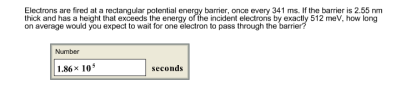 Electrons are fired at a rectangular potential energy barrier, once every 341 ms. If the barrier is 2.55 nm thick and has a height that exceeds the energy of the incident electrons by exactly 512 meV, how long on average would you expect to wait for one electron to pass through the barrier Number 1.86 x 10⁵ seconds
Electrons are fired at a rectangular potential energy barrier, once every 341 ms. If the barrier is 2.55 nm thick and has...
Electrons are fired at a rectangular potential energy barrier, once every 341 ms. If the barrier is 2.55 nm thick and has a height that exceeds the energy of the incident electrons by exactly 512 meV, how long on average would you expect to wait for one electron to pass through the barrier Number 1.86 x 10⁵ seconds
Electrons are fired at a rectangular potential energy barrier, once every 341 ms. If the barrier is 2.55 nm thick and has...
Electrons are fired at a rectangular potential energy barrier, once every 245 ms. If the barrier...
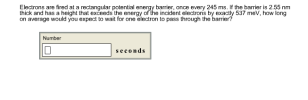 Electrons are fired at a rectangular potential energy barrier, once every 245 ms. If the barrier is 2.55 nm thick and has a height that exceeds the energy of the incident electrons by exactly 537 meV, how long on average would you expect to wait for one electron to pass through the barri Number seconds
Electrons are fired at a rectangular potential energy barrier, once every 245 ms. If the barrier...
Electrons are fired at a rectangular potential energy barrier, once every 245 ms. If the barrier is 2.55 nm thick and has a height that exceeds the energy of the incident electrons by exactly 612 meV, how long on average would you expect to wait for one electron to pass through the barrier?
4. An electron having total energy E 4.50 eV approaches a rectangular Energy energy barrier with...
 4. An electron having total energy E 4.50 eV approaches a rectangular Energy energy barrier with U= 5.00 eV and L = 950 pm as shown. Classically, the electron cannot pass through the barrier because E < U. However, quantum mechanically the probability of tunneling is not zero. a) Calculate this probability, which is the transmission coefficient. b) By how much would the width L of the potential barrier have to change for the chance of an incident 4.50-eV electron...
An electron with an energy of E=9.8eV is incident upon a square potential barrier of height U=13.8eV with a width of L=0.13nm. What is the probability of reflection (reflection coefficient)? Calculate...
An electron with an energy of E=9.8eV is incident upon a square potential barrier of height U=13.8eV with a width of L=0.13nm. What is the probability of reflection (reflection coefficient)? Calculate your answer using two decimal places. Mass of the electron is 0.511 MeV/c2 Please also note that ħc=197 eV.nm
2. An electron with energy E= 1 eV is incident upon a rectangular barrier of potential...
 2. An electron with energy E= 1 eV is incident upon a rectangular barrier of potential energy Vo = 2 eV. About how wide must the barrier be so that the transmission probability is 10-37 Electron mass is m=9.1 x 10⁻³¹ kg. (Hint: note the word "about". A quick sensible approximation is accepted for full credit. The exact calculation is feasible in an exam, but long and perilous - avoid at all costs.]
mechani mie The potential energy barrier shown below is a simplified model of thec electrons in...
 mechani mie The potential energy barrier shown below is a simplified model of thec electrons in metals. The metal workfunction (Ew), the minimum energy required to remove an electron from the metal, is given by Ew-,-E where 1s the height of the potential energy barrier and E is the energy of the electrons near the surface of the metal. The potential energy barrier is = 5 eV V(x) V=0 (a) The wavefunction of an electron on the surface (x< 0)...
e potential energy barrier of height 6.90 eV and thickness 0.820 nm, at a rate equivalent...
 e potential energy barrier of height 6.90 eV and thickness 0.820 nm, at a rate equivalent to a current of 1200 A Units If years Units years a) How many years would you heve to Suppose a beam of 4.90 eV protons strikes a wait (on average) for one proton to be transmitted through the bamier? (b) How long would you have to wait if the beam consisted of electrons rather than protons? (a) N (b) Number t Click if...
plz hlp Tunneling An electron of energy E = 2 eV is incident on a barrier...
 plz hlp
Tunneling An electron of energy E = 2 eV is incident on a barrier of width L = 0.61 nm and height Vo-3 eV as shown in the figure below. (The figure is not drawn to scale.) 1) What is the probability that the electron will pass through the barrier? The transmission probability is 0 SubmitHelp 2) Lets understand the influence of the exponential dependence. If the barrier height were decreased to 2.8 eV (this corresponds to only...
plz hlp
Tunneling An electron of energy E = 2 eV is incident on a barrier of width L = 0.61 nm and height Vo-3 eV as shown in the figure below. (The figure is not drawn to scale.) 1) What is the probability that the electron will pass through the barrier? The transmission probability is 0 SubmitHelp 2) Lets understand the influence of the exponential dependence. If the barrier height were decreased to 2.8 eV (this corresponds to only...
 Electrons are fired at a rectangular potential energy barrier, once every 341 ms. If the barrier is 2.55 nm thick and has a height that exceeds the energy of the incident electrons by exactly 512 meV, how long on average would you expect to wait for one electron to pass through the barrier Number 1.86 x 10⁵ seconds
Electrons are fired at a rectangular potential energy barrier, once every 341 ms. If the barrier is 2.55 nm thick and has...
Electrons are fired at a rectangular potential energy barrier, once every 341 ms. If the barrier is 2.55 nm thick and has a height that exceeds the energy of the incident electrons by exactly 512 meV, how long on average would you expect to wait for one electron to pass through the barrier Number 1.86 x 10⁵ seconds
Electrons are fired at a rectangular potential energy barrier, once every 341 ms. If the barrier is 2.55 nm thick and has...
 Electrons are fired at a rectangular potential energy barrier, once every 245 ms. If the barrier is 2.55 nm thick and has a height that exceeds the energy of the incident electrons by exactly 537 meV, how long on average would you expect to wait for one electron to pass through the barri Number seconds
 4. An electron having total energy E 4.50 eV approaches a rectangular Energy energy barrier with U= 5.00 eV and L = 950 pm as shown. Classically, the electron cannot pass through the barrier because E < U. However, quantum mechanically the probability of tunneling is not zero. a) Calculate this probability, which is the transmission coefficient. b) By how much would the width L of the potential barrier have to change for the chance of an incident 4.50-eV electron...
 2. An electron with energy E= 1 eV is incident upon a rectangular barrier of potential energy Vo = 2 eV. About how wide must the barrier be so that the transmission probability is 10-37 Electron mass is m=9.1 x 10⁻³¹ kg. (Hint: note the word "about". A quick sensible approximation is accepted for full credit. The exact calculation is feasible in an exam, but long and perilous - avoid at all costs.]
 mechani mie The potential energy barrier shown below is a simplified model of thec electrons in metals. The metal workfunction (Ew), the minimum energy required to remove an electron from the metal, is given by Ew-,-E where 1s the height of the potential energy barrier and E is the energy of the electrons near the surface of the metal. The potential energy barrier is = 5 eV V(x) V=0 (a) The wavefunction of an electron on the surface (x< 0)...
 e potential energy barrier of height 6.90 eV and thickness 0.820 nm, at a rate equivalent to a current of 1200 A Units If years Units years a) How many years would you heve to Suppose a beam of 4.90 eV protons strikes a wait (on average) for one proton to be transmitted through the bamier? (b) How long would you have to wait if the beam consisted of electrons rather than protons? (a) N (b) Number t Click if...
 plz hlp
Tunneling An electron of energy E = 2 eV is incident on a barrier of width L = 0.61 nm and height Vo-3 eV as shown in the figure below. (The figure is not drawn to scale.) 1) What is the probability that the electron will pass through the barrier? The transmission probability is 0 SubmitHelp 2) Lets understand the influence of the exponential dependence. If the barrier height were decreased to 2.8 eV (this corresponds to only...
plz hlp
Tunneling An electron of energy E = 2 eV is incident on a barrier of width L = 0.61 nm and height Vo-3 eV as shown in the figure below. (The figure is not drawn to scale.) 1) What is the probability that the electron will pass through the barrier? The transmission probability is 0 SubmitHelp 2) Lets understand the influence of the exponential dependence. If the barrier height were decreased to 2.8 eV (this corresponds to only...
Most questions answered within 3 hours.
-
Where is the error in this code sequence?
String s1 = "Hello";
String s2 = "ello";...
asked 11 months ago -
Financial data for Joel de Paris, Inc., for last year
follow:
Joel de Paris, Inc.
Balance...
asked 11 months ago -
Consider this reaction:
Al2(SO4)3 (aq)+ BaCl3
(aq) Al2Cl6 (aq)- +
3BaSO4(s) . What is the...
asked 11 months ago -
Suppose that Savneet is considering increasing her
recent random sample from 20 car rentals to 40...
asked 11 months ago -
Trucks arrive at an unloading terminal at an average rate of 120
per hour.
Trucks arrive...
asked 11 months ago -
Why are methanol and ethanol completely soluble in water while
octanol is not very little soluble....
asked 11 months ago -
A facilities manager at a university reads in a research report
that the mean amount of...
asked 11 months ago -
When the CuSO4 is rehydrated by adding water to the anhydrous
compound, is this an endothermic...
asked 11 months ago -
A ray of sunlight is passing from diamond into crown glass; the
angle of incidence is...
asked 11 months ago -
A block of mass 0.249 kg is placed on top of a light, vertical
spring of...
asked 11 months ago -
how do the kidneys compensate in the presences of acidosis
a) trigger hyperventilate
b) reserve acid...
asked 11 months ago -
Question 501 pts
The rental rate of capital to the firm increases. Which of the
following...
asked 11 months ago