What steps would you take to analyze the assets and liabilities of a business combination? What...
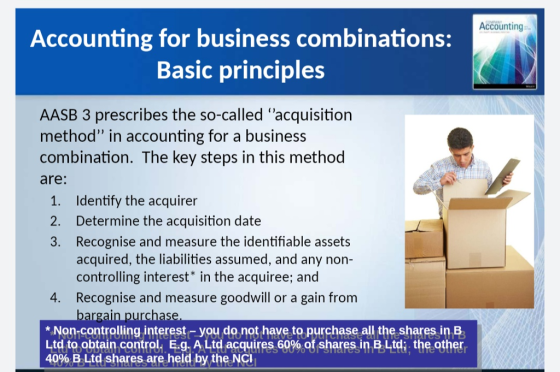
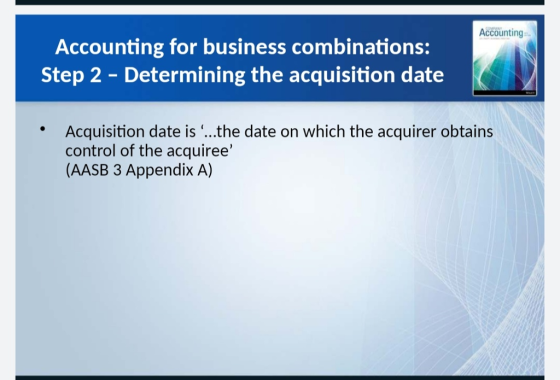
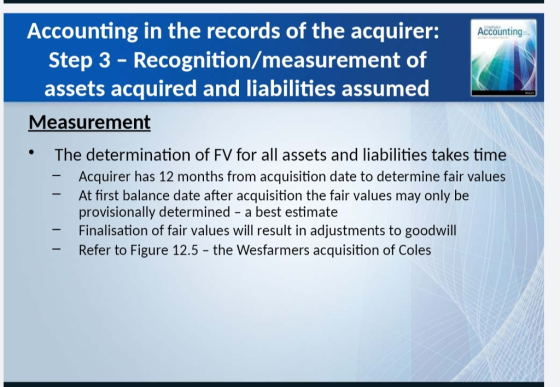
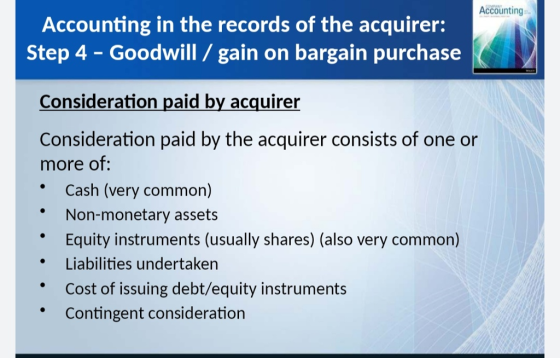
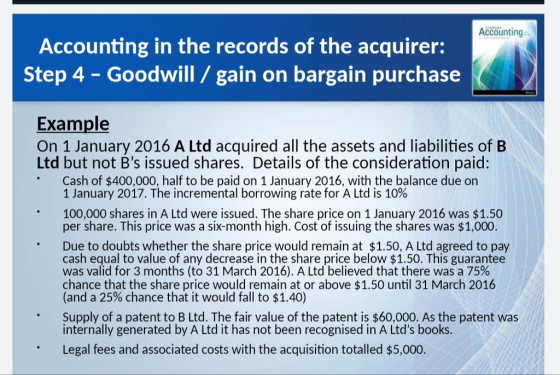
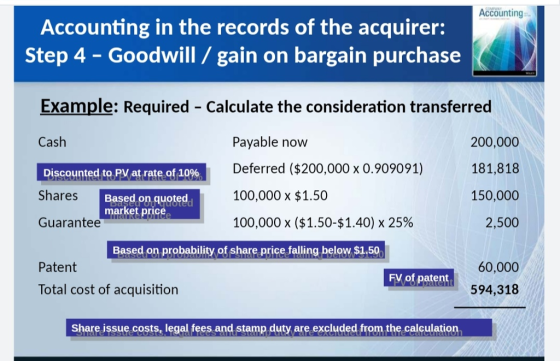
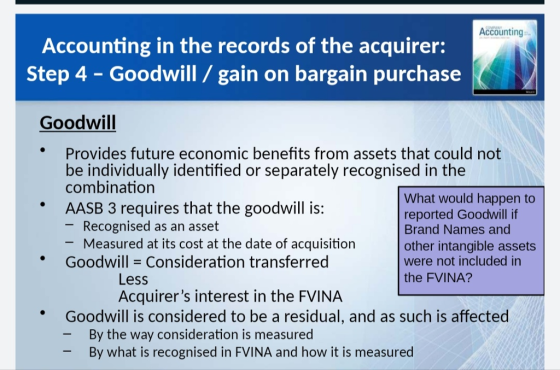
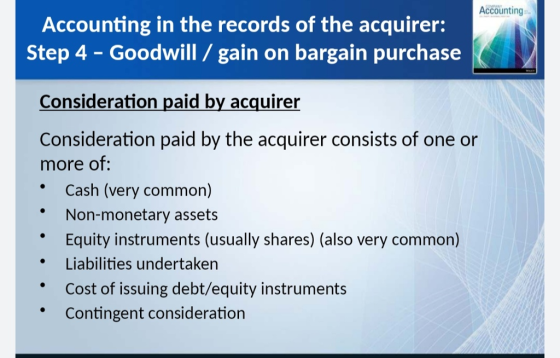
What steps would you take to analyze the assets and liabilities of a business combination? What are the U.S. GAAP and IFRS accounting rules regarding consolidations?
Homework Answers





 The U.S.GAAP and IFRS rules
are as follows :
The U.S.GAAP and IFRS rules
are as follows :
U.S.GAAP rules that should be considered while preparing consolidation financial statement:
- If a company has a majority of voting power in another company (here it is more than 50%), then consolidation of financial statements can be done.
- According to GAAP, if your business holds 20% to 50% in equity; you need to report your financial statements under the equity method. The reasoning behind this that as a company when you have 20%-50% equity in the other company, you can exert your influence.
- According to GAAP, in consolidated statements, equity portions or retained earnings of subsidiary companies should be removed.
- If the subsidiary is not fully owned, then non-controlling interest should be used.
- While producing the consolidated statements, the balance sheets of subsidiary companies should be adjusted to the current fair market value of the assets.
- While preparing the consolidated income statement, if the revenue of the parent company is the expense of the subsidiary; it should be completely removed. IFRS rules regarding consolidation are as follows :
-
Consolidation procedures
In order to prepare consolidated financial statements, IFRS 10 prescribes the following consolidation procedures:
- Combine like items of assets, liabilities, equity, income, expenses and cash flows of the parent with those of its subsidiaries;
- Offset (eliminate):
- The carrying amount of the parent’s investment in each subsidiary; and
- The parent’s portion of equity of each subsidiary;
- Eliminate in full intragroup assets and liabilities, equity, income, expenses and cash flows relating to transactions between entities of the group. Differences in U.S GAAP and IFRS rules :
- US GAAP adopts a bipolar consolidationmodel, which makes a distinction between a variable interest model and voting interest model. Under IFRS, on the contrary,consolidation is based on control, which is presumed to exist when a parent company holds more than half of a business' voting power, or holds legal rights.
Add Answer to:
What steps would you take to analyze the assets and liabilities
of a business combination? What...
What is the accounting valuarion basis for consolidating assets and liabilities in a business combination? please...
What is the accounting valuarion basis for consolidating assets and liabilities in a business combination? please explain in detail
In a pre-2009 business combination, Acme Company acquired all of Brem Company’s assets and liabilities for...
In a pre-2009 business combination, Acme Company acquired all of Brem Company’s assets and liabilities for cash. After the combination Acme formally dissolved Brem. At the acquisition date, the following book and fair values were available for the Brem Company accounts: Book Values Fair Values Current assets $ 63,200 $ 63,200 Equipment 150,000 216,000 Trademark 0 324,000 Liabilities (68,200 ) (68,200 ) Common stock (100,000 ) Retained earnings (45,000 ) In addition, Acme paid an investment bank $32,100 cash for...
In a pre-2009 business combination, Acme Company acquired all of Brem Company’s assets and liabilities for...
In a pre-2009 business combination, Acme Company acquired all of Brem Company’s assets and liabilities for cash. After the combination Acme formally dissolved Brem. At the acquisition date, the following book and fair values were available for the Brem Company accounts: Book Values Fair Values Current assets $ 56,800 $ 56,800 Equipment 157,000 220,000 Trademark 0 330,000 Liabilities (68,800 ) (68,800 ) Common stock (100,000 ) Retained earnings (45,000 ) In addition, Acme paid an investment bank $28,100 cash for...
In a pre-2009 business combination, Acme Company acquired all of Brem Company’s assets and liabilities for...
In a pre-2009 business combination, Acme Company acquired all of Brem Company’s assets and liabilities for cash. After the combination Acme formally dissolved Brem. At the acquisition date, the following book and fair values were available for the Brem Company accounts: Book Values Fair Values Current assets $ 81,800 $ 81,800 Equipment 131,000 198,000 Trademark (0) 352,000 Liabilities (67,800 ) (67,800 ) Common stock (100,000 ) (0) Retained earnings (45,000 ) (0) In addition, Acme paid an investment bank $31,200...
What steps would you take to identify and evaluate opportunities for a new business, or one...
What steps would you take to identify and evaluate opportunities for a new business, or one within an existing business? Would it matter if the new business were completely separate, or within an existing enterprise? If so, why? How would you approach any differences as may exist?
Which of the following is not one of the steps to prepare IFRS statements for the...
 Which of the following is not one of the steps to prepare IFRS statements for the first time? Multiple Choice 0 Determine applicable IFRS accounting policies based on standards in force on the reporting date. 0 Recognize assets and liabilities required to be recognized under IFRS that were not recognized under previous GAAP. 0 Derecognize assets and liabilities previously recognized that are not allowed to be recognized under IFRS. 0 Reclassify items previously classified in a different manner from what...
HolmesWatson (HW) is considering what the effect would be of reporting its liabilities under IFRS rather...
 HolmesWatson (HW) is considering what the effect would be of reporting its liabilities under IFRS rather than U.S. GAAP. The following facts apply: a. HW is defending against a lawsuit and believes it is virtually certain to lose in court. If it loses the lawsuit, management estimates it will need to pay a range of damages that falls between $5,200,000 and $10,200,000, with each amount in that range equally likely. b. HW is defending against another lawsuit that is identical...
HolmesWatson (HW) is considering what the effect would be of reporting its liabilities under IFRS rather...
 HolmesWatson (HW) is considering what the effect would be of reporting its liabilities under IFRS rather than U.S. GAAP. The following facts apply: a. HW is defending against a lawsuit and believes it is virtually certain to lose in court. If it loses the lawsuit, management estimates it will need to pay a range of damages that falls between $6,800,000 and $11,800,000, with each amount in that range equally likely. b. HW is defending against another lawsuit that is identical...
HolmesWatson (HW) is considering what the effect would be of reporting its liabilities under IFRS rather...
 HolmesWatson (HW) is considering what the effect would be of reporting its liabilities under IFRS rather than U.S. GAAP. The following facts apply: a. HW is defending against a lawsuit and believes it is virtually certain to lose in court. If it loses the lawsuit, management estimates it will need to pay a range of damages that falls between $5,000,000 and $10,000,000, with each amount in that range equally likely. b. HW is defending against another lawsuit that is identical...
In a pre-2009 business combination, Acme Company acquired all of Brem Company’s assets and liabilities for...
In a pre-2009 business combination, Acme Company acquired all of Brem Company’s assets and liabilities for cash. After the combination Acme formally dissolved Brem. At the acquisition date, the following book and fair values were available for the Brem Company accounts: Book Values Fair Values Current assets $ 81,800 $ 81,800 Equipment 131,000 198,000 Trademark 0 352,000 Liabilities (67,800 ) (67,800 ) Common stock (100,000 ) Retained earnings (45,000 ) In addition, Acme paid an investment bank $31,200 cash for...
 Which of the following is not one of the steps to prepare IFRS statements for the first time? Multiple Choice 0 Determine applicable IFRS accounting policies based on standards in force on the reporting date. 0 Recognize assets and liabilities required to be recognized under IFRS that were not recognized under previous GAAP. 0 Derecognize assets and liabilities previously recognized that are not allowed to be recognized under IFRS. 0 Reclassify items previously classified in a different manner from what...
 HolmesWatson (HW) is considering what the effect would be of reporting its liabilities under IFRS rather than U.S. GAAP. The following facts apply: a. HW is defending against a lawsuit and believes it is virtually certain to lose in court. If it loses the lawsuit, management estimates it will need to pay a range of damages that falls between $5,200,000 and $10,200,000, with each amount in that range equally likely. b. HW is defending against another lawsuit that is identical...
 HolmesWatson (HW) is considering what the effect would be of reporting its liabilities under IFRS rather than U.S. GAAP. The following facts apply: a. HW is defending against a lawsuit and believes it is virtually certain to lose in court. If it loses the lawsuit, management estimates it will need to pay a range of damages that falls between $6,800,000 and $11,800,000, with each amount in that range equally likely. b. HW is defending against another lawsuit that is identical...
 HolmesWatson (HW) is considering what the effect would be of reporting its liabilities under IFRS rather than U.S. GAAP. The following facts apply: a. HW is defending against a lawsuit and believes it is virtually certain to lose in court. If it loses the lawsuit, management estimates it will need to pay a range of damages that falls between $5,000,000 and $10,000,000, with each amount in that range equally likely. b. HW is defending against another lawsuit that is identical...
Most questions answered within 3 hours.
-
Where is the error in this code sequence?
String s1 = "Hello";
String s2 = "ello";...
asked 10 months ago -
Financial data for Joel de Paris, Inc., for last year
follow:
Joel de Paris, Inc.
Balance...
asked 10 months ago -
Consider this reaction:
Al2(SO4)3 (aq)+ BaCl3
(aq) Al2Cl6 (aq)- +
3BaSO4(s) . What is the...
asked 10 months ago -
Suppose that Savneet is considering increasing her
recent random sample from 20 car rentals to 40...
asked 10 months ago -
Trucks arrive at an unloading terminal at an average rate of 120
per hour.
Trucks arrive...
asked 10 months ago -
Why are methanol and ethanol completely soluble in water while
octanol is not very little soluble....
asked 10 months ago -
A facilities manager at a university reads in a research report
that the mean amount of...
asked 10 months ago -
When the CuSO4 is rehydrated by adding water to the anhydrous
compound, is this an endothermic...
asked 10 months ago -
A ray of sunlight is passing from diamond into crown glass; the
angle of incidence is...
asked 10 months ago -
A block of mass 0.249 kg is placed on top of a light, vertical
spring of...
asked 10 months ago -
how do the kidneys compensate in the presences of acidosis
a) trigger hyperventilate
b) reserve acid...
asked 10 months ago -
Question 501 pts
The rental rate of capital to the firm increases. Which of the
following...
asked 10 months ago