3. Think about you benefit from food. Let c be the market value of the amount...
3. Think about you benefit from food. Let c be the market value of the amount of food you have in a given day and u(c) the utility from consuming c. (a) Plot u(c) (utility on the y axis, consumption on the x axis). Explain why it is the shape it is.
Homework Answers
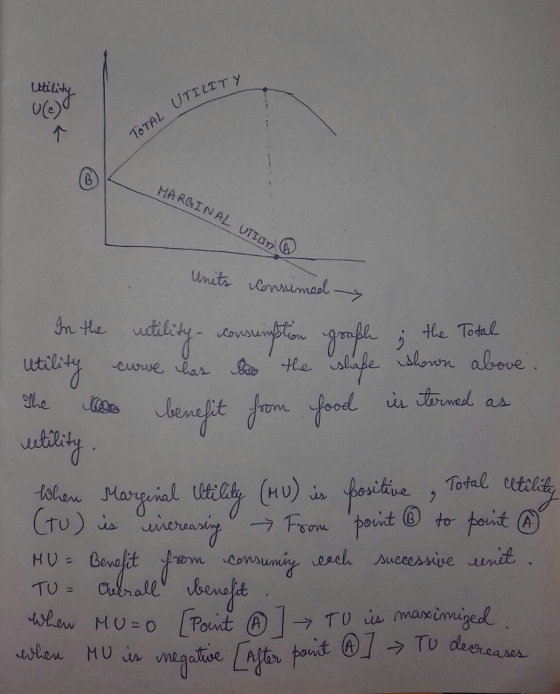
In this question we examine the utility-consumption graph where we see the relation between marginal and total utility . The shape of the total utility curve depends upon marginal utility . When we are consuming the first few units of food , with each successive unit the TU increases since we get positive MU from them . When we reach Point of Satiety ( Point A ) the MU becomes zero and the TU is maximized . After this point the next unit consumed fetches us negative MU . We do not need any more food and if we still keep on consuming it will cause harm to our health and thus causes negative MU , hence TU curve falls down .
Add Answer to:
3. Think about you benefit from food. Let c be the market value
of the amount...
3. Think about you benefit from food. Let c be the market value of the amount...
3. Think about you benefit from food. Let c be the market value of the amount of food you have in a given day and u(c) the utility from consuming c. (a) Plot u(c) (utility on the y axis, consumption on the x axis). Explain why it is the shape it is. (b) If you have enough money to consume C in a week, how much would you spend each day? Is this consistent with your plot? (c) You are...
3. Think about you benefit from food. Let c be the market value of the amount...
3. Think about you benefit from food. Let c be the market value of the amount of food you have in a given day and u(c) the utility from consuming c. (B) If you have enough money to consume C in a week, how much would you spend each day? Is this consistent with your plot?
3. Think about you benefit from food. Let c be the market value of the amount...
3. Think about you benefit from food. Let c be the market value of the amount of food you have in a given day and u(c) the utility from consuming c. (c) You are offered the choice between (A) $150 dollars worth of food for the week (B) 50% chance that you get $600 worth of food for the week and 50% you get $0 worth of food for the week. If this is the only source of food (e.g....
(1 point) Suppose that you have two consumption choices: good X, and good Y. An indifference...
 (1 point) Suppose that you have two consumption choices: good X, and good Y. An indifference curve is the set of consumption choices with a CONSTANT utility. For example if consuming 10X and 6Y gives me the same utility as consuming 11X and 5Y, then these are both points on the same indifference curve. An indifference map is the set of all indifference curves with EVERY given utility. Consider the indifference map given by: U = XY, where U is...
Suppose that a fast-food junkie derives utility from three goods-soft drinks (x), hamburgers (y), and ice...
 Suppose that a fast-food junkie derives utility from three goods-soft drinks (x), hamburgers (y), and ice cream sundaes (z)-according to the Cobb- Douglas utility function: Suppose also that the prices for these goods are given by Px-1,py-4, and pz-8 and this consumer's income is given by 1-8 If z-0, then the combination of x and y that optimize utility involve x*- utility U and y*- , These values of x* and y result in a level of If z- 1,...
John has preferences for food F and clothing C described by a utility function U(F,C) =...
 John has preferences for food F and clothing C described by a utility function U(F,C) = min (F, 2C). Suppose that food costs $1 a unit and that clothing costs $2 a unit. John has $12 to spend on food and clothing. (10 pts.) a) On a graph, draw indifference curves corresponding to u = 6, u = 10, u = 14. Make sure to label coordinates clearly. Using the graph, find the optimal choice of food and clothing. Let...
I am trying to understand this material how can i go about solving #4 3. (8...
 I am trying to understand this material how can i go about solving
#4
3. (8 points total) Suppose a firm has the following benefit and cost structure: B(Q) 140Q 302 C(Q) 0.50 a. Find the MB(Q) and MC(Q) functions. b. What value of Q maximizes the Net Benefit NB(Q) B(Q)-C(Q)? 4. (50 points total) Abby is a first grader who likes to drink milk and juice. Suppose her parents give her $12 a week in pocket money to spend...
I am trying to understand this material how can i go about solving
#4
3. (8 points total) Suppose a firm has the following benefit and cost structure: B(Q) 140Q 302 C(Q) 0.50 a. Find the MB(Q) and MC(Q) functions. b. What value of Q maximizes the Net Benefit NB(Q) B(Q)-C(Q)? 4. (50 points total) Abby is a first grader who likes to drink milk and juice. Suppose her parents give her $12 a week in pocket money to spend...
Consider the standard two-periods consumption model where consumers have the utility func- tion u(c)-S Furthermore, let...
 Consider the standard two-periods consumption model where consumers have the utility func- tion u(c)-S Furthermore, let a =0, y 0,and y-1. where 0 < ? and ? > 1 are parameters (a) Write down the consumer problem (b) Find the first order conditions. (c) Find the optimal consumption plan (c and c as function of variables ans parameters "given" to the consumer) Set ?-05, ? (d) (e) Set ?-2, ?-0.5 and r-0.02. Which consumption is larger, present or future? why?...
Clark gains utility from consumption c and leisure l and his preferences for consumption and leisure...
Clark gains utility from consumption c and leisure l and his preferences for consumption and leisure can be expressed as U(c, l) = 2(√ c)(l). This utility function implies that Clark’s marginal utility of leisure is 2√ c and his marginal utility of consumption is l √ c . He has 16 hours per day to allocate between leisure (l) and work (h). His hourly wage is $12 after taxes. Clark also receives a daily check of $30 from the...
(Use this information to answer a, b, c below) Suppose Mary’s utility function for two goods...
(Use this information to answer a, b, c below) Suppose Mary’s utility function for two goods X and Y is given by: U(X,Y) = 3X1/2Y1/2 . Suppose consumption bundle A consists of 10 units of X and 30 units of Y, and consumption bundle B consists of 40 units of X and 20 units of Y. a. Consumption bundle A lies on a higher/lower/same indifference curve than consumption bundle B. Show computations. b. Compute Mary’s MRSxy at consumption bundle A....
 (1 point) Suppose that you have two consumption choices: good X, and good Y. An indifference curve is the set of consumption choices with a CONSTANT utility. For example if consuming 10X and 6Y gives me the same utility as consuming 11X and 5Y, then these are both points on the same indifference curve. An indifference map is the set of all indifference curves with EVERY given utility. Consider the indifference map given by: U = XY, where U is...
 Suppose that a fast-food junkie derives utility from three goods-soft drinks (x), hamburgers (y), and ice cream sundaes (z)-according to the Cobb- Douglas utility function: Suppose also that the prices for these goods are given by Px-1,py-4, and pz-8 and this consumer's income is given by 1-8 If z-0, then the combination of x and y that optimize utility involve x*- utility U and y*- , These values of x* and y result in a level of If z- 1,...
 John has preferences for food F and clothing C described by a utility function U(F,C) = min (F, 2C). Suppose that food costs $1 a unit and that clothing costs $2 a unit. John has $12 to spend on food and clothing. (10 pts.) a) On a graph, draw indifference curves corresponding to u = 6, u = 10, u = 14. Make sure to label coordinates clearly. Using the graph, find the optimal choice of food and clothing. Let...
 I am trying to understand this material how can i go about solving
#4
3. (8 points total) Suppose a firm has the following benefit and cost structure: B(Q) 140Q 302 C(Q) 0.50 a. Find the MB(Q) and MC(Q) functions. b. What value of Q maximizes the Net Benefit NB(Q) B(Q)-C(Q)? 4. (50 points total) Abby is a first grader who likes to drink milk and juice. Suppose her parents give her $12 a week in pocket money to spend...
I am trying to understand this material how can i go about solving
#4
3. (8 points total) Suppose a firm has the following benefit and cost structure: B(Q) 140Q 302 C(Q) 0.50 a. Find the MB(Q) and MC(Q) functions. b. What value of Q maximizes the Net Benefit NB(Q) B(Q)-C(Q)? 4. (50 points total) Abby is a first grader who likes to drink milk and juice. Suppose her parents give her $12 a week in pocket money to spend...
 Consider the standard two-periods consumption model where consumers have the utility func- tion u(c)-S Furthermore, let a =0, y 0,and y-1. where 0 < ? and ? > 1 are parameters (a) Write down the consumer problem (b) Find the first order conditions. (c) Find the optimal consumption plan (c and c as function of variables ans parameters "given" to the consumer) Set ?-05, ? (d) (e) Set ?-2, ?-0.5 and r-0.02. Which consumption is larger, present or future? why?...
Most questions answered within 3 hours.
-
Where is the error in this code sequence?
String s1 = "Hello";
String s2 = "ello";...
asked 11 months ago -
Financial data for Joel de Paris, Inc., for last year
follow:
Joel de Paris, Inc.
Balance...
asked 11 months ago -
Consider this reaction:
Al2(SO4)3 (aq)+ BaCl3
(aq) Al2Cl6 (aq)- +
3BaSO4(s) . What is the...
asked 11 months ago -
Suppose that Savneet is considering increasing her
recent random sample from 20 car rentals to 40...
asked 11 months ago -
Trucks arrive at an unloading terminal at an average rate of 120
per hour.
Trucks arrive...
asked 11 months ago -
Why are methanol and ethanol completely soluble in water while
octanol is not very little soluble....
asked 11 months ago -
A facilities manager at a university reads in a research report
that the mean amount of...
asked 11 months ago -
When the CuSO4 is rehydrated by adding water to the anhydrous
compound, is this an endothermic...
asked 11 months ago -
A ray of sunlight is passing from diamond into crown glass; the
angle of incidence is...
asked 11 months ago -
A block of mass 0.249 kg is placed on top of a light, vertical
spring of...
asked 11 months ago -
how do the kidneys compensate in the presences of acidosis
a) trigger hyperventilate
b) reserve acid...
asked 11 months ago -
Question 501 pts
The rental rate of capital to the firm increases. Which of the
following...
asked 11 months ago