
Homework Answers
Add Answer to:
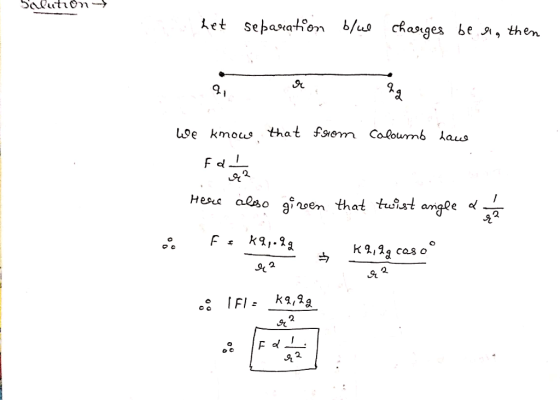
Look at the following graph. If the twist angle shows an inverse-square relationship to the separation...
Trestoring Ktorsion0 where 0 is the twist angle and Kenios is the torsion constant of the...
 Trestoring Ktorsion0 where 0 is the twist angle and Kenios is the torsion constant of the wire and vector τ_LXF where I is the lever-arm distance fron the charged sphere to the torsion wire and F is the force due to the charges Look at the following graph. If the twist angle shows an inverse-square relationship to the separation distance r between charges, what does that say about the charge force F and distance r? FIGURE 2 Twist angle vs....
The relationship between the electric force and the charge on the spheres will be determined by...
 The relationship between the electric force and the charge on the spheres will be determined by adjusting the voltage on the spheres while keeping the separation distance r between the spheres constant. Q = CV where C is the capacitance of a charged sphere (we'll study capacitance later, just know that Q a V) and the relationship between V2 and the twist angle is linear, what does that say about the relationship between the magnitude of charges O and the...
What does the graph of Range vs angle look like? Also what is the slope of...
What does the graph of Range vs angle look like? Also what is the slope of that graph What does the graph of altitude vs angle look like? What is the slope of that graph?
As you discussed in Activity 2.10, Relationship 2 of the Particle Model of Matter gives the...
 As you discussed in Activity 2.10, Relationship 2 of the Particle Model of Matter gives the relation between the force acting between two particles and the potential energy due to this force: the force is equal to the derivative of the potential energy with respect to the particle separation. The force is always in the direction that lowers the potential energy. 3) a) The electrical force between two positively charged objects is always repulsive and becomes weaker as distance increases,...
The given graph shows the relationship of df(x)/dx vs. x. Which of the following graphs is...
 The given graph shows the relationship of df(x)/dx vs. x. Which of the following graphs is reasonable as a plot of f(x) vs. x?
Two point charges are separated by a distance r. If the separation is reduced by a...
Two point charges are separated by a distance r. If the separation is reduced by a factor of 3.6, by what factor does the electric force between the two charges increase?
Two point charges are separated by a distance r. If the separation is reduced by a...
Two point charges are separated by a distance r. If the separation is reduced by a factor of 2.9, by what factor does the electric force between them change?
Experiment 2: Inverse Square Law The inverse square law is a concept that comes up in...
Experiment 2: Inverse Square Law The inverse square law is a concept that comes up in several areas of physics. This experiment does not demonstrate how gravity "works,” but it aims to give you a better picture of how the force of gravity diminishes greatly as distance increases. In Figure 6, gravity is represented by the amount of light spread out over an area, A. Figure 6: Inverse square law. "A" represents the original area at distance, d. Note the...
11. The graph below shows the relationship between pressure and volume of a gas. What would...
 11. The graph below shows the relationship between pressure and volume of a gas. What would this graph look like if volume was directly proportional to pressure! Volume PV = constant Pressure
The figure shows an arrangement of four charged particles, with angle θ = 33.0 ˚ and...
 The figure shows an arrangement of four charged particles, with
angle θ = 33.0 ˚ and distance d = 2.00 cm. Particle 2 has charge q2
= 6.40 × 10⁻¹⁹ C; particles 3 and 4 have charges q3 = q4 = -4.80 ×
10-19 C. (a) What is the distance D between the origin and particle
2 if the net electrostatic force on particle 1 due to the other
particles is zero? (b) If particles 3 and 4 were moved...
The figure shows an arrangement of four charged particles, with
angle θ = 33.0 ˚ and distance d = 2.00 cm. Particle 2 has charge q2
= 6.40 × 10⁻¹⁹ C; particles 3 and 4 have charges q3 = q4 = -4.80 ×
10-19 C. (a) What is the distance D between the origin and particle
2 if the net electrostatic force on particle 1 due to the other
particles is zero? (b) If particles 3 and 4 were moved...
 Trestoring Ktorsion0 where 0 is the twist angle and Kenios is the torsion constant of the wire and vector τ_LXF where I is the lever-arm distance fron the charged sphere to the torsion wire and F is the force due to the charges Look at the following graph. If the twist angle shows an inverse-square relationship to the separation distance r between charges, what does that say about the charge force F and distance r? FIGURE 2 Twist angle vs....
 The relationship between the electric force and the charge on the spheres will be determined by adjusting the voltage on the spheres while keeping the separation distance r between the spheres constant. Q = CV where C is the capacitance of a charged sphere (we'll study capacitance later, just know that Q a V) and the relationship between V2 and the twist angle is linear, what does that say about the relationship between the magnitude of charges O and the...
 As you discussed in Activity 2.10, Relationship 2 of the Particle Model of Matter gives the relation between the force acting between two particles and the potential energy due to this force: the force is equal to the derivative of the potential energy with respect to the particle separation. The force is always in the direction that lowers the potential energy. 3) a) The electrical force between two positively charged objects is always repulsive and becomes weaker as distance increases,...
 The given graph shows the relationship of df(x)/dx vs. x. Which of the following graphs is reasonable as a plot of f(x) vs. x?
 11. The graph below shows the relationship between pressure and volume of a gas. What would this graph look like if volume was directly proportional to pressure! Volume PV = constant Pressure
 The figure shows an arrangement of four charged particles, with
angle θ = 33.0 ˚ and distance d = 2.00 cm. Particle 2 has charge q2
= 6.40 × 10⁻¹⁹ C; particles 3 and 4 have charges q3 = q4 = -4.80 ×
10-19 C. (a) What is the distance D between the origin and particle
2 if the net electrostatic force on particle 1 due to the other
particles is zero? (b) If particles 3 and 4 were moved...
The figure shows an arrangement of four charged particles, with
angle θ = 33.0 ˚ and distance d = 2.00 cm. Particle 2 has charge q2
= 6.40 × 10⁻¹⁹ C; particles 3 and 4 have charges q3 = q4 = -4.80 ×
10-19 C. (a) What is the distance D between the origin and particle
2 if the net electrostatic force on particle 1 due to the other
particles is zero? (b) If particles 3 and 4 were moved...
Most questions answered within 3 hours.
-
Where is the error in this code sequence?
String s1 = "Hello";
String s2 = "ello";...
asked 10 months ago -
Financial data for Joel de Paris, Inc., for last year
follow:
Joel de Paris, Inc.
Balance...
asked 10 months ago -
Consider this reaction:
Al2(SO4)3 (aq)+ BaCl3
(aq) Al2Cl6 (aq)- +
3BaSO4(s) . What is the...
asked 10 months ago -
Suppose that Savneet is considering increasing her
recent random sample from 20 car rentals to 40...
asked 10 months ago -
Trucks arrive at an unloading terminal at an average rate of 120
per hour.
Trucks arrive...
asked 10 months ago -
Why are methanol and ethanol completely soluble in water while
octanol is not very little soluble....
asked 10 months ago -
A facilities manager at a university reads in a research report
that the mean amount of...
asked 10 months ago -
When the CuSO4 is rehydrated by adding water to the anhydrous
compound, is this an endothermic...
asked 10 months ago -
A ray of sunlight is passing from diamond into crown glass; the
angle of incidence is...
asked 10 months ago -
A block of mass 0.249 kg is placed on top of a light, vertical
spring of...
asked 10 months ago -
how do the kidneys compensate in the presences of acidosis
a) trigger hyperventilate
b) reserve acid...
asked 10 months ago -
Question 501 pts
The rental rate of capital to the firm increases. Which of the
following...
asked 10 months ago