It is possible for a substance, with respect to a given reaction, to a. be kinetically...
It is possible for a substance, with respect to a given reaction, to
| a. |
be kinetically and thermodynamically stable. |
|
| b. |
be kinetically stable but not thermodynamically stable. |
|
| c. |
be thermodynamically stable but not kinetically stable. |
|
| d. |
fall in either category a or category b. |
|
| e. |
fall in either category a or category c. |
Homework Answers

Add Answer to:
It is possible for a substance, with respect to a given
reaction, to
a.
be kinetically...
5. The Latimer diagram for nitrogen in acidic solutions is shown below: +5 +4 +3 +2...
5. The Latimer diagram for nitrogen in acidic solutions is shown below: +5 +4 +3 +2 +1 0 -1 -2 -3 0.80 1.07 1.00 1.59 1.77 -1.87 1.41 1.28 NO3- ? N2O4 ? HNO2 ? NO ? N2O ? N2 ? NH3OH+ ? N2H5+ ? NH4+ (a) Write a balanced half reaction for reduction of NO to NH4+ in acid. (b) What is the value of Eo for the half reaction in part (a)? (c) Is this half reaction more...
VA U YULLALUus, vul te reacals are kinetically stable. 4. Consider the dissociation reaction of the...
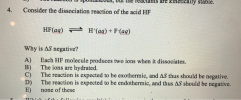 VA U YULLALUus, vul te reacals are kinetically stable. 4. Consider the dissociation reaction of the acid HF HF(aq) 2 H(aq) + F(ag) Why is AS negative? A) Each HF molecule produces two ions when it dissociates. B) The ions are hydrated. The reaction is expected to be exothermic, and AS thus should be negative. D) The reaction is expected to be endothermic, and thus AS should be negative. E) none of these . . .
which reaction product would be kinetically favored? Potential energy A+B E+F C+D Reaction coordinate Select one:...
 which reaction product would be kinetically favored? Potential energy A+B E+F C+D Reaction coordinate Select one: O a. All would be favored ob. None would be favored O c. E and F d. C and D
Name_ 08 (4 pts total) Explain why the formation of the carbocation that leads to the...
 Name_ 08 (4 pts total) Explain why the formation of the carbocation that leads to the way product of this reaction is both thermodynamically and kinetically favorable con the formation of the other possible carbocation. (Hint: there are some key terms that I am looking for and none of them are "Marko Rule" -I am asking you to explain why/how Markovnikov's Rule works) нас H.SO H30 C H, H,0 Q8a (2 pts) It is thermodynamically favorable because... Q8b (2 pts)...
22) Given the following balanced equation, determine the rate of reaction with respect to [H2). 222)...
 22) Given the following balanced equation, determine the rate of reaction with respect to [H2). 222) N2(g) + 3 H2(g) - 2 NH3(g) A) Rate + 3 A[12] 2 At 3 A[H2] +- B) Rate At C) Rate = C) Rate - 3 2 A[H21 At D) Rate = D) Rate 1 4/H2] 3 At E) It is not possible to determine without more information.
The reaction, A+B+C Products, was studied kinetically and the following data were obtained. d[A] 110M- 7.5...
 The reaction, A+B+C Products, was studied kinetically and the following data were obtained. d[A] 110M- 7.5 [A). [B] [C]. dt 0.010 0.005 0.010 5 0.010 0.005 0.015 0.010 0.015 0.010 45 0.020_0.005_0010 14.1 A. Determine the integrated rate law for the reaction. B. Determine the rate constant.
Postlab Assignment for Exp 42 “A Wittig Reaction of trans-cinnamaldehyde” 1. Which of the two possible products...
Postlab Assignment for Exp 42 “A Wittig Reaction of trans-cinnamaldehyde” 1. Which of the two possible products (E,Eor E,Z) from our experiment is more thermodynamically stable? Briefly explain. 2. Of the three 1,4-diphenyl-1,3-butadiene isomers (E,Eor E,Z orZ,Z) indicate the most suitable diene that can be used as a reactant in a Diels-Alder reaction. Briefly explain your choice. 3. What is the benefit of triturating the product in 60 % ethanol? 4. The ylide you made in this experiment is fairly stable...
For the following reaction identify the substance oxidized and the substance reduced: 3502 + 2HNO3 +...
 For the following reaction identify the substance oxidized and the substance reduced: 3502 + 2HNO3 + 2H20 — 37,804 + 2NO The substance oxidized is: Choose one: O A. NO O B. H2O O C. H2SO4 O D. SO2 O E. HNO3 The substance reduced is: Choose one: O A. SO2 O B. NO O C. H2O O D. HNO3 O E. H2SO4
Given A + 3B 2C + D This reaction is first order with respect to reactant...
 Given A + 3B
2C + D
This reaction is first order with respect to reactant A and
second order with respect to reactant B. If the concentration of A
is doubled and the concentration of B is halved, the rate of the
reaction would ________ by a factor of _______.
Given A + 3B
2C + D
This reaction is first order with respect to reactant A and
second order with respect to reactant B. If the concentration of A
is doubled and the concentration of B is halved, the rate of the
reaction would ________ by a factor of _______.
Imagine a product favored chemical reaction happening in a living organism in which a substance D...
Imagine a product favored chemical reaction happening in a living organism in which a substance D goes to E. It is known that the concentration of D remains well above zero and constant over time. Given that the reaction is product-favored, how is the concentration of D maintained? Give two possible reasons. How might the catalysis of the reaction maintain the concentration of D?
 VA U YULLALUus, vul te reacals are kinetically stable. 4. Consider the dissociation reaction of the acid HF HF(aq) 2 H(aq) + F(ag) Why is AS negative? A) Each HF molecule produces two ions when it dissociates. B) The ions are hydrated. The reaction is expected to be exothermic, and AS thus should be negative. D) The reaction is expected to be endothermic, and thus AS should be negative. E) none of these . . .
 which reaction product would be kinetically favored? Potential energy A+B E+F C+D Reaction coordinate Select one: O a. All would be favored ob. None would be favored O c. E and F d. C and D
 Name_ 08 (4 pts total) Explain why the formation of the carbocation that leads to the way product of this reaction is both thermodynamically and kinetically favorable con the formation of the other possible carbocation. (Hint: there are some key terms that I am looking for and none of them are "Marko Rule" -I am asking you to explain why/how Markovnikov's Rule works) нас H.SO H30 C H, H,0 Q8a (2 pts) It is thermodynamically favorable because... Q8b (2 pts)...
 22) Given the following balanced equation, determine the rate of reaction with respect to [H2). 222) N2(g) + 3 H2(g) - 2 NH3(g) A) Rate + 3 A[12] 2 At 3 A[H2] +- B) Rate At C) Rate = C) Rate - 3 2 A[H21 At D) Rate = D) Rate 1 4/H2] 3 At E) It is not possible to determine without more information.
 The reaction, A+B+C Products, was studied kinetically and the following data were obtained. d[A] 110M- 7.5 [A). [B] [C]. dt 0.010 0.005 0.010 5 0.010 0.005 0.015 0.010 0.015 0.010 45 0.020_0.005_0010 14.1 A. Determine the integrated rate law for the reaction. B. Determine the rate constant.
 For the following reaction identify the substance oxidized and the substance reduced: 3502 + 2HNO3 + 2H20 — 37,804 + 2NO The substance oxidized is: Choose one: O A. NO O B. H2O O C. H2SO4 O D. SO2 O E. HNO3 The substance reduced is: Choose one: O A. SO2 O B. NO O C. H2O O D. HNO3 O E. H2SO4
 Given A + 3B
2C + D
This reaction is first order with respect to reactant A and
second order with respect to reactant B. If the concentration of A
is doubled and the concentration of B is halved, the rate of the
reaction would ________ by a factor of _______.
Given A + 3B
2C + D
This reaction is first order with respect to reactant A and
second order with respect to reactant B. If the concentration of A
is doubled and the concentration of B is halved, the rate of the
reaction would ________ by a factor of _______.
Most questions answered within 3 hours.
-
Where is the error in this code sequence?
String s1 = "Hello";
String s2 = "ello";...
asked 10 months ago -
Financial data for Joel de Paris, Inc., for last year
follow:
Joel de Paris, Inc.
Balance...
asked 10 months ago -
Consider this reaction:
Al2(SO4)3 (aq)+ BaCl3
(aq) Al2Cl6 (aq)- +
3BaSO4(s) . What is the...
asked 10 months ago -
Suppose that Savneet is considering increasing her
recent random sample from 20 car rentals to 40...
asked 10 months ago -
Trucks arrive at an unloading terminal at an average rate of 120
per hour.
Trucks arrive...
asked 10 months ago -
Why are methanol and ethanol completely soluble in water while
octanol is not very little soluble....
asked 10 months ago -
A facilities manager at a university reads in a research report
that the mean amount of...
asked 10 months ago -
When the CuSO4 is rehydrated by adding water to the anhydrous
compound, is this an endothermic...
asked 10 months ago -
A ray of sunlight is passing from diamond into crown glass; the
angle of incidence is...
asked 10 months ago -
A block of mass 0.249 kg is placed on top of a light, vertical
spring of...
asked 10 months ago -
how do the kidneys compensate in the presences of acidosis
a) trigger hyperventilate
b) reserve acid...
asked 10 months ago -
Question 501 pts
The rental rate of capital to the firm increases. Which of the
following...
asked 10 months ago