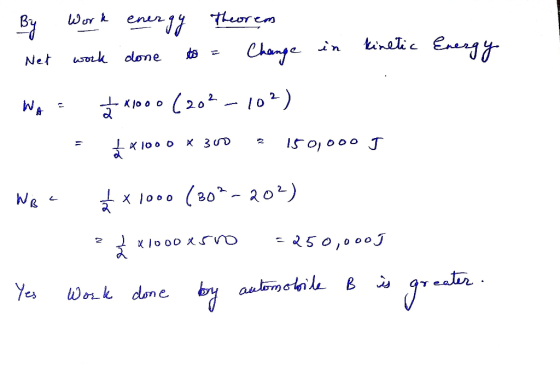
A 1000kg automobile (A) accelerates from 10.0m/s to 20.0m/s, while an identical automobile (B) accelerates from...
Homework Answers
Add Answer to:
A
1000kg automobile (A) accelerates from 10.0m/s to 20.0m/s, while an
identical automobile (B) accelerates from...
An automobile has a total mass of 1100 kg. It accelerates from rest to 69 km/h...
An automobile has a total mass of 1100 kg. It accelerates from rest to 69 km/h in 12 s. Assume each wheel is a uniform 23 kg disk. Find, for the end of the 12 s interval, (a) the rotational kinetic energy of each wheel about its axle, (b) the total kinetic energy of each wheel, and (c) the total kinetic energy of the automobile.
Animal "one" accelerates from rest to 17.3 mph in 19.5 s. Animal "two" accelerates from rest...
Animal "one" accelerates from rest to 17.3 mph in 19.5 s. Animal "two" accelerates from rest to 8.6 mph in the same amount of time. By what factor is the average acceleration developed by animal "one" greater than the average acceleration developed by animal "two"?
A proton is released from rest at point A in a constant electric field and accelerates...
 A proton is released from rest at point A in a constant electric field and accelerates to point B (see part a of the drawing). An electron is released from rest at point 8 and accelerates to point A (see part b of the drawing). How does the change in the proton's electric potential energy compare with the change in the electrons electric potential energy? O The proton experiences a greater change in electric potential energy, since it has a...
While a 1000kg car was traveling 50m/s, the brakes are applied to slow it down to...
 While a 1000kg car was traveling 50m/s, the brakes are applied to slow it down to 10m/s, what is the total work done on the car. A) 120,000 J B) 1200 kJ C) -120,000JD -1200 kJ E) None of the above vf I A constant force F is applied for 6 seconds to change the particle's velocity from vi to vy. Determine the force F if the particle's mass is 6 kg. A) (17.3 j) N C) (-17.3 j) N...
A truck accelerates uniformly from rest to 23.0 m/s in 5.4 s along a level stretch of road. Determine the average p...
 A truck accelerates uniformly from rest to 23.0 m/s in 5.4 s along a level stretch of road. Determine the average power (in W) required to accelerate the truck for the following values of the weight (ignore friction). (a) 8.00 x 103 N X 9036000 Can you write an expression for the average power in terms of the vork done on the truck and the time over which this work occurs? How does the work done on the truck compare...
3. Two identical spheres, A and B, made out of non-conducting (i.e. insulating) materials are given...
3. Two identical spheres, A and B, made out of non-conducting (i.e. insulating) materials are given identical charges, +q, uniformly distributed over their surfaces. They are placed so that their centers are separated by some distance, r. This distance is not much greater than the radius of the spheres. Two other identical spheres, C and D, are made out of metal. They are the same size as spheres A and B. They are also each given a charge, +q, and...
1. An automobile starts from rest and accelerates to a final velocity in two stages along...
1. An automobile starts from rest and accelerates to a final velocity in two stages along a straight road. Each stage occupies the same amount of time. In stage 1, the magnitude of the car's acceleration is 2.99 m/s2. The magnitude of the car's velocity at the end of stage 2 is 2.20 times greater than it is at the end of stage 1. Calculate the magnitude of the acceleration in stage 2. 2. The Space Shuttle travels at a...
A pushing force is applied to a 3.5-kg box. It starts from 2m/s and accelerates to...
A pushing force is applied to a 3.5-kg box. It starts from 2m/s and accelerates to 5.2 m/s covering the distance of 6 m. (a) Find the work done by the pushing force. (b) If friction is negligible, find the average force exerted on the box. Find (c) an impulse of the force, (d) the change in the momentum, (e) the final kinetic energy.
A 53.0 kg cheetah accelerates from rest to its top speed of 32.3 m/s. (a) How...
A 53.0 kg cheetah accelerates from rest to its top speed of 32.3 m/s. (a) How much net work (in J) is required for the cheetah to reach its top speed? J (b) One food Calorie equals 4186 J. How many Calories of net work are required for the cheetah to reach its top speed? Note: Due to inefficiencies in converting chemical energy to mechanical energy, the amount calculated here is only a fraction of the energy that must be...
Two identical cannon balls were dropped from the same height but one landed on concrete and...
Two identical cannon balls were dropped from the same height but one landed on concrete and the other landed on grass. Compare the impulses of the two. A) Impulse is greater on concrete B) Impulse is less on the grass C) Both A and B D) Neither. Impulses are the same
 A proton is released from rest at point A in a constant electric field and accelerates to point B (see part a of the drawing). An electron is released from rest at point 8 and accelerates to point A (see part b of the drawing). How does the change in the proton's electric potential energy compare with the change in the electrons electric potential energy? O The proton experiences a greater change in electric potential energy, since it has a...
 While a 1000kg car was traveling 50m/s, the brakes are applied to slow it down to 10m/s, what is the total work done on the car. A) 120,000 J B) 1200 kJ C) -120,000JD -1200 kJ E) None of the above vf I A constant force F is applied for 6 seconds to change the particle's velocity from vi to vy. Determine the force F if the particle's mass is 6 kg. A) (17.3 j) N C) (-17.3 j) N...
 A truck accelerates uniformly from rest to 23.0 m/s in 5.4 s along a level stretch of road. Determine the average power (in W) required to accelerate the truck for the following values of the weight (ignore friction). (a) 8.00 x 103 N X 9036000 Can you write an expression for the average power in terms of the vork done on the truck and the time over which this work occurs? How does the work done on the truck compare...
Most questions answered within 3 hours.
-
Where is the error in this code sequence?
String s1 = "Hello";
String s2 = "ello";...
asked 10 months ago -
Financial data for Joel de Paris, Inc., for last year
follow:
Joel de Paris, Inc.
Balance...
asked 10 months ago -
Consider this reaction:
Al2(SO4)3 (aq)+ BaCl3
(aq) Al2Cl6 (aq)- +
3BaSO4(s) . What is the...
asked 10 months ago -
Suppose that Savneet is considering increasing her
recent random sample from 20 car rentals to 40...
asked 10 months ago -
Trucks arrive at an unloading terminal at an average rate of 120
per hour.
Trucks arrive...
asked 10 months ago -
Why are methanol and ethanol completely soluble in water while
octanol is not very little soluble....
asked 10 months ago -
A facilities manager at a university reads in a research report
that the mean amount of...
asked 10 months ago -
When the CuSO4 is rehydrated by adding water to the anhydrous
compound, is this an endothermic...
asked 10 months ago -
A ray of sunlight is passing from diamond into crown glass; the
angle of incidence is...
asked 10 months ago -
A block of mass 0.249 kg is placed on top of a light, vertical
spring of...
asked 10 months ago -
how do the kidneys compensate in the presences of acidosis
a) trigger hyperventilate
b) reserve acid...
asked 10 months ago -
Question 501 pts
The rental rate of capital to the firm increases. Which of the
following...
asked 10 months ago